- Tata Steel to commission 0.75 mnt recycling plant by FY’26
- India targets 30% scrap utilisation in steelmaking by FY’30
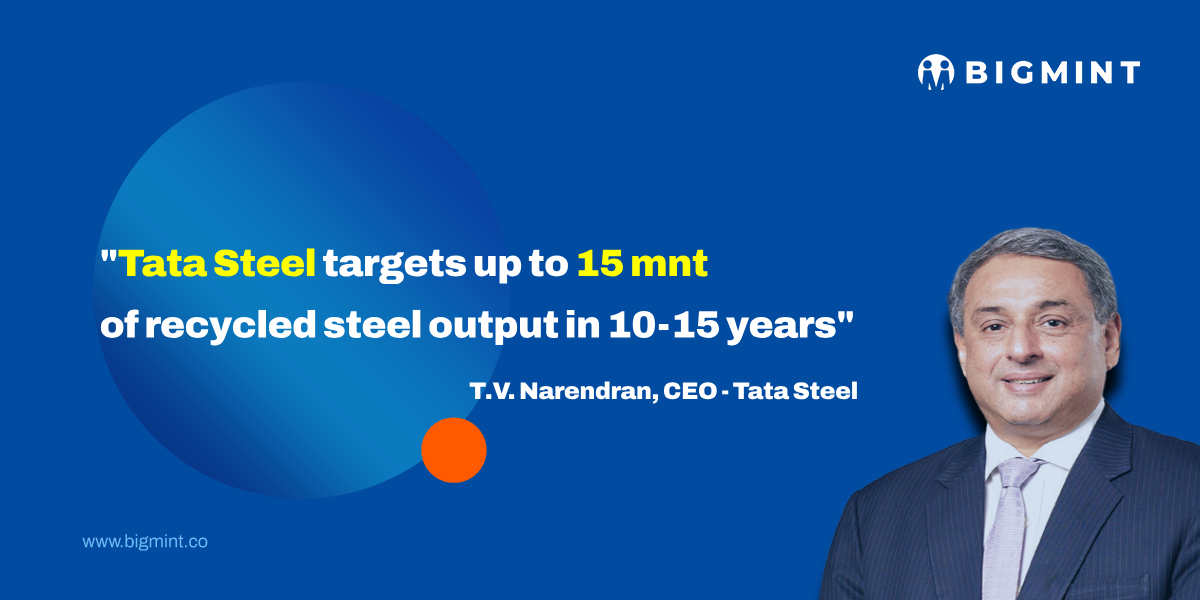
Tata Steel Ltd aims to produce 10-15 million tonnes (mnt) of steel through recycling in the next 10-15 years (2035-2040) as part of its broader decarbonisation strategy, Chief Executive Officer and Managing Director T.V. Narendran said during his latest industry interaction last week.
“Linearity to circularity is one shift we are making. You will see in the next 10-15 years, 10-15 mnt of Tata Steel’s production will be through the recycling route,” Narendran said when asked about the company’s sustainability vision.
In FY’25, the steelmaker produced 30.92 mnt of steel across its operations in India, the UK, the Netherlands, and Thailand, out of a total capacity of 35 mnt. Tata Steel’s installed capacity currently stands at 1.7 mnt in Thailand.
Scaling green capacity in India
Tata Steel currently has an installed capacity of over 26 mnt in India, with production at around 22 mnt in FY’25, accounting for nearly 15% of the country’s total crude steel production (152 mnt).
Tata Steel aims to scale its production capacity in India alone to up to 40 mnt by 2030.

A scrap processing facility is already operational near Delhi, and a 0.75 mnt per annum recycling-based steel plant is under development in Ludhiana, expected to be commissioned by the end of FY’26.
India’s shift towards sustainable steelmaking is being steered by the Ministry of Steel’s Vision 2047 roadmap, which targets increasing the share of scrap in steel production to 30% by FY’30, up from the current 20%.
Notably, India was the second-largest steel-producing country in FY’25, with production reaching nearly 152 mnt. The contribution of the BF-BOF route was 63.3 mnt — around 42%. Production from the EAF and IF routes stood at roughly 32 mnt and over 56 mnt, respectively.

UK: Tata Steel to replace blast furnaces at Port Talbot with EAF
Tata Steel is shutting down its blast furnaces at the 3 million tonnes per annum (mtpa) Port Talbot facility in South Wales, replacing them with a scrap-based electric arc furnace (EAF) as part of its green transition strategy. The new facility is expected to consume over 2 million tonnes (mnt) of scrap annually, with 70-80% of the charge mix likely to be scrap. This shift is expected to reduce the availability of UK-origin scrap for exports, as domestic consumption rises sharply.
Netherlands: IJmuiden to also implement low-emission tech
In the Netherlands, Tata Steel is in discussions with the Dutch government to implement similar low-emission technologies at its IJmuiden plant, which produced 6.75 mnt of liquid steel in FY’25.
“By 2035, we won’t have any blast furnaces operating in Europe. From producing 10 million tonnes using blast furnaces, we’ll move to greener, alternate processes,” said T.V. Narendran.
Strategic shift towards decarbonisation
According to BigMint data, India’s scrap consumption in steelmaking reached 34-35 mnt in FY’25. Domestic ferrous scrap generation is expected to increase to 46.7 mnt by FY’30 from 32.4 mnt currently.

As a key decarbonisation lever, scrap usage is being prioritised, with policy focus on building a formal, efficient scrap value chain across the country.
Tata Steel’s growing emphasis on electric arc furnace (EAF) technology and recycling-led production mirrors global efforts to reduce emissions in the steel sector — one of the world’s most carbon-intensive industries. The company’s transformation strategy signals a major step in the industry’s broader pivot away from traditional blast furnace operations towards cleaner, more sustainable steelmaking.

Leave a Reply