- Larger EAFs could support higher-quality, lower-energy and export-oriented secondary steel production
- Domestic scrap collection and processing will become increasingly important as imported scrap faces freight and geopolitical risks
India’s steelmaking ecosystem is entering a structural transition as rising steel demand, changing raw-material economics and decarbonisation pressures reshape the choice between scrap, Direct Reduced Iron (DRI) and pig iron.
The debate is increasingly moving beyond the simple question of whether scrap or DRI will dominate. Industry participants are instead focusing on how steelmakers can optimise metallic charge mixes, improve raw-material recovery, reduce energy costs and build greater supply security.
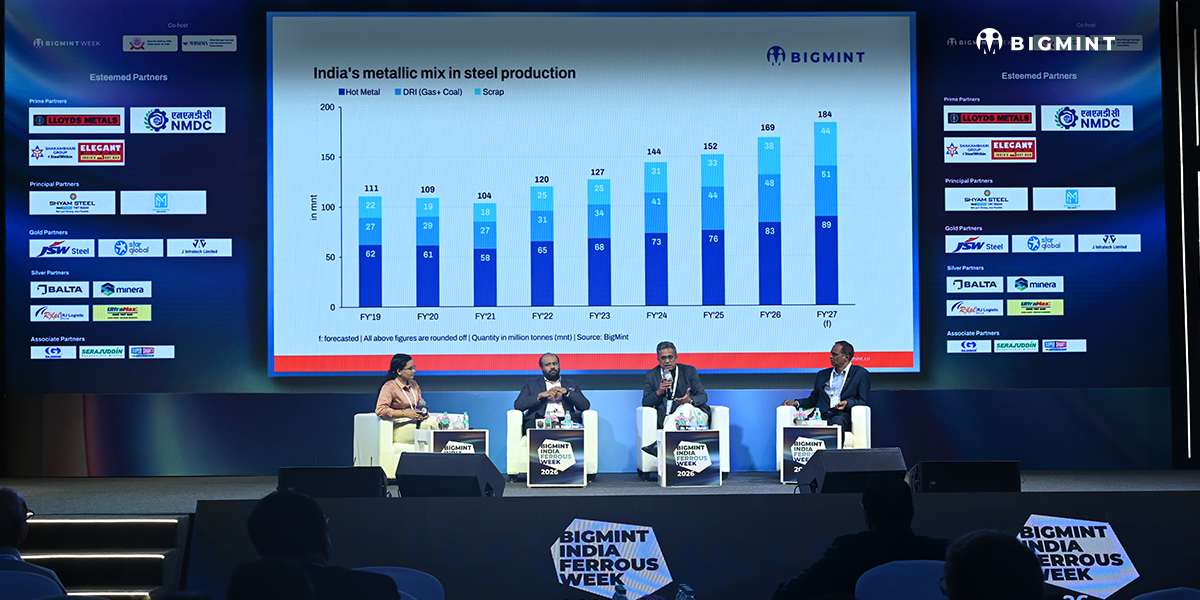
At the recently-concluded BigMint India Ferrous Week 2026, held from 19th-21st August in Kolkata, West Bengal, Mr. Naman Shah, Founder & CEO, NowPurchase, Mr. N Krishna, Director, DRI Technologies and Mr. Pankaj Khetan, Managing Director, Sponge Sales India (P) Ltd discussed the evolving economics of scrap and DRI, the role of digital procurement, captive power generation and the transition from Induction Furnaces (IF) to Electric Arc Furnaces (EAF).
Collection remains key challenge for domestic scrap
India’s domestic scrap consumption increased sharply from around 15 million tonnes (mnt) in H1 2025 to about 20 mnt in H1 2026. However, the growth in consumption has also exposed weaknesses in the domestic collection and aggregation network.
Mr. Shah highlighted that significant quantities of scrap are generated across India, but fragmented collection, sorting and aggregation continue to prevent the material from entering organised supply chains efficiently.
Household, municipal and other dispersed scrap streams remain particularly challenging. A more organised recycling ecosystem, supported by better source-level collection and processing, could unlock additional domestic supply without relying solely on higher scrap generation.
Digital procurement can improve charge-mix decisions
According to Mr. Shah, digital procurement platforms are evolving beyond basic price discovery and transaction execution. They can potentially help steelmakers make more informed decisions on the combination of scrap, sponge iron and pig iron.
Key areas include:
- Dynamic charge-mix optimisation: Steelmakers can adjust the proportion of scrap, sponge iron and pig iron according to real-time relative pricing rather than following a fixed blend.
- Value-in-use analysis: The cheapest material on a per-tonne basis may not necessarily deliver the lowest cost of liquid steel. Actual metallic recovery, yield and furnace performance need to be considered.
- Total cost of ownership: Digital procurement can help connect purchasing decisions with shop-floor recovery data, allowing producers to evaluate raw materials based on their effective cost per tonne of liquid steel.
The shift from simply comparing purchase prices to measuring value-in-use could become an important source of margin improvement for secondary steelmakers.
DRI economics strengthened by captive power
India’s DRI industry has developed a distinct advantage through the integration of waste-heat recovery and captive power generation. Mr. Krishna explained that a typical DRI plant consumes around 0.5-0.6 tonnes of iron ore or pellets to produce one tonne of sponge iron, along with non-coking coal. The process generates substantial waste heat, which can be recovered to produce electricity.
Modern plants can generate up to around 550 kWh of power per tonne of sponge iron. With grid electricity costing around INR 7/unit, captive generation can provide savings of roughly INR 3,500-4,000/t of sponge iron, significantly improving the economics of integrated DRI-steel complexes.
The use of lower-grade domestic coal, coal-washery rejects and middlings has further supported this model, particularly with the adoption of CFBC/APC boiler technology. This has allowed some secondary steel complexes to operate as relatively self-sufficient systems, using waste heat from the DRI process to meet a significant portion of their electricity requirements.
Pig iron remains a location-driven option
The competitiveness of pig iron is not determined by its purchase price alone. Geography, freight and furnace configuration remain critical factors.
In eastern India, proximity to integrated steel plants makes pig iron and hot metal comparatively accessible. However, producers in southern India can face higher freight costs and longer lead times, reducing the attractiveness of pig iron even when its base price appears competitive.
Furnace technology also determines how easily the metallic mix can be adjusted.
Blast furnaces generally operate with relatively limited flexibility in merchant pig iron and scrap usage, while EAFs and IFs offer greater flexibility to modify metallic inputs according to market economics.
Mr. Shah noted that large steelmakers already track value-in-use closely, but the same level of commercial and operational integration has yet to become widespread among mid-sized and secondary producers.
From induction furnaces to larger EAFs

The next major technology shift for India’s secondary steel industry could be the movement from smaller Induction Furnaces to larger Electric Arc Furnaces.
The induction-furnace route expanded rapidly after 2020, particularly through smaller units producing around 300-500 tonnes per day. However, scaling up production while meeting increasingly stringent quality requirements could favour larger EAF installations.
EAF’s also offer greater control over chemistry and impurity levels, making the technology better suited to higher-grade and more specialised steel production.
An important advantage is the possibility of matching larger EAF power requirements with electricity generated through captive DRI waste-heat systems, potentially reducing dependence on grid power.
Decarbonisation: economics will determine the technology
Decarbonisation is expected to become an increasingly important factor in determining India’s future metallic mix.
Carbon Capture, Utilisation and Storage (CCUS) is emerging as a potential mid-term solution for reducing emissions from existing industrial processes. The technology is already being evaluated through pilot projects.
Green hydrogen offers another pathway, particularly for low-carbon DRI production. However, the economics remain challenging.
Hydrogen blending in DRI reduction has demonstrated technical feasibility, but production costs remain significantly above the levels required for widespread commercial adoption. Substantial cost reductions and policy support would therefore be required before hydrogen-based DRI can compete directly with conventional routes.
India’s scrap strategy: Domestic supply gains importance
Imported scrap is increasingly exposed to freight volatility, geopolitical disruptions and changes in global trade flows. Disruptions around major shipping routes, including the Red Sea and Strait of Hormuz, can increase voyage distances, insurance costs and landed scrap prices. This makes domestic scrap increasingly attractive from a supply-security perspective.
Over the next five years, India’s domestic scrap generation is expected to benefit from rising consumption, higher vehicle ownership and end-of-life vehicle dismantling, growing electronics consumption and continued urbanisation. However, higher generation alone will not be sufficient. Collection, segregation, processing and aggregation capacity will need to expand alongside demand.
DRI and scrap to serve different steel segments

The panel indicated that the future Indian steel industry may not see a simple winner between DRI and scrap. Instead, the two routes are likely to become increasingly segmented according to product requirements, plant configuration and economics.
The DRI-based route is likely to remain important for mainstream infrastructure products such as TMT bars and structural steel, particularly where captive power and local raw-material availability provide a cost advantage.
Meanwhile, scrap-intensive EAF and IF operations could increasingly focus on alloy steels, engineering grades and other specialised products where flexible metallic charging and tighter process control provide greater value.
Outlook
India’s future steelmaking strategy is likely to depend less on choosing a single dominant metallic and more on maintaining the flexibility to switch between scrap, DRI and pig iron as market conditions change. For steelmakers, the competitive advantage will increasingly come from optimising charge mix, measuring actual metal recovery, securing reliable raw-material supplies and improving energy efficiency.
The combination of organised domestic scrap collection, digital procurement, captive DRI-based power and larger EAFs could give India’s secondary steel industry a more efficient and resilient foundation as it moves towards higher-quality and lower-emission steel production.
Leave a Reply