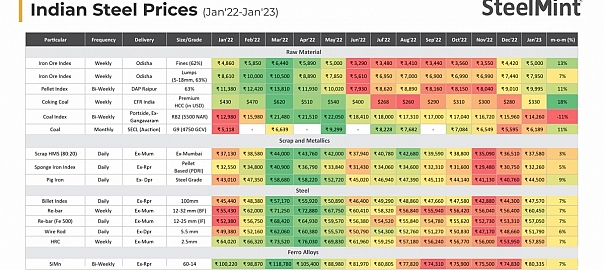
- Rise in iron ore prices has cascading effect on other steel segments
- Positive global cues also support finished prices
- Longs may be under pressure amid liquidity issues
Morning Brief: All steel and raw material-related prices showed a m-o-m uptrend in January 2023, except for portside prices of RB2 grade of thermal coal imported from South Africa, as per data maintained with SteelMint. It was mainly the cost push, along with positive global sentiments, that led to a spurt in finished prices. SteelMint goes behind the scene:
Coal
- South African RB2: The bi-weekly index tracking the average portside ex-Gangavaram prices of the South African RB2 5500 NAR dropped 11% m-o-m in January, 2022 to INR 14,260/tonne compared to INR 15,960/t in December, 2022.
It may be recalled RB2 prices had surged the most amongst all the steel-related raw materials in 2022 rising an astronomical 102% y-o-y to an average almost INR 18,000/tonne (t) against INR 8,830/t in 2021. However, from December onwards, prices of RB1 and RB3 fell to become quite competitive with RB2.
Plus, cheaper domestic coal was increasingly made available to sponge iron units which are the main consumers of this imported grade.
Domestic coal from India’s largest coal miner, Coal India Limited (CIL), was available in higher volumes, supported by the fact that CIL saw a 12% increase in domestic production in CY22 to 861.90 million tonnes (mnt) against 766.39 mnt in 2021. In January, 2023, CIL’s output rose 11% y-o-y to 71.88 mnt against 64.50 mnt in January 2022 and m-o-m by 8% from 66.42 mnt in December 2022.
- Australian low-vol HCC coking coal: Average prices of the Australian low-vol HCC rose a sharp 18% m-o-m in January to $330/t against $280/t in December 2022, amid supply tightness due to the closure of rail corridors in Queensland and heavy rains in Australia which hampered coal avacuation. In addition, global demand also supported the higher prices. Improved demand from Southeast Asia also kept coking coal prices bolstered.
- SECL’s G9 (4750 GCV) auctions: Prices in these auctions rose 11% m-o-m to INR 6,189/t against INR 5,595/t in December, 2022.
The rise in SECL prices was supported by aggressive bidding from the power companies as they looked to replenish their inventory ahead of the peak summer season. It was basically due to robust power demand that power companies showed interest in procurement via e-auctions.
On the supply side, CIL subsidiaries scaled up production in the last quarter of the fiscal, which is the peak mining period. In January 2023, production hit 71.9 mnt, the highest for the fiscal, registering double digit growth y-o-y for the third straight month.
Imported prices are usually higher than domestic material. And despite the m-o-m rise in price, domestic SECL prices are still cheaper.
Nevertheless, if imported coal prices decline further, domestic prices may follow suit.
Ferro alloys
- Silico manganese 60:14: Prices of the bi-weekly 60:14 grade silico manganese index emerging out of Raipur gained by 7% m-o-m to INR 80,335/t in January, 2023 against INR 74,830/t in December, 2022. Prices fell on account of a decline in local demand amid liquidity crunch as the fiscal nears closure as well as a bearish overseas market. Additionally, manganese ore prices were stable, which allowed buyers to take advantage of lower prices.
Scraps and metallics
All showed an increase m-o-m in a range of 3-9%. All three metallics showed an uptrend mainly on account of an increase in raw material and energy prices – iron ore prices and pellets and well as domestic auctioned prices of SECL were up.
- Pellet-based P-DRI: The pellet-based P-DRI, ex-Raipur, gained 5% to INR 32,260/t in January, 2023, compared to INR 30,750/t in December, 2022.
- Steel grade pig iron: Prices of this material rose 9% m-o-m in this period to INR 44,500/t (INR 40,760/t in December, 2022).
- Domestic scrap prices (ex-Mumbai): These upped 3% to INR 37,580/t against INR 36,510/t in December, 2022. Also, domestic demand showed an uptrend although there were liquidity issues in the local markets which kept prices volatile on a d-o-d basis.
Iron ore
This raw material, in terms of fines, lumps and the high-grade 63% pellets, showed an increasing trend m-o-m.
- Fines, lumps and pellets: Fe62% fines from Odisha rose 13% to INR 5,000/t (INR 4,420/t) in January 2023 while the Fe63% lumps (Odisha) also upped 7% to INR 7,950/t (INR 7,440/t) m-o-m. Fe63% pellets (DAP Raipur) gained 11% m-o-m to INR 9,995/t (INR 9,010/t).
Iron ore was the key market mover in January, it seems. Its prices were pushed up by certain factors. First, with less inventory with mills and pellet makers, there was active participation in OMC’s auction last month. Secondly, small miners nearly ended their environmental clearance (EC) limits for the fiscal which led to lesser availability of material at a time when availability of high grades fines is crucial this being the demand season for steel. This allowed iron ore prices to rule higher. Thirdly, removal of the export duty on low grade iron ore rekindled export opportunities, which touched a 1.5-year high in January 2023.
Where pellets are concerned, removal of the 50% export duty helped exports to rebound, which pulled up domestic prices. In a cyclical impact, higher iron ore prices also pushed up pellet prices.
Steel
This segment, comprising billets and finished products, saw prices moving up across the spectrum.
- Billets: The ex-Raipur billet index went up 7% m-o-m to INR 47,570/t in January, 2022 (INR 44,300/t in December 2022).
- Rebar: The ex-Mumbai BF-grade rose 7% to INR 60,450/t (INR 56,400/t) in the period under review. The IF grade also rose 7% to INR 57,050/t (INR 53,310/t) while wire rods (ex-Durgapur), were up 6% to INR 51,790/t (INR 48,660/t) last month.
- HRC: Ex-Mumbai trade-level HRC prices looked up by 7% in January, 2023 to INR 57,850/t from INR 53,950/t in December 2023.
Some key factors helped to raise finished prices. One key reason was the improvement in global export offers, as the new calendar started, on cues of comparatively lower energy prices and stable interest rates. European buyers returned to restocking after a long hiatus of 8-9 months. Chinese buyers and traders also resumed activities after the Lunar holidays were over by end-January. Higher global export offers had a rub-off effect on the export offers from Indian mills and on domestic prices in a cascading impact. The 15% export duty removal led to a spurt in export offers.
Outlook
Prices are likely to remain on the higher side in March, the closing month of the current financial year. But, having said that, the market could see some resistance from buyers of long products, especially in the secondary sector, on the back of liquidity issues. Thus, IF-route mills may be under pressure. Even if prices do not drop, they may not rise from here. Infrastructure and construction consume around 63% of India’s total steel production, in which the share of the former is at around 27%. The project segment will continue to buy keeping its completion deadlines in view. However, stockists, traders and individual builders may step back in case of further price hikes.
Also, the gap between HRCs and rebar, which had touched a three-year high with the latter at a premium, needs to normalize which may restrain a price hike in longs.


Leave a Reply