- Rebar, HRC prices rise on higher input costs, depleted inventories
- Iron ore, pellets, domestic coal prices rise on supply constraints
- Coking coal rallies on global supply concerns but may moderate in Oct
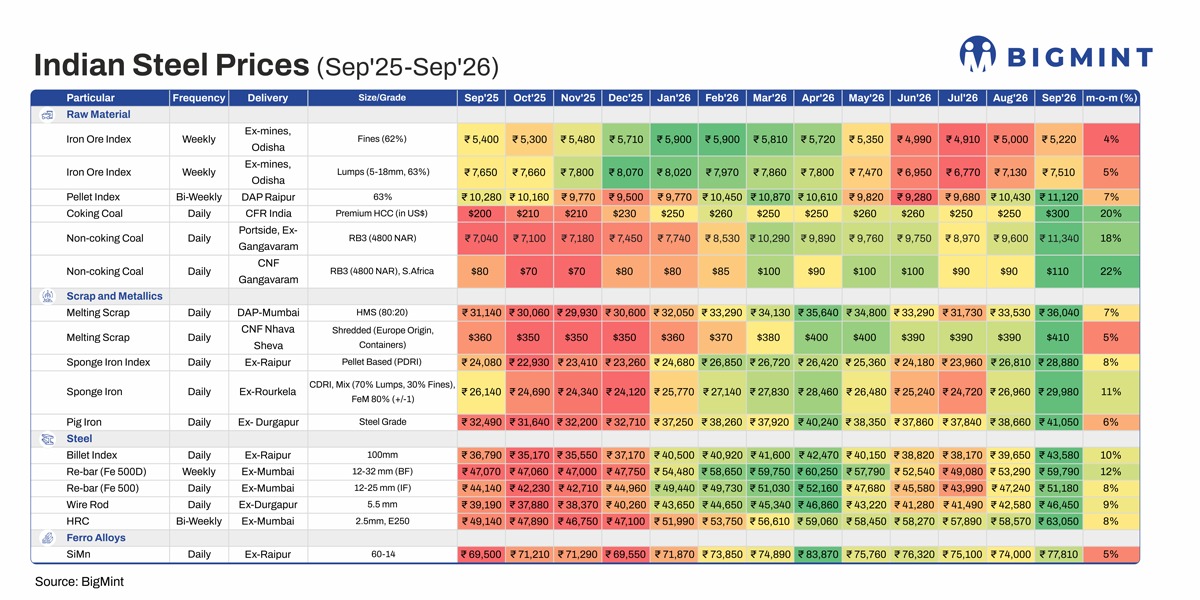
Morning Brief: Indian steel and raw material prices strengthened across segments in September as production costs spiralled while finished steel availability tightened. Rebar and HRC prices rose 12% and 8% m-o-m respectively, with lower output at major rebar producers, maintenance-related HRC supply constraints and higher export allocations tightening domestic availability.
At the same time, higher iron ore, coal and pellet costs raised production costs. Improved project activity and stronger automotive demand provided additional support, allowing mills to pass through a larger share of the cost to prices.
Iron ore, coal costs rise on tight availability
BigMint’s Odisha iron ore fines index (Fe 62%) increased 4% m-o-m to INR 5,220/t in September, while lump ore prices rose 5% to INR 7,510/t. India’s iron ore production fell to a one-year low of 21.6 mnt in August due to monsoon disruptions, while Odisha dispatches declined to 11.1 mnt, again more than one-year low.
Odisha Mining Corporation’s dispatches fell to 2.4 mnt, the lowest since July 2025. OMC lowered auctioned volumes, while bids increased by up to INR 750/t m-o-m despite subdued bidding. NMDC raised iron ore prices by up to INR 250/t for September, following a similar increase by Lloyds at the end of August.
Tight domestic availability increased India’s reliance on imports. Iron ore and pellet imports reached an 11-year high of 2.22 mnt in August, including 1.7 mnt of fines and lumps and 0.5 mnt of pellets. Tight availability in Odisha and Karnataka supported the increase, while NMDC’s sales from Karnataka mines during April-August fell to 4.43 mnt, from 5.82 mnt a year earlier.
Pellet prices increased 7% m-o-m to INR 11,120/t DAP Raipur, supported by higher iron ore prices and tight supply following maintenance shutdowns. India’s iron ore and pellet exports also rose to 2.15 mnt in August, including 0.95 mnt of iron ore, while pellet exports nearly doubled as monthly iron ore export volumes declined.
Coking coal recorded the sharpest increase among the major raw materials. BigMint’s premium HCC index rose 20% m-o-m to $300/t CNF India as global supply concerns pushed imported coal prices higher. India’s coking coal imports fell more than 20% m-o-m to 5.3 mnt in August, while Australian supplies declined to 2.2 mnt from 3.5 mnt as mills diversified sourcing to manage steel margins.
Chinese coking coal inventories also remained tight, with stocks at 523 surveyed mines falling to over four-year low. Russian coal output was 32.7 mnt in July, the lowest monthly level of the year. With global supply conditions already supporting prices, the scope for another significant increase in imported coking coal prices is expected to be limited.
Domestic non-coking coal prices increased 18% m-o-m to INR 11,340/t, supported by higher electricity demand, weaker hydropower generation and falling coal stocks at power plants. Coal India Limited’s SWMA e-auction offered volume fell 16.4% m-o-m to 21.07 mnt in August, while the average premium over notified prices increased to 59% from 41%, indicating stronger competition for available coal. Monsoon-related supply constraints further tightened availability.
Higher input costs lift metallics
Higher raw material costs continued to move through the metallics market. BigMint’s PDRI sponge iron index increased 8% m-o-m to INR 28,880/t ex-Raipur, while CDRI sponge iron rose 11% to INR 29,980/t ex-Rourkela. Pig iron prices increased 6% to INR 41,050/t ex-Durgapur.
The increase in sponge iron and pig iron prices followed higher pellet and coal costs, while lower scrap availability continued to support demand for alternative metallics.
Domestic melting scrap prices rose 7% m-o-m to INR 36,040/t DAP Mumbai, while imported shredded scrap increased 5% to $410/t CNF Nhava Sheva.
Some mid-sized sponge iron producers with waste heat recovery boilers have also been selling surplus electricity on power exchanges as power realisations reached around INR 10/unit, compared with estimated generation costs of about INR 3/unit. Some producers have committed available surplus power through October, potentially limiting the electricity available for captive steelmaking and constraining output at integrated sponge iron and steel facilities.
Rebar supply tightens as major mills cut output
Rebar prices rose as lower production at major mills reduced open market availability. India’s rebar production declined 21.4% from 5.09 mnt in March to 4 mnt in August, while combined output from Jindal Steel and RINL fell from around 0.32 mnt to 0.12 mnt.
Jindal Steel’s rebar production declined from 0.19 mnt to 0.09 mnt, while RINL’s output fell from 0.13 mnt to around 0.025 mnt. Jindal’s production was affected by the ramp-up and stabilisation of its new Angul blast furnace, while RINL’s operations were constrained by the June ladle accident, financial pressures and BOF stabilisation.
BigMint’s BF-route rebar index increased 12% m-o-m to INR 59,790/t ex-Mumbai, while IF-route rebar rose 8% to INR 51,180/t. Lower inventories and reduced production tightened spot availability, while higher coking coal costs increased blast furnace production costs. Improved project demand allowed mills to maintain firm offers.
Higher exports squeeze domestic availability
Indian steel exports increased by around 37.5% to roughly 1.10 mnt/month from about 0.80 mnt over the past two to three months. Greater clarity on EU market access encouraged mills to commit export volumes, while higher semi-finished steel exports also absorbed additional tonnes.
HRC strengthens as supply tightens
HRC prices increased 8% m-o-m to INR 63,050/t ex-Mumbai, supported by higher production costs and improved demand from the automotive sector.
Domestic HRC availability tightened amid maintenance shutdowns at major eastern Indian mills and lower material arrivals reported by traders and distributors. Net HRC production declined 15.7% from 2.67 mnt in July to 2.25 mnt in August.
The reduction in HRC production left a smaller pool of material available for merchant market sales. BigMint’s steel rake dispatches also declined 15.2% from 4.93 mnt in August to 4.18 mnt in September, although the data covers broader steel dispatches rather than HRC alone.
Demand provided additional support. Indian passenger vehicle manufacturers increased factory dispatches in September ahead of Navratri and Dussehra as festive stocking and customer sentiment strengthened, supporting higher production and near-term HRC demand.
The weaker rupee also raised the domestic cost of imported coking coal and other dollar-denominated inputs while improving rupee export realisations and increasing the landed cost of imported steel.
Therefore, the weakening currency added to the cost and trade support for domestic steel prices.
Outlook
Indian steel prices enter October with both the cost floor and supply constraints elevated. Iron ore and pellet prices are likely to remain supported by constrained domestic availability, while coking coal remains firm after its September rally, although the scope for another significant increase appears limited. Higher replacement costs, reduced rebar output and maintenance-related HRC constraints should continue to support steel prices in the near term.
Major mills have already announced list price hikes for long and flat products in October. Project demand and stronger automotive activity provide support but higher exports and continued power market incentives may keep some steelmaking capacity directed away from domestic supply. If demand firms during the festive period, mills should retain room to defend recent price increases. However, prices are likely to moderate if supplies improve.
Leave a Reply