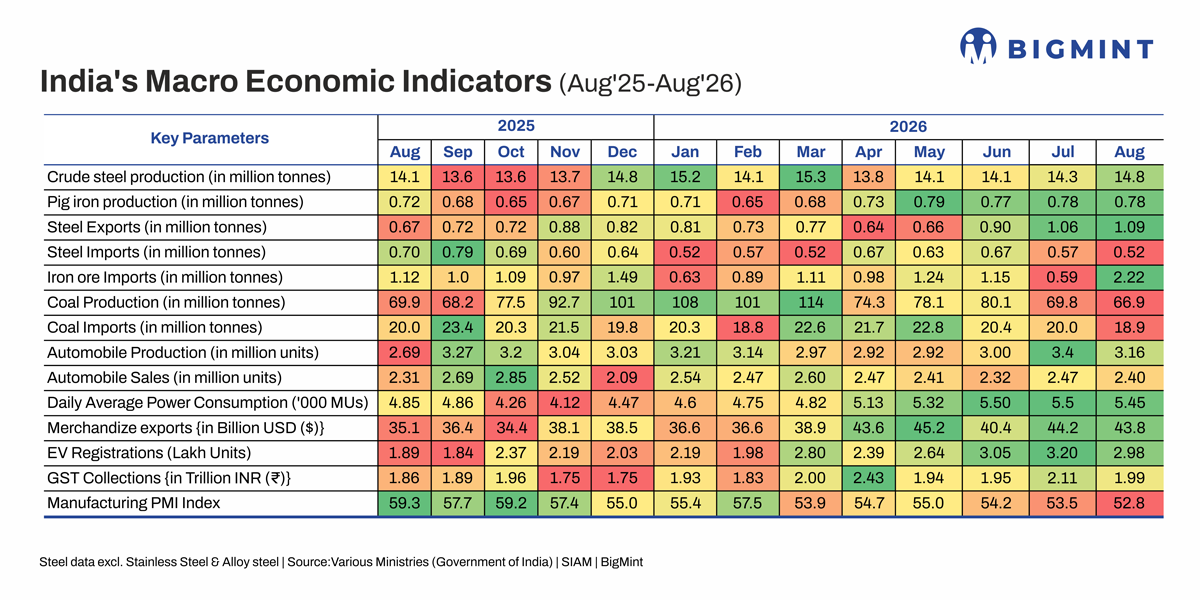
- Crude steel production rises to 14.8 mnt as exports increase, imports decline
- Power demand remains firm while coal shortage continues
- EV registrations and merchandise exports moderate; domestic activity remains supportive
Morning Brief: India’s industrial indicators in August ’26 showed a widening divergence across sectors. Crude steel production rose to 14.8 million tonnes (mnt) as exports increased and imports declined, while power consumption remained near its recent high. Automobile production and sales, EV registrations, merchandise exports, GST collections and manufacturing activity moderated from July. The July strength in automobiles had been supported by lower GST rates, softer financing costs, new model launches and pre-festive demand, setting a high base for August.
India’s industrial momentum diverged in August, with steel and power holding firm while automobiles, EV registrations and manufacturing activity softened after July’s stronger run. The shift leaves the industrial cycle increasingly dependent on whether stronger steel and domestic activity can offset slower vehicle production and external trade.
Steel market strengthens on higher output and exports
Crude steel production increased 3.5% m-o-m to 14.8 mnt in August from 14.3 mnt in July, extending the recovery from 13.83 mnt in April. Steel exports rose for the second consecutive month to 1.09 mnt, from 1.06 mnt in July, while imports declined to 0.52 mnt from 0.57 mnt.
The monthly steel trade balance therefore strengthened further, with exports more than doubling imports. Iron ore imports also jumped to 2.22 mnt from 0.59 mnt in July, while pig iron production remained unchanged at 0.8 mnt.
The steel data show a simultaneous increase in crude steel production and exports alongside lower finished steel imports. The sharp increase in iron ore imports also coincided with the recovery in steel output, pointing to stronger upstream raw-material intake during the month.
Automobile activity cools after July surge
Automobile production declined around 7% m-o-m to 3.16 million units in August from 3.4 million, while sales fell to 2.4 million units from 2.5 million. EV registrations also eased to 2.98 lakh units from 3.2 lakh.
The moderation followed a strong July. Passenger vehicle sales had reached a record level during the month, supported by lower GST rates, softer financing costs and new model launches. Two-wheeler sales also benefited from sustained momentum ahead of the festive season.
August’s decline therefore came after a period of unusually strong automobile activity. Production, sales and EV registrations all remained above their early-2026 levels, indicating a cooling from the July peak rather than a return to the weaker volumes seen earlier in the year.
Power demand stays firm despite lower coal availability
Daily average power consumption edged up to 5.45 thousand MUs in August from 5.44 thousand MUs in July, keeping demand close to its recent high. Coal production, however, declined to 66.9 mnt from 69.8 mnt, while coal imports fell to 18.9 mnt from 20 mnt. Power demand remained firm even as both domestic coal production and imports moved lower. The previous month’s easing in daily power consumption had been linked to the monsoon reducing cooling demand after the June heatwave. The August increase suggests that this seasonal easing did not extend further, with electricity consumption remaining elevated.
Manufacturing and trade lose some momentum
Manufacturing PMI declined to 52.8 in August from 53.5 in July, remaining above the 50-point expansion threshold. The earlier moderation in manufacturing activity had been associated with slower order growth and more challenging operating conditions, providing a softer starting point for August. Merchandise exports also eased to $43.8 billion from $44.2 billion, although steel exports moved higher. GST collections declined to INR 1.99 trillion from INR 2.1 trillion after July’s three-month high. The July increase in GST collections had been supported by resilient domestic consumption and higher imports.
EV registrations followed the broader automobile moderation, falling from 3.2 lakh in July to 2.98 lakh in August. However, August registrations remained well above the 2.19 lakh recorded in January and 1.98 lakh in February, keeping the longer-term increase intact.
Outlook
Steel and auto demand may edge higher in September as pre-festive buying supports activity, while the festive period is also expected to lift power demand. Higher electricity demand would increase requirements from thermal generators and put further pressure on coal availability.
The Centre has also directed about 112 captive coal-fired plants to operate at maximum capacity from October through December and is considering mandatory blending of up to 5% imported coal with domestic coal as plant stocks tighten. That could keep coal procurement, imported-coal availability and thermal plant utilisation in focus as industrial and power demand rise into the festive season.

Leave a Reply