- Exemption order covers manufacturers from 17 countries
- Japan leads with 87 exempted licences; South Korea gets 53
In a strategic move to alleviate supply constraints for domestic steel producers, India’s Ministry of Steel has exempted 202 foreign steel licences from the mandatory Bureau of Indian Standards (BIS) quality certification requirement under the Steel Import Monitoring System (SIMS) portal. This exemption order, issued on 8 August, covers manufacturers from 17 countries, including prominent steel exporters such as Japan, South Korea, Germany, Italy, France, Russia, and the US.
Japan leads the list with a total of 87 exempted licences, underscoring its crucial role as a supplier of high-grade steel utilised in automotive, engineering, and specialised industrial sectors. South Korea follows with 53 exempted licences, while Germany, Italy, France, and Russia also have significant representation. The exemption process is based on a directive issued on 11 July, which allows companies to self-declare eligibility for exemptions, subject to subsequent verification by BIS.
This initiative aims to ensure the uninterrupted availability of quality inputs for integrated steel plants (ISPs), thereby reducing delays and potential bottlenecks associated with certification processes. The ministry highlighted that this is a continuous exercise, and further licences may be exempted upon verified requests.
Notable beneficiaries of this exemption include major players such as Nippon Steel and JFE Steel from Japan and Posco and Hyundai Steel from South Korea. By relaxing certification requirements for selected imports, the move is poised to assist ISPs in managing input costs amid fluctuating global steel prices.
India’s Q1FY’25 steel imports decline 17% y-o-y
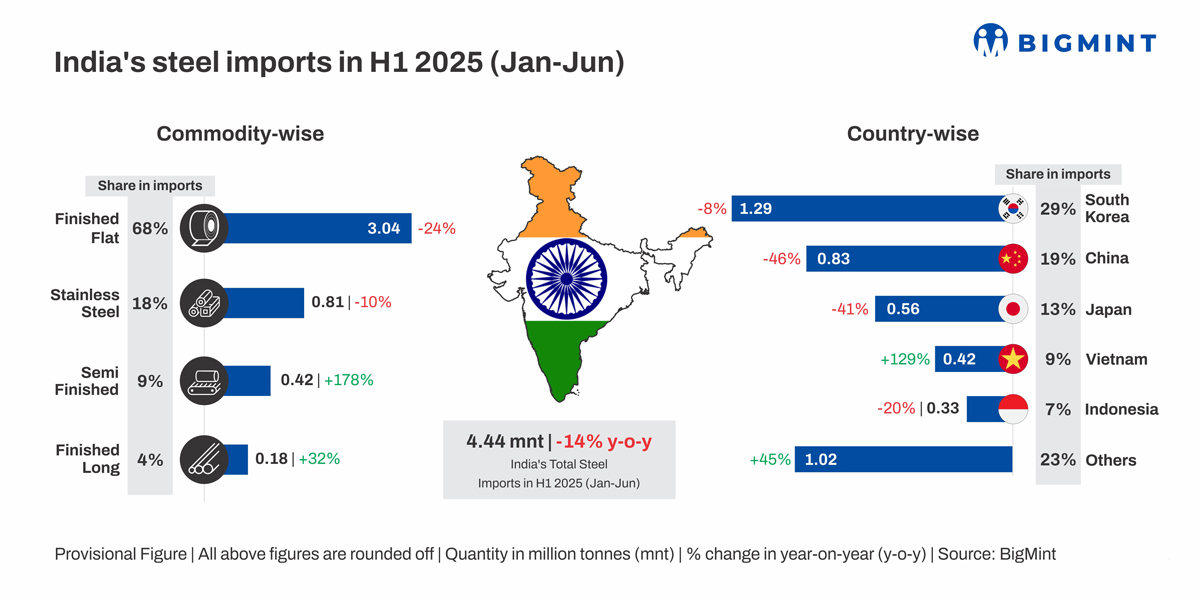
India’s steel imports for the first quarter of fiscal year 2025 (April to June) contracted by 14% y-o-y, to approximately 2.17 million tonnes (mnt) from 2.53 mnt in the same period of 2024. South Korea, China, and Japan remained the largest steel exporters to India during this timeframe. China exported approximately 0.4 mnt, while Japan and South Korea shipped around 0.18 mnt and 0.6 mnt, respectively.
This decline in imports aligns with the government’s protective trade measures, including a temporary 12% safeguard duty imposed to curb low-priced steel imports, particularly from China and Japan. Despite the downtrend in imports, India continues to be a net importer of steel, balancing domestic demand and supply considerations.
Outlook
The recent exemptions are expected to provide immediate relief to domestic steel manufacturers by facilitating a steady supply of specialised, high-grade steel inputs that are not produced locally. This provision will help ISPs maintain continuity in production schedules, reduce procurement-related delays, and better manage input costs in the volatile global steel market.
Additionally, the policy move may contribute to price stability for downstream sectors such as automotive and engineering, which rely heavily on imported steel of specific grades and quality. As the exemption process remains dynamic, stakeholders can expect further adjustments aimed at supporting the domestic steel industry in the face of ongoing global market fluctuations.
Leave a Reply