- India approved 2.57 mnt capacity in September after July’s 7.53 mnt surge
- BOF, IF projects account for about 91% of the approved crude steel capacity
- Downstream approvals are heavily skewed towards long products
Morning Brief: India’s crude steel capacity expansion approvals reached 23.34 mnt in H1 FY’27, as project approvals continued to accumulate after the exceptional 7.53 mnt recorded in July. September contributed 2.57 mnt, up from 1.60 mnt in August, taking the April-September total across the environmental clearance (EC) and consent-to-establish (CTE) stages to 23.34 mnt, according to BigMint data.
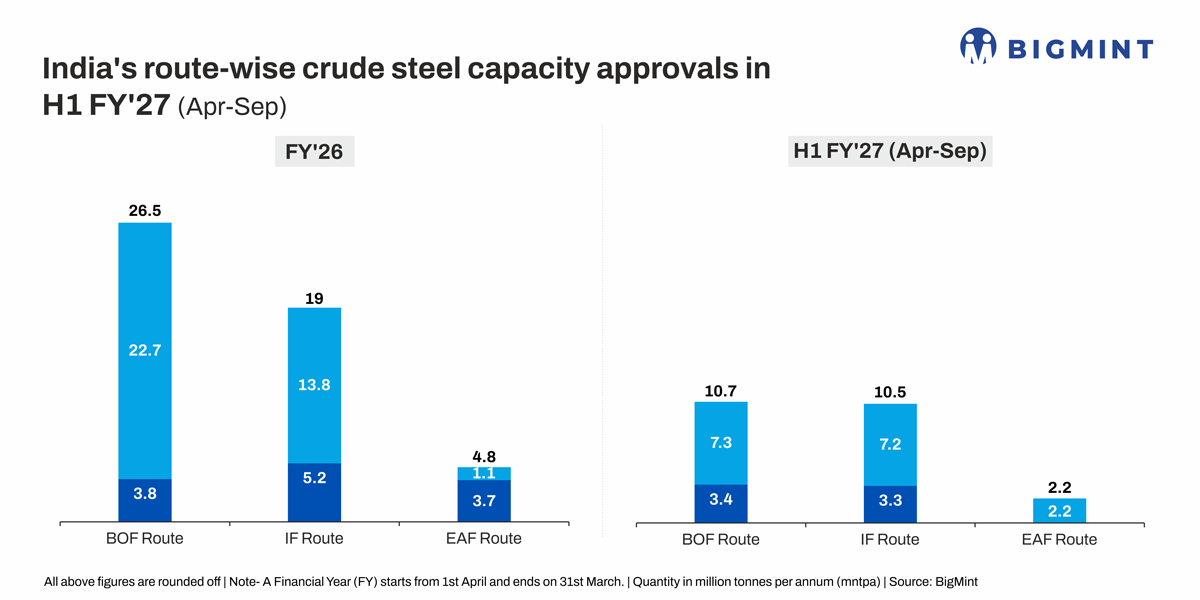
The headline number is significant, but the composition of the pipeline provides a clearer picture of the expansion underway. BOF and IF projects account for 21.17 mnt, or about 91% of approved crude steel capacity, while downstream approvals are overwhelmingly concentrated in long products.
BOF and IF account for 91% of approved capacity
BOF projects account for 10.67 mnt of approved capacity and IF projects for 10.50 mnt, with EAF projects contributing another 2.17 mnt.

The near-even split between BOF and IF indicates that the current pipeline spans both integrated steelmaking and induction furnace capacity rather than being concentrated in a single production route. BOF capacity represents larger integrated additions, while the scale of IF approvals points to continued expansion through secondary steelmaking as well.
The stage of approvals is also important. Of the 23.34 mnt total, 16.7 mnt is at the EC stage, compared with 6.6 mnt at CTE. The majority of the approved pipeline therefore remains at the regulatory stage and should not be treated as immediate production capacity.
Long steel dominates downstream additions
The strongest skew in the pipeline appears in downstream capacity. Approved long rolling capacity stands at 15.1 mnt, compared with only 0.4 mnt of flat steel capacity covering HRC and plate.
Long products therefore account for the overwhelming majority of the downstream rolling capacity included in the H1 approval pipeline. The expansion is consequently being accompanied by substantial downstream capacity, with the emphasis firmly on long steel rather than flat products.
The pipeline also includes pellet and sponge iron projects, extending investment beyond crude steelmaking into upstream and downstream parts of the steel value chain.
Karnataka leads state-wise approvals
Karnataka accounts for the largest share of approved crude steel capacity at 6.0 mnt, entirely through the BOF route. Odisha follows with 3.84 mnt, comprising 3.37 mnt of BOF and 0.47 mnt of IF capacity. Chhattisgarh ranks third at 3.70 mnt, including 1.30 mnt of BOF and 2.40 mnt of IF capacity.

The three states together account for 13.54 mnt, or nearly 58% of the H1 crude steel approval pipeline. Karnataka’s position is particularly notable because its entire approved capacity is through BOF, while Chhattisgarh’s pipeline is weighted towards IF capacity.
July surge does not define the full H1 pipeline
The monthly data shows that the 23.34 mnt H1 total was not built through a uniform pace of approvals. April recorded 4.86 mnt, May 5.79 mnt and June 0.98 mnt, before approvals surged to 7.53 mnt in July. August then fell to 1.60 mnt, followed by 2.57 mnt in September.
July remains the largest month by a wide margin, with 7.46 mnt of its 7.53 mnt total coming from EC-stage approvals. The subsequent approvals in August and September bring the H1 pipeline to 23.34 mnt, showing that activity continued after the July concentration rather than ending with it.
Outlook
The H1 approval pipeline points to a substantial expansion cycle, but 23.34 mnt of approvals is not equivalent to 23.34 mnt of new operating capacity. With 16.7 mnt still at the EC stage, the timing of construction, commissioning and eventual production will determine how quickly the approved pipeline reaches the market.
For now, the composition is clear. BOF and IF account for about 91% of crude steel approvals, while 15.1 mnt of long rolling capacity dwarfs the 0.4 mnt approved for flat steel. The next phase of India’s capacity expansion is therefore being shaped not only by the volume of new steelmaking capacity, but by where that capacity sits in the production route and downstream product chain.
Leave a Reply