- Q1 cement sales rise despite Assam floods, election disruptions
- Company lowers FY27 volume growth guidance to 8-9%
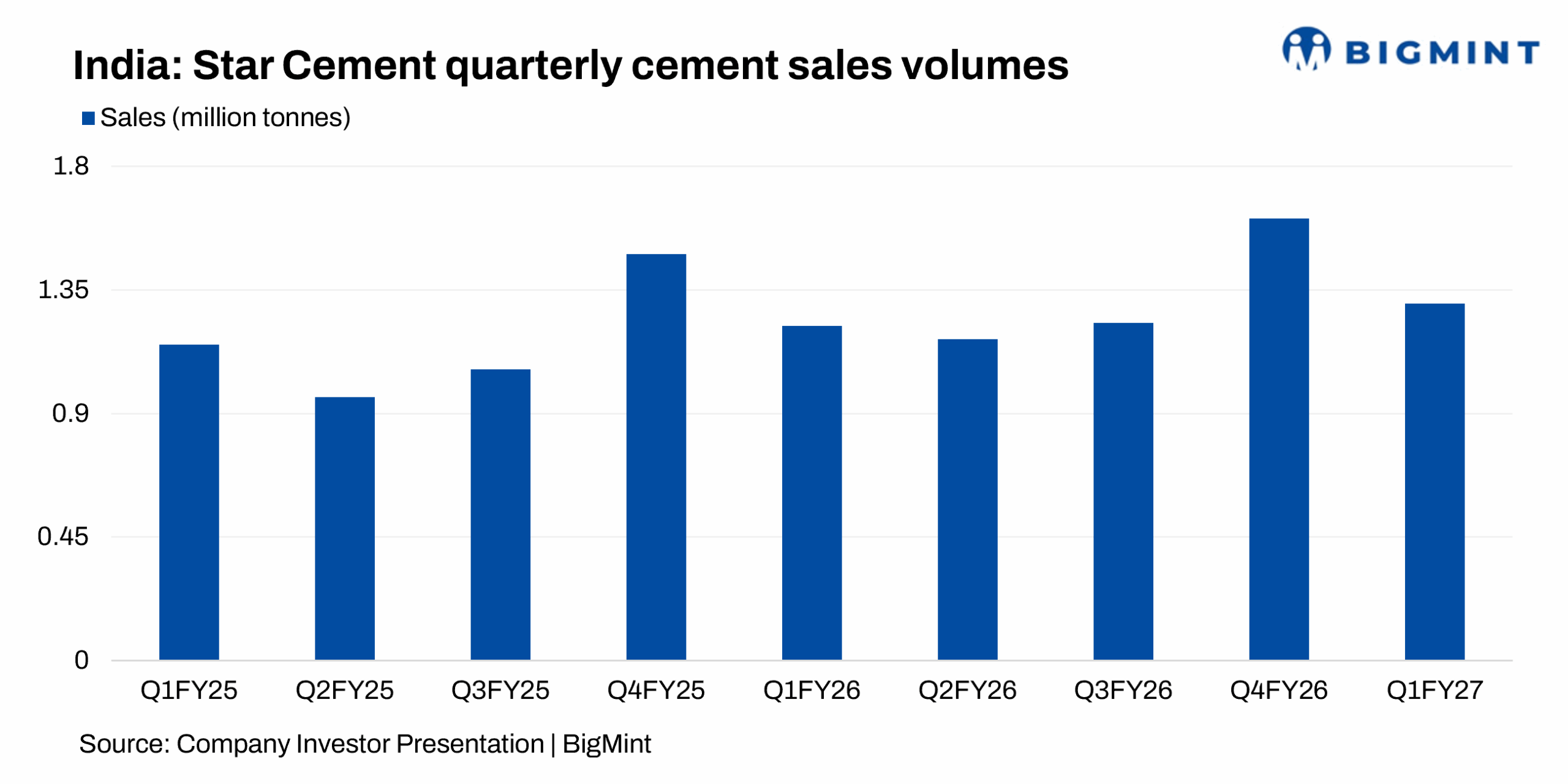
Star Cement reported a 7% y-o-y increase in cement sales to 1.30 mnt in Q1FY27 from 1.22 mnt in Q1FY26, despite flooding in Assam, election-related disruptions and the onset of the monsoon affecting demand in the Northeast.
EBITDA/tonne fell to INR 1,497 from INR 1,774. The company lowered its FY27 cement volume growth guidance to 8-9% from 10-12%, while retaining its EBITDA/t guidance of INR 1,500-1,600.
Sales growth led by non-Northeast markets
Star Cement produced 1.31 mnt of cement in Q1FY27, up from 1.23 mnt in Q1FY26, while clinker production increased to 0.91 mnt from 0.89 mnt. Cement sales increased y-o-y to 1.30 mnt in Q1 from 1.22 mnt in same period year ago.
Sales outside the Northeast increased to 0.43 mnt from 0.36 mnt, providing the main support to overall volume growth. In contrast, Northeast cement sales remained broadly stable at 0.87 mnt as elections in Assam and the onset of the monsoon disrupted construction activity.
The company expects demand in the Northeast to improve from Q3 and targeting 8-9% growth in the region during FY27. However, clinker sales are expected to remain stagnant or decline by 5-10%, as increasing availability of clinker imported into the Northeast from outside the region could limit external clinker demand.
The regional divergence highlights the importance of non-Northeast markets in supporting volumes while construction activity in Assam remains disrupted.
Floods continue to affect Northeast demand
Star Cement reported around 12% y-o-y volume decline in July as severe flooding disrupted activity across Assam. August month recorded marginal growth, while a favorable base in September and post-monsoon pent-up demand are expected to support recovery during Q3 and Q4.
Cement prices remain broadly stable
Cement prices remained broadly stable across key markets despite weaker regional demand. Prices in Bihar were around INR 10/t higher than Q1 levels, while prices in West Bengal and the Northeast increased by roughly INR 3/t.
The limited movement in prices indicates that volume recovery rather than pricing is likely to remain the primary driver of revenue growth through the recovery period.
With the company already lowering its volume guidance, sustained pricing will be important for protecting realizations while demand conditions remain uneven across regions.
Higher fuel costs pressure profitability
Star Cement’s Q1 profitability weakened despite higher cement sales. EBITDA declined to INR 203 crore from INR 230 crore, while EBITDA/t fell to INR 1,497 from INR 1,774.
Fuel cost increased to INR 1.55 per unit in Q1FY27 from INR 1.33 in Q4FY26. Around 45% of fuel requirements were met through the Fuel Supply Agreement (FSA), while around 30% was sourced through spot purchases.
The company expects fuel cost to decline to around INR 1.45 per unit in Q2FY27 as FSA supplies improve, with further moderation expected during the second half. However, Q2 EBITDA/t is expected to decline to around INR 1,400 due to shutdown expenses and lower fixed-cost absorption during the monsoon.
The company has retained its FY27 EBITDA/t guidance of INR 1,500-1,600. Achieving this target will therefore depend on lower fuel costs, improved capacity utilization as demand recovers and stronger volumes during the second half.
Rajasthan expansion strengthens North India strategy
The company is prioritizing North India growth, with its Nimbol, Rajasthan project forming a key part of its expansion plans.
- The project includes 3.3 mnt of clinker and 3 mnt of grinding capacity.
- Land acquisition is completed, while the public hearing is scheduled for August and environmental clearance is expected by early October.
- Equipment orders are likely to be finalized by late August or early September, with construction targeted to start between October and November.
- Commissioning is expected in Q4FY28 or Q1FY29. The project has also received capital subsidy and SGST benefits from the Rajasthan government.
Capex remains focused on capacity expansion
Star Cement has retained its Capex plan of INR 500 crore for FY27 and around INR 1,500 crore for FY28, with Q1FY27 spending at approximately INR 93 crore.
The Rajasthan project is estimated to cost around INR 2,700 crore excluding GST and up to INR 2,900 crore including GST.
The company is also evaluating a grinding unit in West Bengal or Bihar, with the final location dependent on industrial incentives, project economics and railway connectivity. Splitting capacity between both states could reduce economies of scale, particularly for a greenfield project requiring dedicated railway infrastructure.
Logistics, green energy support cost efficiency
Star Cement is improving logistics through a railway siding at Silchar, wagon tippler at Siliguri and electric vehicles on selected routes. The Siliguri wagon tippler is expected to save around INR 150/t. Green energy accounted for around 30% of the energy mix in Q1FY27, including waste heat recovery, while the company is evaluating solar and group-captive power options to further reduce energy costs.
Outlook
Star Cement is expected to deliver 8-9% volume growth in FY27, with recovery concentrated in Q3 and Q4 as flood and monsoon disruptions ease. Northeast demand is likely to improve on pent-up construction activity, while non-Northeast markets should continue supporting volumes. Fuel costs are expected to moderate from Q2, supporting EBITDA per tonne despite lower subsidy income and monsoon-related fixed-cost pressure.
Leave a Reply