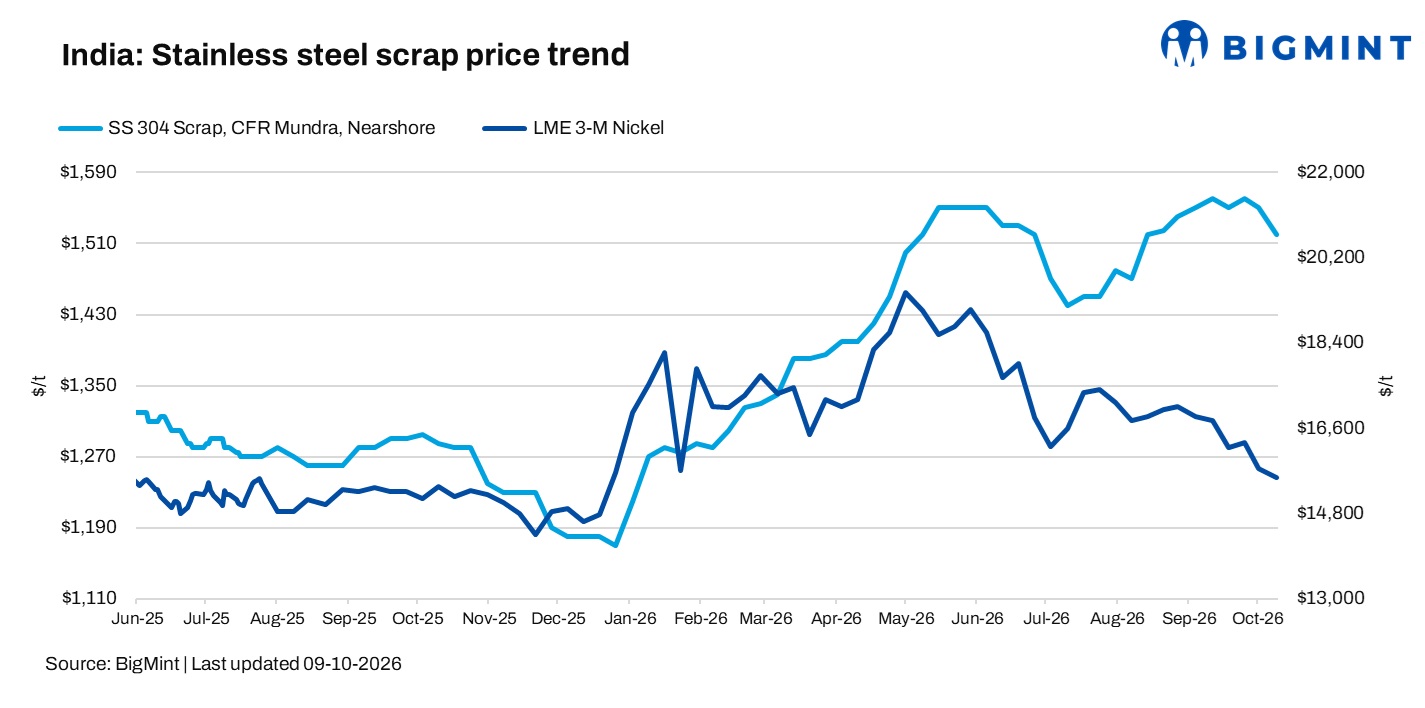
- Buyers remain cautious amid subdued finished steel demand
- Mills consider billets and NPI as scrap alternatives
India’s stainless steel scrap market witnessed a mixed-to-soft trend during the week ended 9 October 2026, as declining LME nickel prices and subdued finished steel demand espeially longs segment weighed on market sentiment. Buyers remained cautious and focused on immediate requirements, while mills increasingly considered alternatives such as nickel pig iron (NPI) and billets amid softer NPI prices. Some mills booked billets and slabs in bulk as a substitute for stainless steel scrap.
However, limited scrap availability continued to lend support to prices, limiting the extent of corrections. Market participants remained cautious amid uncertainty over freight rates, the strengthening US dollar against the Indian rupee, and Pre-Shipment Inspection Certificate (PSIC) requirements, which have added to the cost of imported scrap.
A trader noted that demand remained slow and buying activity was not aggressive, adding that scrap prices were softening alongside declining NPI prices. LME nickel was hovering around $15,553/t at the time of assessment, adding to the downward pressure on market sentiment.
Prices
Domestic scrap
Domestic 304 stainless steel scrap prices remained unchanged week-on-week at INR 147,000/t DAP Delhi and INR 152,000/t DAP Mumbai. Trading activity in Mumbai remained subdued amid falling nickel prices and cautious buying.
Domestic 316 scrap prices stood at INR 304,500/t DAP Mumbai and INR 297,000/t DAP Delhi, with both assessments increasing by INR 2,000/t week-on-week. Tight availability continued to support the grade despite weaker overall market sentiment.
Imported scrap
Imported 304 stainless steel scrap prices declined by $30/t week-on-week to $1,520/t CFR Mundra. Market indications ranged from $1,470-1,530/t.
Imported 316 scrap prices stood at $3,145/t CFR Mundra. Offers were reported at $3,100-3,150/t, while deals were heard within the $3,050-3,150/t range.
Import-related freight costs and uncertainty surrounding PSIC requirements continued to influence procurement decisions. Separately, the European Union’s proposed restrictions on metal waste shipments to certain destinations, including India, are scheduled to take effect in May 2027, subject to the final implementation framework.
Global market
Global stainless steel markets showed diverging cost-price trends in Q3 2026, with trade measures and regional demand influencing price movements. In Europe, import restrictions and quota utilisation supported landed 304 stainless steel prices despite lower alloy surcharges. Indonesia’s NPI prices declined, but integrated mills saw only a modest reduction in production costs. Meanwhile, Malaysia faced rising scrap costs amid subdued domestic buying, while India recorded a closer alignment between raw material and finished steel prices. These developments highlight how trade policies, import competition and regional supply conditions continue to shape stainless steel scrap and finished steel markets.
Outlook
India’s stainless steel scrap market is expected to remain under downward pressure in the near term amid weak finished steel demand and declining nickel prices. However, tight scrap availability could limit further corrections, particularly for 316 grade. Buying activity may improve if downstream demand strengthens, while nickel price movements, NPI availability and import-related costs will remain key factors influencing market direction.
Leave a Reply