- Elevated alloy costs, limited imports support scrap prices
- Buyers prefer need-based purchases amid higher offers
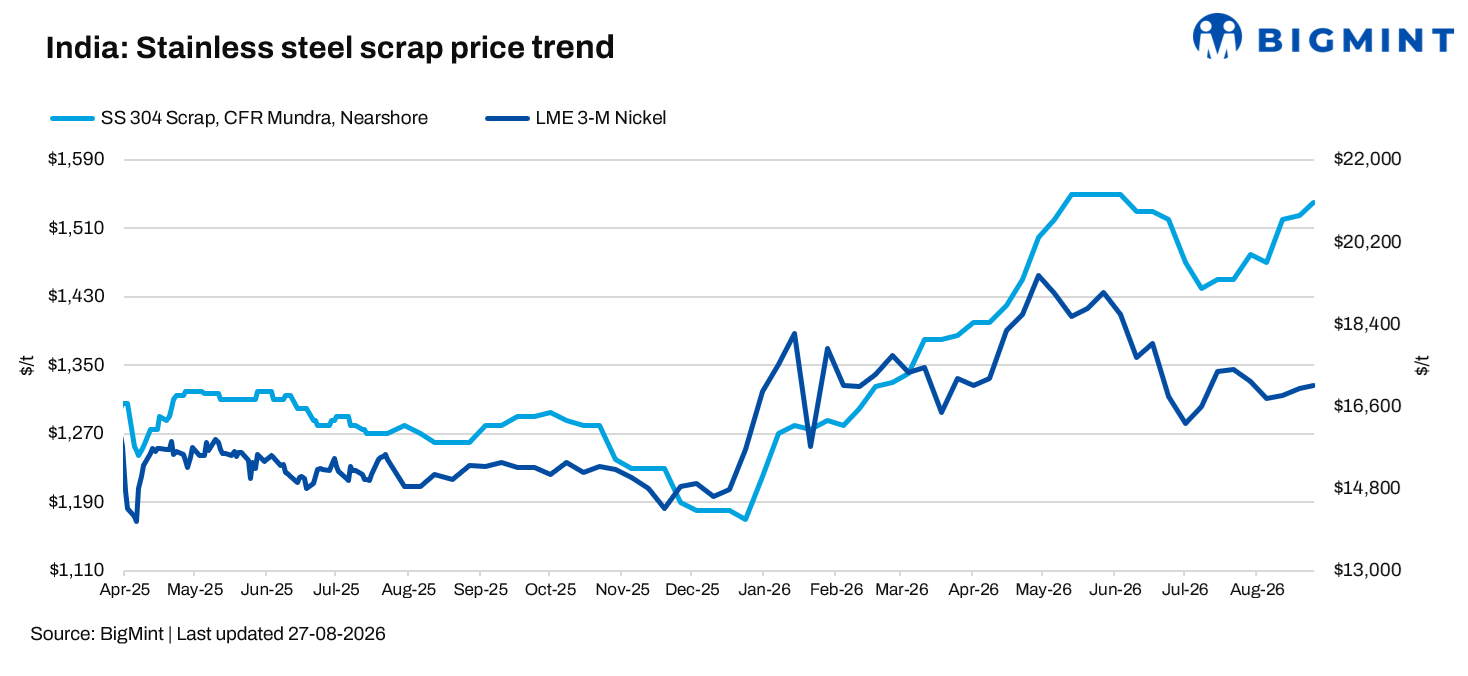
India’s stainless steel scrap market remained firm in the week ended 27 August 2026, with prices moving higher amid tight availability, elevated alloy costs and volatile nickel prices. Market participants remained cautious towards higher supplier offers and largely adopted a need-based buying strategy to fulfil immediate requirements.
304 scrap prices increase
BigMint’s assessment showed domestic 304-grade stainless steel scrap prices increased by INR 2,000/t w-o-w to INR 147,000/t DAP Delhi. Imported 304 scrap prices also rose by $15/t w-o-w to $1,540/t CFR Mundra, supported by constrained availability and volatile nickel prices.
Domestic 304 scrap offers were heard at around INR 148,000-152,000/t, while imported material was reported at around $1,520-1,540/t CFR India.
316 scrap remains tighter
The 316-grade scrap market remained particularly tight, with imported offers touching above $3,000/t CFR India. Domestic offers were heard at around INR 295,000-300,000/t, reflecting continued supply constraints and elevated molybdenum costs.
BigMint’s assessment showed domestic 316-grade scrap prices increased by INR 8,000/t w-o-w to INR 293,000/t DAP Delhi, while imported 316 scrap prices rose by $45/t w-o-w to $2,980/t CFR Mundra.
Buyers remain cautious
Despite support from volatile nickel prices, buyers remained reluctant to build large inventories at elevated price levels. Purchasing remained largely requirement-driven, while higher import costs and limited availability continued to support domestic material.
Outlook
India’s stainless steel scrap market is expected to remain firm in the near term. Tight domestic availability, restricted import flows, and elevated alloy costs are likely to provide a floor to prices, while high scrap values and nickel volatility may limit aggressive buying.
The 316 segment is expected to remain relatively stronger than 304, supported by tighter availability and higher molybdenum costs. Higher freight rates and container shortages are also likely to keep imported scrap less competitive and sustain mills’ reliance on domestic material.
Market participants will closely monitor LME nickel, molybdenum costs, scrap availability, import flows, freight rates and downstream demand for further direction.
Leave a Reply