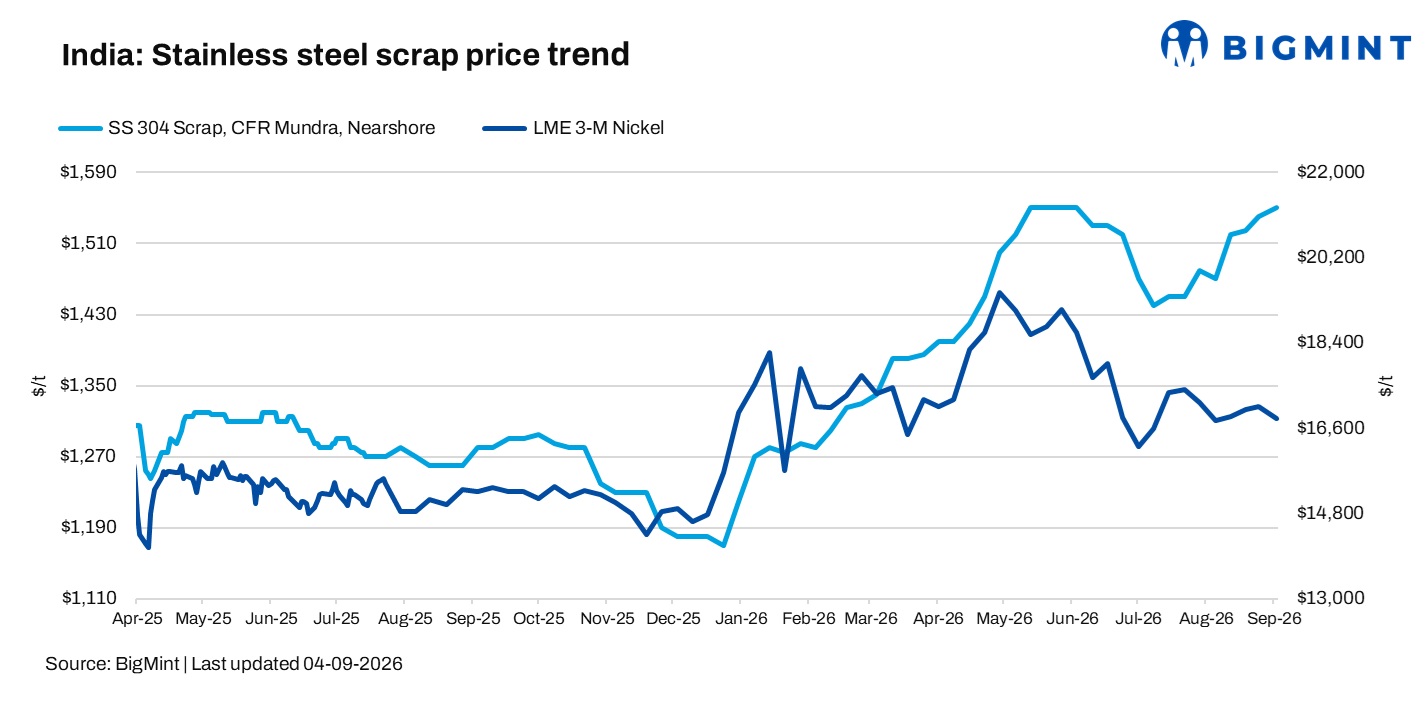
- Domestic scrap prices rise on limited availability
- Higher alloy costs support stainless steel scrap
India’s stainless steel scrap prices remained firm in the week ended 4 September 2026, with prices moving higher amid tight availability, elevated alloy costs and fluctuating nickel prices. Market participants remained cautious towards higher supplier offers and largely adopted a wait-and-watch approach to imported material, while domestic scrap continued to see better buying interest.
304 scrap prices move higher
BigMint’s assessment showed domestic 304-grade stainless steel scrap prices increased by INR 3,000/t w-o-w to INR 150,000/t DAP Delhi. Imported 304 scrap prices also increased by $10/t w-o-w to $1,550/t CFR Mundra, supported by constrained availability and higher nickel-linked costs. Domestic 304 scrap offers were heard at around INR 150,000-155,000/t, while imported material was reported at around $1,520-1,550/t CFR India. BigMint also introduced its new 304-grade stainless steel scrap assessment on a DAP-Mumbai basis, which stood at INR 152,000/t.
316 scrap remains tight
The 316-grade scrap market remained particularly tight, with imported offers heard at around $3,020-3,070/t CFR India. Domestic offers were reported at around INR 295,000-300,000/t, reflecting continued supply constraints and elevated molybdenum costs.
BigMint’s assessment showed domestic 316-grade scrap prices increased by INR 2,000/t w-o-w to INR 295,000/t DAP Delhi, while imported 316 scrap prices rose by $70/t w-o-w to $3,050/t CFR Mundra.
The sharp increase in imported 316 prices reflects tight availability and continued cost pressure from molybdenum, keeping the grade relatively stronger than 304.
Global stainless steel scrap prices remain firm
Global 304 scrap indications remained firm across major markets. European 304 scrap was assessed at around $1,380-1,400/t CIF Rotterdam, up approximately $100-120/t from levels around $1,280/t two months earlier.
In Asia, 304 scrap was heard at around $1,380/t CIF Thailand, $1,390/t CIF Klang in Malaysia, $1,480-1,500/t CFR South Korea and around $1,500/t on a Japan domestic basis. Global 316 scrap indications remained broadly within the $2,950-3,100/t range.
China market remains under pressure
China’s stainless steel scrap market remained weak this week, with 304 scrap prices at RMB 10,050-10,150/t ($1,496,1,511/t) in East China and RMB 10,000-10,300/t ($1,489-1,534/t) in Foshan. Weak SS futures, softer finished steel prices and subdued high-grade NPI prices continued to weigh on sentiment.
Although scrap retained a cost advantage over high-grade NPI, narrowing mill margins limited the benefit and encouraged mills to push for lower raw material prices. Expectations of a September-October demand recovery also remained weak, while softer September production schedules reduced expectations for scrap demand.
Persistent tax-invoice constraints further affected market liquidity. Overall, weak demand, lower production and margin pressure are likely to keep China’s stainless steel scrap market under pressure in the near term.
LME nickel prices correct 2% w-o-w
LME three-month nickel prices declined 2% w-o-w to $16,760/t in the week ended 4 September, from around $17,000/t a week earlier. At the time of reporting, LME nickel prices were hovering at $16,810/t. The decline was mainly driven by expectations of higher Indonesian nickel ore supply following potential revisions to RKAB allocations, which raised concerns over additional supply. Meanwhile, elevated LME inventories and subdued downstream demand continued to weigh on market sentiment.
Outlook
India’s stainless steel scrap market is expected to remain firm but cautious in the near term. Tight domestic availability, limited import arrivals and elevated alloy costs are likely to provide a floor to prices. However, higher scrap values and cautious buyer behaviour could limit aggressive purchasing.
Market participants will closely monitor LME nickel, ferro molybdenum costs, scrap availability, import arrivals, freight rates and downstream stainless steel demand for further direction.
Leave a Reply