- Northern mills booking NPI, western mills plan billet purchases
- Revised PSIC issuance timeline expected to ease import procedures
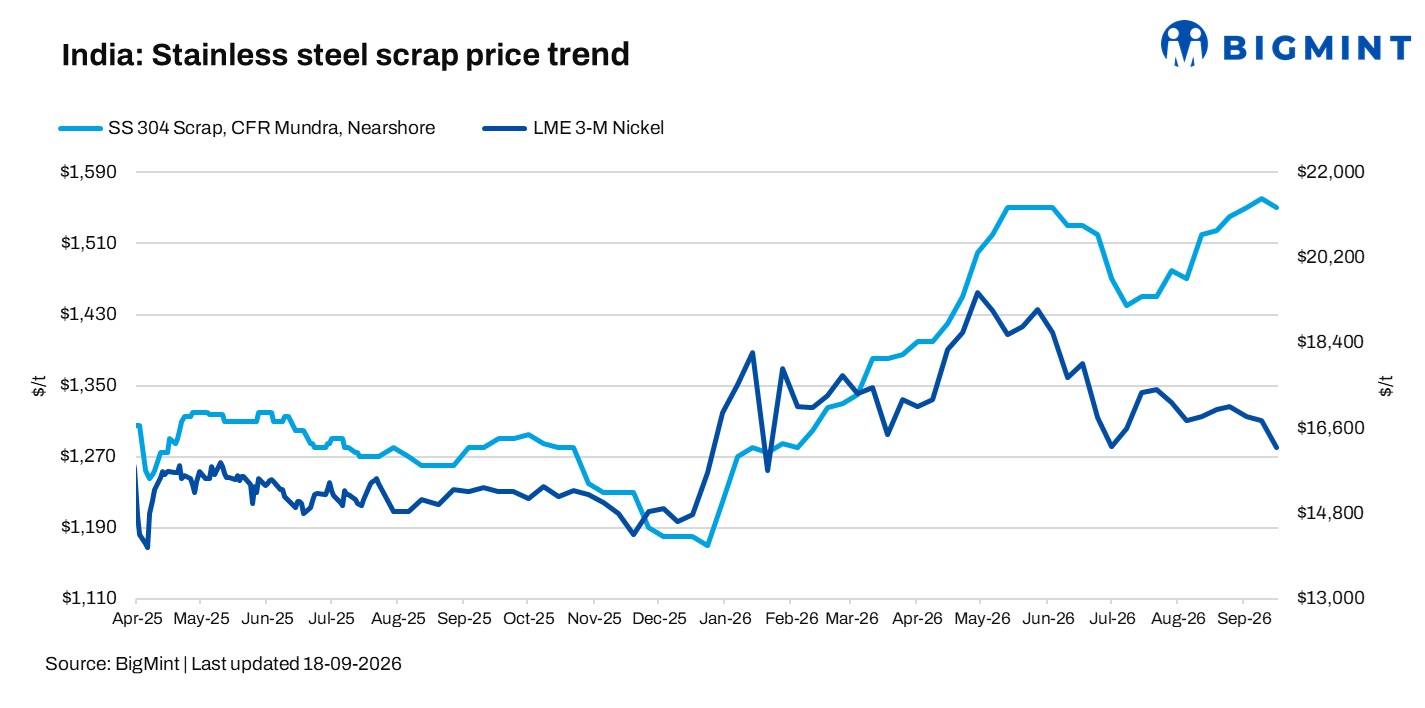
India’s stainless steel scrap prices declined in the week ended 18 September, as buyers increasingly explored alternative raw materials amid firm scrap offers and tight availability.
Prices
Domestic 304-grade stainless steel scrap prices fell by INR 3,000/t w-o-w to INR 148,000/t DAP Delhi.
Imported 304 scrap prices also softened by $10/t w-o-w to $1,550/t CFR Mundra. Market indications for 304-grade scrap were heard in the range of $1,550-1,575/t.
For 316-grade stainless steel scrap, domestic prices declined by INR 2,000/t to INR 293,000/t DAP Delhi, while imported 316 scrap prices decreased by $10/t w-o-w to $3,050/t CFR Mundra. Imported 316 scrap indications were heard at around $3,050-3,100/t.
Market scenario
Market participants reported that mills in the northern region had started booking nickel pig iron (NPI) to meet their raw material requirements. Meanwhile, mills in the western region were planning to purchase billets as an alternative to scrap.
On the other hand, some mills remained uncertain regarding alternative raw material purchases, as they were cautious about procurement decisions amid a lack of clarity regarding market conditions.
Market participants also remained watchful of Indonesia’s revised nickel ore benchmark pricing (HPM) formula, which has lowered feedstock costs for low-grade nickel ore, particularly for high-pressure acid leaching (HPAL)-based producers.
Despite the price correction, scrap availability remained relatively tight. Firm offers and higher compliance-related costs continued to limit material availability, while buyers largely adopted a cautious procurement approach amid uncertainty over nickel price direction.
In Europe, 304-grade stainless steel scrap was heard at around $1,420/t CIF Rotterdam, while 316-grade material was assessed at approximately $2,800-2,820/t CIF Rotterdam.
Revised PSIC timeline to ease import process
Meanwhile, India’s Directorate General of Foreign Trade (DGFT) has revised the timeline for issuance of the Pre-Shipment Inspection Certificate (PSIC).
Under Trade Notice No. 28/2026-27 issued on September 16, the PSIC must now be generated and issued within two days from the date of inspection. The government has also provided a one-time seven-day relaxation for recognised Pre-Shipment Inspection Agencies (PSIAs) to clear backlogged PSICs related to inspections conducted before August 25, 2026.
The revised timeline is expected to streamline the certification process and help reduce delays associated with stainless steel scrap imports into India.
Market participants expect the smoother PSIC process to facilitate the movement of imported scrap and potentially improve availability for Indian mills. If import flows increase while nickel prices remain under pressure, competition between domestic and imported scrap could intensify.
However, firm supplier offers, compliance costs and cautious buying continue to restrict immediate availability in the domestic market.
Outlook
Stainless steel scrap prices are expected to remain under pressure in the near term, as softer nickel prices, cautious buying and increasing interest in alternative raw materials are likely to weigh on sentiment. The revised PSIC issuance timeline could ease import-related bottlenecks and improve scrap availability in India.
Increased availability of imported material, combined with weak-to-moderate buying interest from mills, may limit the scope for a significant price recovery. However, tight spot availability and firm supplier offers could provide some downside resistance.
Leave a Reply