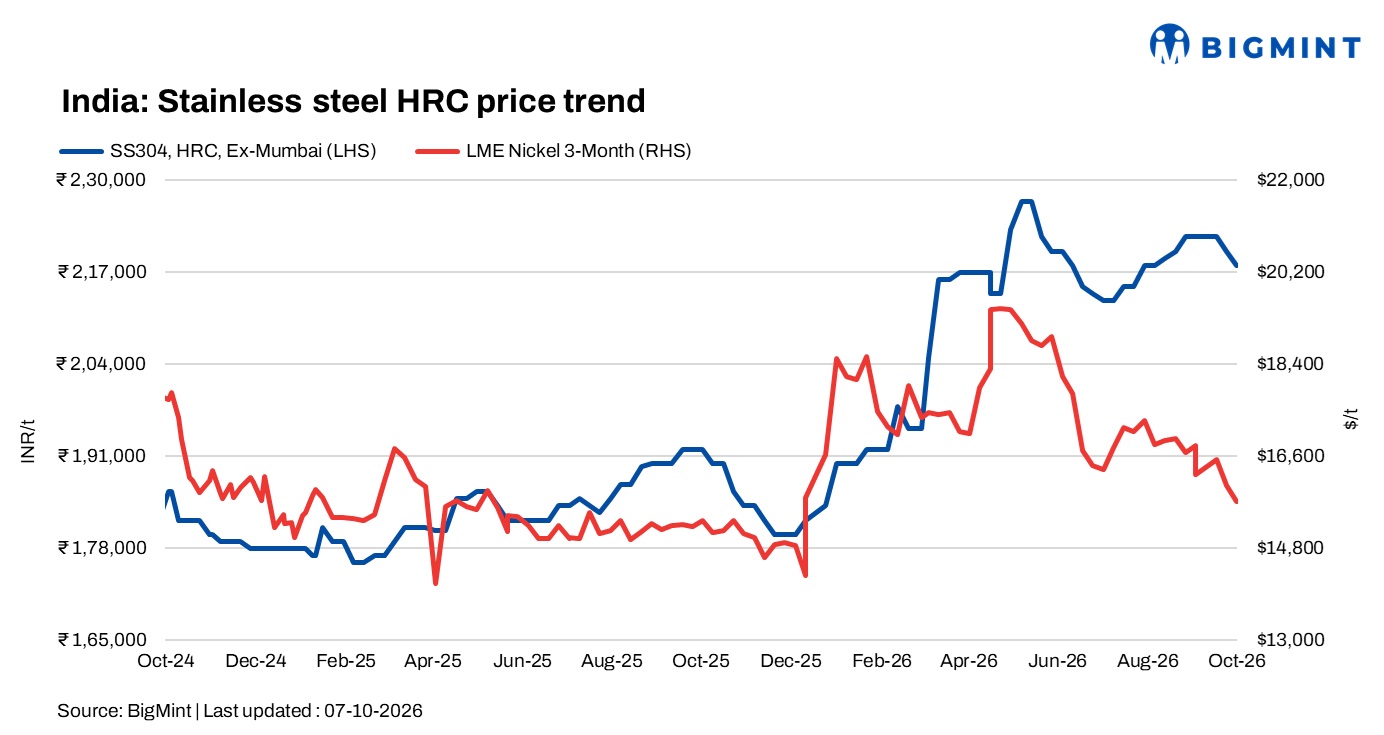
- Nickel volatility keeps buyers cautious
- Firm molybdenum prices support 316 grade prices
India’s stainless steel finished market witnessed mixed trends across flats and longs during the week ended 7 October 2026. Demand remained relatively decent in the flats segment, while buying interest in longs was slightly subdued amid slow demand. Market participants remained cautious due to volatile nickel prices and tight scrap availability. Meanwhile, 316-grade materials witnessed an uptick, supported by higher molybdenum prices and tight availability of 316-grade scrap.
Market participants expect buying activity to gradually improve in October as downstream consumers begin replenishing inventories ahead of Diwali. However, uncertainty over raw material and freight costs is likely to keep buyers focused on immediate requirements.
Finished flats
Demand for stainless steel flat products remained moderate during the week, with buyers largely restricting purchases to immediate requirements. Sellers continued to hold offers firm, supported by elevated scrap costs and tight 316 availability. Market participants also reported liquidity constraints, limiting purchasing activity.
Mills expect prices to remain largely stable in the coming days ahead of the festive season, although higher raw material costs could provide support.
BigMint assessed 304 HR coil prices at INR 218,000/t exw-Mumbai, down INR 2,000/t w-o-w. Meanwhile, 316 HR coil prices increased by INR 5,000/t to INR 455,000/t. The increase came despite softer nickel prices, indicating that tight 316 availability and higher molybdenum costs continued to support the grade.
Finished longs
India’s domestic stainless steel longs market saw mixed trends during the week, despite tight scrap availability and firm alloy costs.
304 black bar prices remained unchanged at INR 200,000/t exw-Mumbai, while 316 black bar prices declined by INR 8,000/t to INR 375,000/t.
India’s stainless steel longs export market remained largely stable during the assessment week ended 6 October, although buying activity remained subdued. Elevated freight costs and tight scrap availability continued to challenge suppliers, while weak overseas demand limited fresh bookings.
BigMint assessed 304 bright bars at $2,350/t FOB Nhava Sheva, unchanged w-o-w, while 316 bright bars were assessed at $4,330/t, up $30/t w-o-w.
Global market
Japan’s domestic stainless steel market remained firm, with distributors gradually raising selling prices for nickel-based cold-rolled stainless steel sheets amid higher procurement costs. SUS304 prices were around JPY 640,000/t ($4,050/t), while distributors have continued efforts to pass on higher purchase costs. However, expectations of lower manufacturer selling prices could put some pressure on procurement costs in the near term.
Nagoya’s stainless steel plate and bar market remained firm, with sellers maintaining a strong stance and scope for price reductions remaining limited. Supply concerns, including mill disruptions and increased procurement from other regions, could further tighten availability depending on cargo movements. Meanwhile, subdued underlying demand may limit significant price increases in the near term.
Taiwan’s stainless steel wire rod export prices rose above NT$97,000/t ($3,050/t), reaching a 17-month high and increasing by more than NT$19,000/t ($597/t) over the past seven months. Higher raw material costs, particularly nickel, have supported domestic price increases and pushed export values higher.
Raw material scenario

Outlook
India’s stainless steel market is expected to remain rangebound to slightly firm in the near term, with festive restocking likely to provide some support in October. However, cautious buying, volatile nickel prices and elevated freight costs could limit the pace of recovery. Tight 316-grade scrap availability and higher molybdenum costs are likely to continue supporting 316 prices, while 304 prices may remain relatively stable.
In the global market, firm Asian stainless steel prices and higher raw material costs could provide further support, although subdued downstream demand may limit significant price gains.
Leave a Reply