- Imported billets landing at steep discounts against domestic material
- Industry warns of risks to domestic investments, competitiveness
India’s stainless steel industry is undergoing a structural shift in raw material sourcing, as buyers increasingly favour semi-finished imports such as billets and slabs over stainless steel scrap. Trade data show billet arrivals surging more than thirteenfold to 128,805 tonnes (t) in 2024 from 9,239 t in 2023. Slab inflows, while lower than 2023’s peak of 575,864 t, remained significant at 429,373 t in 2024. Scrap imports, once the industry’s primary feedstock, dropped 12% y-o-y to 1.21 million tonnes (mnt) from 1.37 mnt in 2023, highlighting a shift in preferences.

Adding to the shift, imports of nickel pig iron (NPI) and ferro nickel (FeNi) rose sharply by 0.20 mnt in 2024. Industry analysts say the cost advantage of these nickel-bearing inputs has encouraged mills to move away from scrap-based melting.
Vishal Wadhwa, GM at Jindal Stainless, stated, “Scrap pricing needs to be realigned in reference to NPI, which is now the guiding benchmark for determining the intrinsic value of nickel. Another structural shift will come once CBAM is implemented, providing scrap with yet another lifeline.”
Why are imports shifting from scrap to semi-finished?
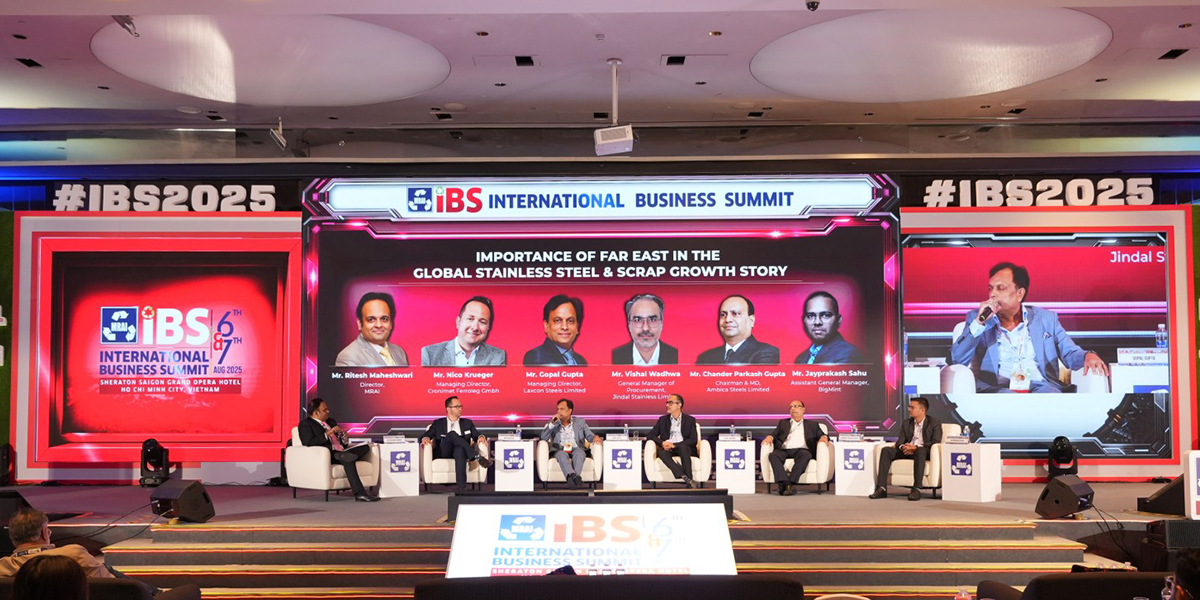
At the Material Recycling Association of India’s (MRAI) International Business Summit (IBS 2025) in Vietnam, discussions highlighted that cost arbitrage remains the key factor. Imported billets have been landing at discounts of $150-170/t against domestic production, according to trade participants. Stainless output based on NPI, dominant in China and Indonesia, continues to enjoy a structural cost edge over India’s scrap-based route.
The managing director and chairman of Laxcon, Gopal Gupta, “The arbitrage is making it difficult to compete. Capacity utilisation at our units is sliding, and investment appetite is cooling as imported material keeps the market under pressure.”
Recyclers also pointed to falling volumes. Ritesh Maheshwari, VP MRAI and Director Shabro noted, “Demand from mills has clearly weakened in the past year. Imports of semi-finished feedstock are displacing scrap usage and affecting margins.”
Nico Krueger, MD at CRONIMET, noted that “stainless steel scrap prices in Europe are already under pressure due to increased inflows of cheaper semi-finished products and NPI imports. He added that the Carbon Border Adjustment Mechanism (CBAM) could play a role in supporting the recycling economy in the long term.”
How is the industry responding?
Concerns over rising semi-finished imports dominated discussions at the Material Recycling Association of India’s (MRAI) International Business Summit (IBS 2025) in Vietnam. Executives cautioned that unchecked inflows could erode domestic competitiveness and slow investment in fresh capacity.
Chairman and MD of Ambica Steels, C P Gupta, who was present at the session, remarked, “India is already dependent on nickel-bearing raw materials from overseas. If billets and slabs continue to replace scrap, we risk hollowing out our recycling base and undermining long-term self-reliance.”
Beyond semi-finished, finished stainless material imports also climbed up by 14% in 2024 to 1.14 mnt, further intensifying competitive pressure on domestic producers. India produced 3.72 mnt of stainless steel during the year, indicating a growing reliance on imported inputs and finished material even as domestic output expands.
Leave a Reply