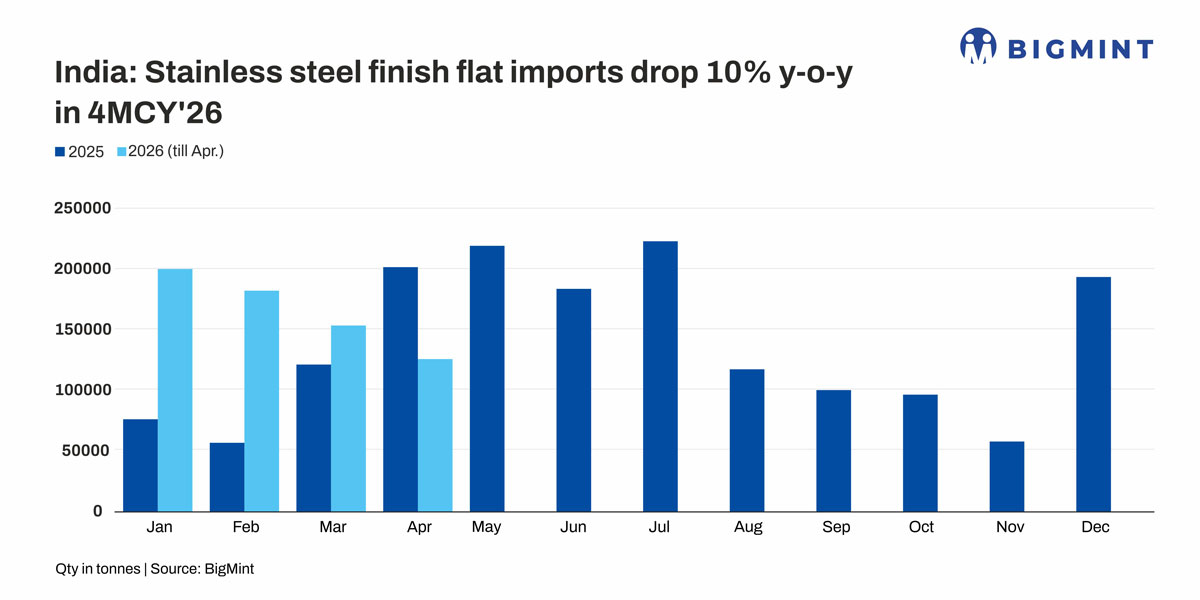
- Imports decline 10% y-o-y to 330,081 t during Jan-Apr’26
- BIS compliance changes, weaker rupee reshape import sourcing
India’s stainless flat steel imports declined 10% y-o-y to 330,081 tonnes (t) during January-April 2026, reflecting a combination of higher domestic production, increased imports of semi-finished stainless steel slabs, evolving Bureau of Indian Standards (BIS) compliance requirements, and a weaker Indian rupee that raised the landed cost of imports. These factors encouraged buyers to increase procurement from domestic producers while relying more on imported semi-finished material for downstream processing.
The BIS certification framework remained a key factor influencing import flows during the review period. Buyers increasingly sourced material from BIS-certified overseas mills as compliance timelines remained uncertain. The impact was most visible in imports from Indonesia, which fell 85% y-o-y to 17,720 t from 121,974 t in January-April 2025 after several suppliers encountered certification-related constraints. Although the government subsequently extended the BIS exemption for certain stainless steel products, procurement patterns had already shifted towards certified suppliers and domestic producers.
Higher domestic output further reduced dependence on imported finished flats. India’s stainless steel flat production increased 5% y-o-y to 975,000 t during January-April 2026 from 928,000 t a year earlier, improving local availability across key product categories. Production also recovered sharply in April, rising 26% month-on-month (m-o-m) to 229,000 t from 182,000 t in March, reflecting improved mill utilisation and easing the need for overseas purchases.
At the same time, imports of stainless steel slabs rose 34% y-o-y to 195,956 t from 146,609 t in the corresponding period last year, providing domestic rerollers and integrated mills with additional feedstock for conversion into finished flat products. Although slab imports declined 44% m-o-m to 30,599 t in April from 55,122 t in March, they continued to support higher domestic value addition and capacity utilisation, reducing reliance on imported finished material.
Currency movements also weighed on import demand. The Indian rupee averaged INR 92.79 per US dollar during January-April 2026, compared with INR 86.02 per US dollar in the same period last year, representing a depreciation of nearly 8%. The currency weakened further from INR 91.69 per US dollar in January to INR 94.91 per US dollar in April, increasing the landed cost of imports, compressing traders’ margins, and encouraging buyers to adopt a need-based procurement strategy.
Imports from China also declined during the period, falling 22% y-o-y to 59,947 t. From 1 January, Chinese exporters were required to obtain shipment-specific export licences supported by commercial contracts and quality inspection certificates. While the measure did not restrict exports, the additional compliance requirements, combined with India’s BIS framework, rising slab imports, stronger domestic production, and higher import costs due to currency depreciation, reduced the competitiveness and flexibility of Chinese supplies.

The import data indicate a broader shift in India’s stainless steel supply chain rather than a temporary slowdown in demand. Greater domestic production, increased use of imported semi-finished slabs, evolving regulatory requirements, and currency-related cost pressures collectively strengthened domestic value addition while reducing dependence on imported finished stainless steel flat products.
Leave a Reply