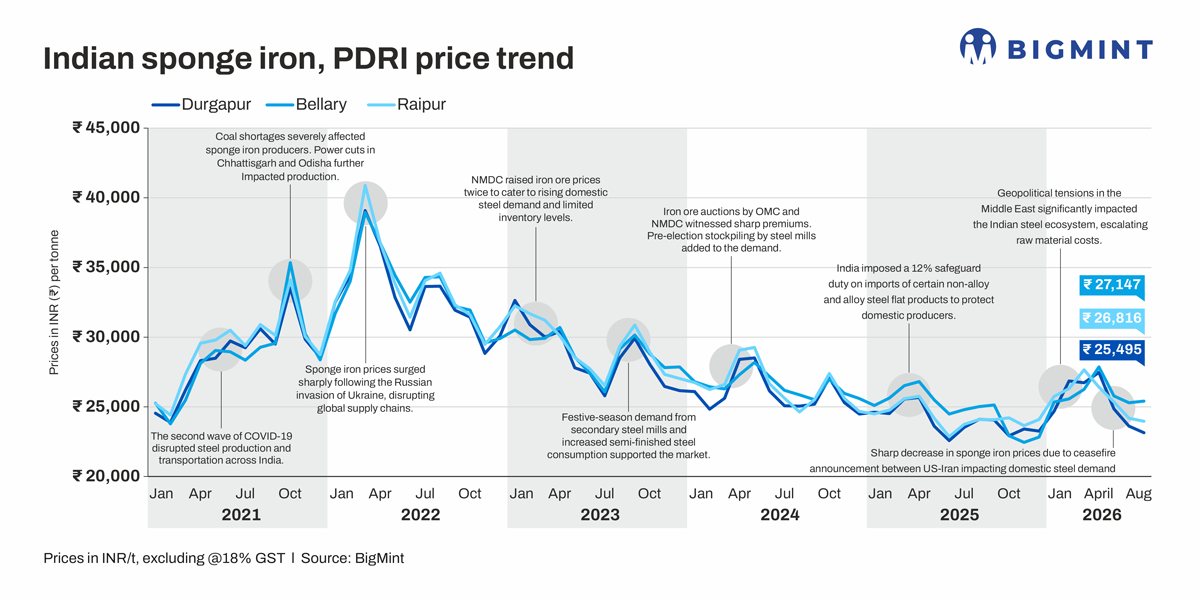
- Raipur PDRI hits two-year high at INR 29,700/t
- Lower scrap imports support higher DRI consumption
Indian sponge iron prices strengthened sharply in August 2026, with major markets recording gains of INR 3,600-5,350/t m-o-m as tight raw-material availability and higher production costs outweighed uneven finished steel demand. Raipur PDRI prices rose to INR 29,700/t on 29 August, the highest level in two years, while the monthly average increased to around INR 26,700/t from INR 24,000/t in July.
The rally was driven primarily by higher coal and pellet costs, tighter spot availability and improved DRI economics against melting scrap. Producers gained greater pricing power as monsoon-related disruptions affected coal dispatches, pellet availability, and material movement across key production clusters.
Coal costs raise sponge iron production economics
Non-coking coal prices (5,000 GCV) increased to around INR 6,900/t ex-Bilaspur in August from INR 5,650/t in July. Heavy monsoon rainfall disrupted coal dispatches and affected the availability of preferred grades, while tighter railway rake availability made deliveries less predictable.
Market participants reported that domestic coal remained available through auctions and linkages, but supply consistency weakened as logistics resources were prioritised for thermal power generation amid elevated electricity demand. Fresh imported coal bookings remained limited where landed costs were substantially above domestic material, keeping producers dependent on available domestic supplies and existing imported stocks.
Pellet supply remains tight
Raipur pellet prices increased by around INR 700/t m-o-m to INR 10,400/t in August. Tight availability, active buying from sponge iron producers and limited availability of suitable fines raised replacement costs. A major pellet producer also remained out of production for around 45 days from mid-July, further tightening availability in the market. The combination of higher coal and pellet costs pushed up sponge iron production economics and supported higher producer offers.
Regional markets post sharp gains
Raipur PDRI prices increased by around INR 4,300/t during August, while Raigarh prices rose by INR 4,550/t to INR 29,100/t ex-Raigarh by month-end. Tight raw-material availability, plant maintenance and monsoon-related logistics disruptions supported the gains. Improved buying from local markets and destinations including Uttar Pradesh and Maharashtra also provided periodic support.
In Durgapur, pellet-based sponge iron prices climbed by INR 5,350/t to INR 28,750/t, reaching a two-year high. Tight iron ore, pellet, and non-coking coal availability, alongside maintenance-related supply constraints, restricted spot availability. Rourkela 70:30 CDRI/mix prices also increased to INR 26,956/t in August from INR 24,720/t in July.
Mandi Gobindgarh prices increased by around INR 4,100/t m-o-m to an average of about INR 30,700/t DAP. Eastern material availability remained constrained by maintenance and monsoon disruptions, while higher input costs supported offers. However, subdued furnace utilisation limited sustained buying.
In Bellary, sponge iron prices increased by around 13% m-o-m to INR 29,500/t. Imported coal prices rose by around INR 2,000/t ex-Gangavaram and pellet prices by around INR 1,000/t ex-Bellary. Producers also reported bookings covering around 15-20 days of production, keeping prompt availability relatively tight.
 Scrap shortage improves DRI competitiveness
Higher scrap prices further strengthened sponge iron economics. HMS 80:20 prices at Mandi Gobindgarh averaged around INR 36,300/t in August, up INR 1,800/t m-o-m, while the latest assessment reached INR 39,400/t on 29 August.
In Jalna, sponge iron was around INR 2,200/t below scrap on average during April-July. The scrap premium widened to around INR 3,200/t in June before narrowing to around INR 1,700/t in July. The wide spread between scrap and sponge iron prices, driven by limited scrap availability, encouraged mills in the western and northern regions to increase DRI usage. Ferrous scrap imports fell 42% y-o-y to 2.73 mnt during January-July 2026, the lowest level in five years, making imported scrap less attractive for mills.
Market feedback indicates that major steelmakers increased the sponge iron share in their metallic charge to around 30-35% during January-July from 15-20% previously. Smaller mills increased DRI usage to around 40-45% from 20-25%. Additional requirements were largely sourced from West Bengal, Odisha, Chhattisgarh and Karnataka.
However, it is to be noted that by the end of August, sponge iron and scrap prices reached parity, with sponge iron marginally higher by around INR 40/t.
Trade activity softens at elevated prices
Domestic sponge iron trade volumes declined to 373,480 t in August from 400,250 t in July, a 6.7% m-o-m fall, indicating some resistance to higher prices. Exports also declined to 21,400 t from 37,250 t. However, export prices strengthened across key destinations. Nepal PDRI increased by $26/t to $304/t, Nepal CDRI/mix rose by $33/t to $338/t, while Bangladesh CDRI lumps increased by $47/t to $358/t. The combination of higher replacement costs and tight availability kept producer offers firm despite slower buying at elevated levels.
Outlook
Sponge iron prices are expected to remain firm in September. Higher coal, pellet and iron ore replacement costs, combined with constrained availability, should continue to support producer offers, while a recovery in finished steel demand could improve procurement.
However, the resumption of pellet production at a major producer could ease Raipur supply pressure. Higher domestic coal availability and improved import bookings could also moderate input costs. With the southwest monsoon receding, improved construction activity and logistics may support steel demand, but mills are likely to remain cautious on procurement if sponge iron prices continue to rise sharply.
Leave a Reply