- Anti-dumping duty news fuels optimism across steel chain
- Raipur leads price rally; total trade volumes jump sharply
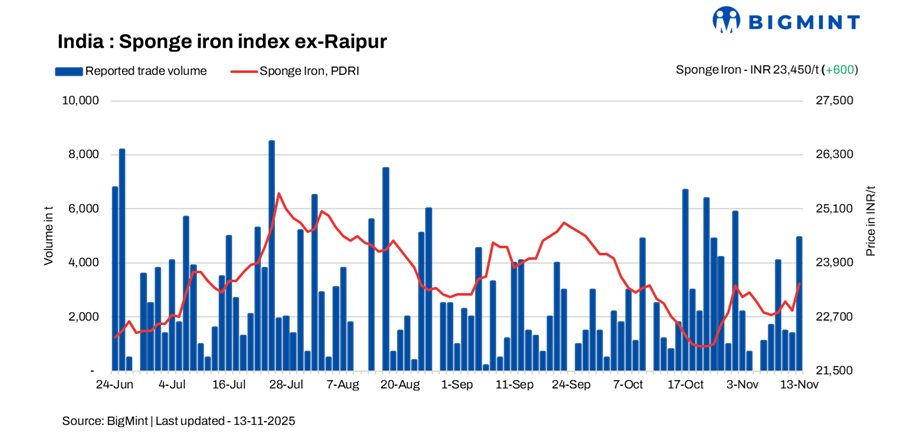
India’s sponge iron (DRI) market witnessed a robust upswing on 13 November 2025, with prices increasing by INR 100-600/t d-o-d across key producing hubs. The rally was led by Raipur, where prices jumped INR 600/t, supported by improved demand in both the semi-finished and finished steel segments and an overall revival in market sentiment following the government’s announcement of anti-dumping duties on hot-rolled flat steel imports.
Anti-dumping duty news improves sentiment
On 12 November, the Ministry of Finance imposed an anti-dumping duty of $121.5/t on imports of hot-rolled flat products of alloy or non-alloy steel from Vietnam, in line with the DGTR’s final recommendations. The move aims to safeguard domestic producers from low-priced imports and is widely perceived as a measure to stabilise market dynamics, encourage domestic consumption, and boost confidence throughout the steel value chain. Industry participants highlighted that the policy development immediately lifted sentiment in the secondary steel sector, particularly among sponge iron and billet manufacturers, who anticipate improved price realisations in the near term.
Trade volumes surge d-o-d
The day recorded a notable spike in trading, with total sponge iron transactions estimated at 28,000 t, sharply higher from around 13,000 t in the previous session. The surge was driven by active restocking and a renewed wave of inquiries from both large and medium-scale steel producers. Sellers, sensing the shift in sentiment, raised offers cautiously through the day, with most deals concluding at higher prices.
Raw materials prices remain firm
Pellet prices in Raipur remained steady at INR 9,600/t (ex-works), reflecting balanced fundamentals and steady supply from local producers. Iron ore prices also held firm, lending stability in input costs.
Rationale
Prices have been derived based on transactions, offers, bids, and indicative price data sets. Transactions are considered as T1 and given a weightage of 50%, whereas other data sets are considered as T2 and given a weightage of the balance 50%.
Click here for detailed methodology



Leave a Reply