- Weak demand, cautious buying pressure sponge iron prices
- Manufacturers resist deeper price cuts amid cost pressure
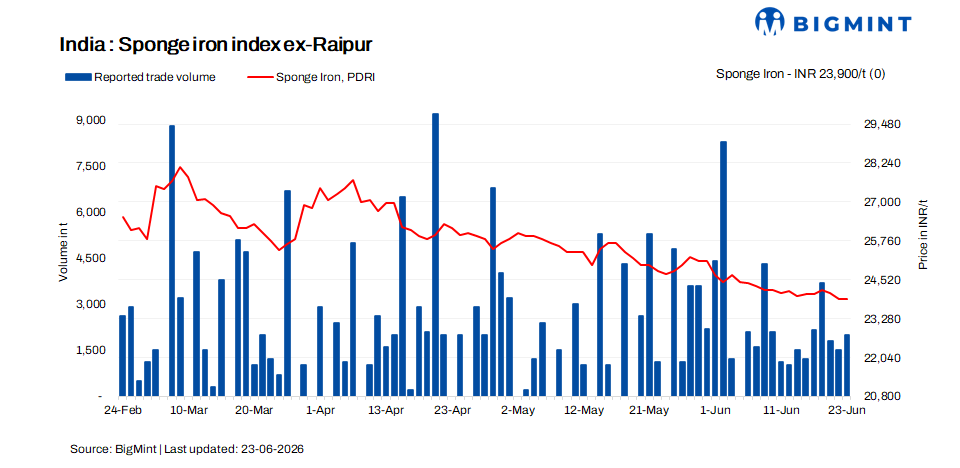
The domestic sponge iron market remained under pressure on 23 June 2026, with prices declining by around INR 50-100/t d-o-d across most regions amid subdued demand and weak market sentiment. Buyers continued to remain cautious, resulting in limited trading activity and downward price corrections in several markets. Durgapur was the only exception, where prices registered a marginal increase of around INR 50/t due to favorable regional supply-demand dynamics.
To stimulate buying interest, sellers reduced their offers across key markets. However, with sponge iron prices already trading near lower levels, producers were unwilling to make significant price cuts. As a result, market participation remained largely need-based, with no major bulk bookings reported. The absence of aggressive buying continued to weigh on overall sentiment, keeping trade volumes restricted.
Downstream demand from the finished steel segment also remained sluggish, further impacting confidence among sponge iron manufacturers. Weak sales in long steel products and slow movement in the construction sector limited procurement activity, reducing expectations of any near-term recovery in sponge iron demand.
On the raw material front, pellet prices continued to hover around INR 8,900-9,000/t, restricting the scope for further reductions in sponge iron prices. Given the current cost structure, manufacturers are finding it difficult to offer material at substantially lower rates. Meanwhile, trade volumes recorded by BigMint stood at around 10,100 t, down from the previous day’s 10,300 t, reflecting the softer market sentiment.
Rationale
Prices have been derived based on transactions, offers, bids, and indicative price data sets. Transactions are considered as T1 and given a weightage of 50%, whereas other data sets are considered as T2 and given a weightage of the balance 50%.
Click here for detailed methodology


Leave a Reply