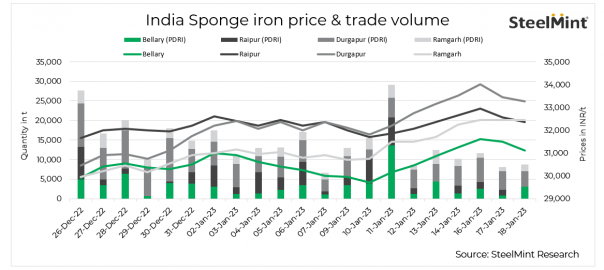
Indian sponge iron prices decreased by INR 50-200/t in key locations. Prices saw a downtrend on account of lower bids followed by volatile prices in north India. This situation has kept buyers cautious, and they procured material as per immediate necessity on lower offers. Thus, prices continued to soften. As a result, trends turned sluggish and spot trades remained slow.
About 12,450 t of sponge iron transactions were recorded today in India as against 11,600 t on 17 January.
Snapshots of key markets
- Rourkela: The prices fell on account of limited trades as buyers are engaged in need-based procurement to fulfil immediate requirements. Spot buying interest was weak today. Moreover, uncertain price movement remained a key factor behind dull trade volumes. Going forward, market participants are waiting for prices to stabilise.
- Raipur: No trading activity was observed amid limited offers at lower prices quoted by sellers. Due to the falling market trend there was less acceptability of the offered prices and the buyers refrained from buying at these levels. Buyers are anticipating the prices to go down further amid slow market. Sponge iron prices further decreased by another INR 200/t today with fewer offers at lower prices. Slow movement in northern region market has also contributed towards lower price offers in Raipur.
- Bellary: Limited spot buying activity in sponge iron ended with a moderate trading volume d-o-d, as slow movement of finished steel in India hindered demand for semi-finished steel.
- Durgapur: Trades reduced today due to low demand in the market as northern region prices declined from the beginning. Buyers remained cautious for bulk booking amid these falling sentiments. Today, sponge prices fell by INR 200/t d-o-d.
- Ramgarh: Market seemed slow due to low demand across regions, especially from northern region. In addition, limited demand has been noticed from rolling mills which impacted semi’s movement in the region.
Rationale –
This index has been derived based on transactions, offers, bids and indicative price data sets. Transactions are considered as T1 and given a weightage of 50% whereas other data sets are considered as T2 and given a weightage of the balance 50%.
Click for detailed methodology
 T1 – Trade, T2 – Offer/Bid/Indicative


Leave a Reply