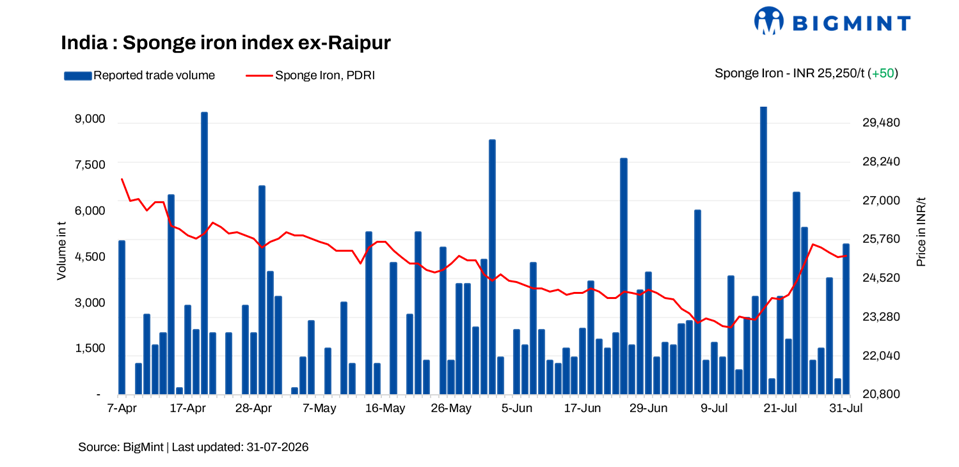
- Trade volumes rose on improved buying interest from the Central region.
- Steelmakers faced margin pressure amid weak rebar demand and high costs.
Prices declined by INR 100-300/t day-on-day across most regions due to limited buying activity and weak finished steel demand. Market sentiment remained subdued as sluggish rebar sales continued to restrict raw sponge iron procurement. Although suppliers trimmed offers to attract buyers, elevated raw material costs and squeezed margins prevented them from implementing steeper price cuts. Despite prices already hovering at relatively low levels, buyers remained cautious, with procurement continuing only on a need-based basis.
Eastern sentiment
A rebar producer from the Durgapur market said, “In rebar, we are facing losses of around INR 1,000-2,000/t because the current sponge-to-rebar conversion spread is nearly INR 17,500/t, compared with the standard level of around INR 19,000/t.” The ongoing margin pressure has made steelmakers cautious about fresh sponge purchases, resulting in muted trading activity and weak market sentiment across most regions.
Central Sentiment
The Central region remained the only positive exception, with PDRI ex-Raipur assessed at around INR 25,250/t, up by INR 50/t day-on-day. The increase was driven by fresh bookings after sponge iron trading had remained limited over the previous two to three days. Buyers returned to the market to secure material, providing modest support to prices and slightly improving sentiment in the region.
Trade Movement:
Overall, trading activity improved, led by stronger demand from the Central region. BigMint recorded approximately 15,000 t of sponge iron trades during the day, around 6,000 t higher than the previous session. However, the broader market remained dull, with buyers seeking lower prices while sellers were reluctant to reduce offers significantly due to persistently high raw material costs. As a result, transactions continued to be driven primarily by immediate consumption requirements rather than any broad-based recovery in demand.
Rationale
Prices have been derived based on transactions, offers, bids, and indicative price data sets. Transactions are considered as T1 and given a weightage of 50%, whereas other data sets are considered as T2 and given a weightage of the balance 50%.
Click here for detailed methodology



Leave a Reply