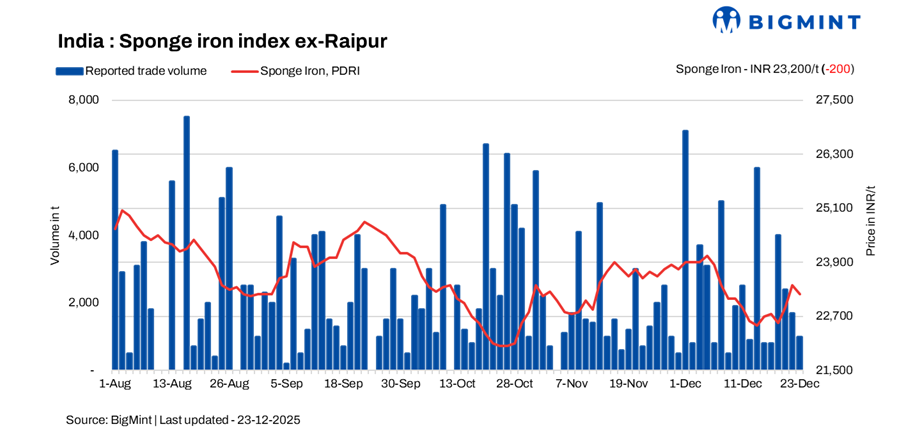
- Spot prices differed across major markets
- Earlier bookings dampened overall trade activity
India’s sponge iron market remained volatile on 23 December, as region-specific demand variations and prevailing uncertainty continued to influence sentiment. Market participants remained cautious, following a wait-and-watch approach and restricting purchases to strictly need-based requirements amid volatile conditions.
Market highlights region wise
East: In the eastern region, prices were largely unchanged across major markets. However, Ramgarh witnessed a marginal decline of INR 50/t. The slight correction was attributed to lower demand, limited enquiries, and earlier bookings, which collectively kept the overall eastern market range-bound.
South: Prices rose across the southern regions. Prices in Hyderabad rose by INR 100/t and by INR 200/t in Bellary (CDRI). Improved enquiries supported sentiment, although booking volumes remained limited due to sufficient coverage from previous transactions.
Central: In the central region, the market remained subdued throughout the trading session. Prices in Raipur declined by INR 200/t, reflecting weak participation, muted demand, and reduced enquiry levels, which weighed on overall regional activity.
Overall, the sponge iron market remained highly volatile, with uneven price movements across regions. Buyers continued to hesitate at higher price levels, opting only for need-based procurement amid uncertain market signals.
Trade activity
Daily trade volumes were estimated at around 10,000 tonnes, significantly lower than the previous session’s 19,000 tonnes, indicating softened momentum. Meanwhile, pellet prices in Raipur remained steady at INR 9,300/t ex-works, suggesting balanced raw material fundamentals.
Rationale
Prices have been derived based on transactions, offers, bids, and indicative price data sets. Transactions are considered as T1 and given a weightage of 50%, whereas other data sets are considered as T2 and given a weightage of the balance 50%.
Click here for detailed methodology



Leave a Reply