- Stocks at Indian ports climb up by 2% w-o-w
- Sponge iron tags soften by INR 200/t w-o-w
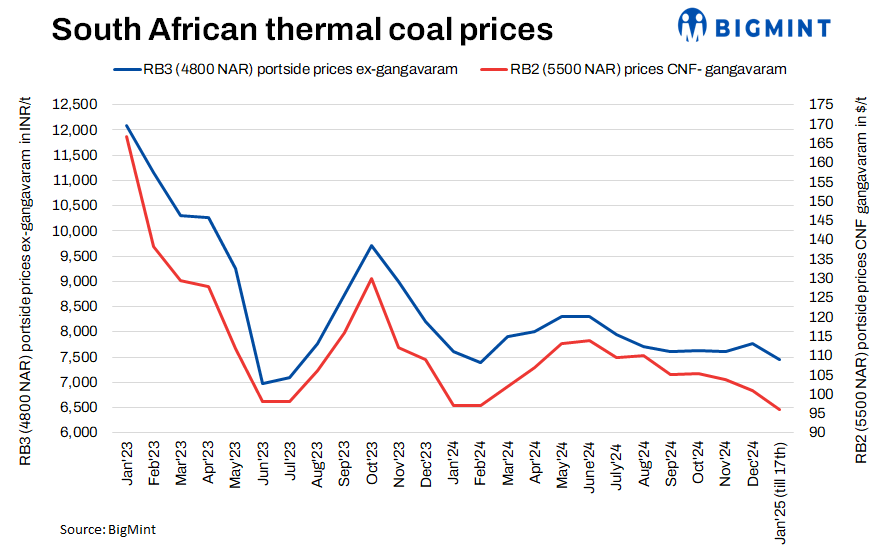
India’s portside prices of South African thermal coal dipped slightly this week amid lower sponge iron prices and high port inventories. RB2 (5500 NAR) prices edged down to INR 8,850/tonne (t), a marginal drop of INR 100/t w-o-w, while RB3 (4800 NAR) prices stayed stable at INR 7,300/t, both ex-Gangavaram. Reduced sponge iron production and abundant domestic coal supplies contributed to weak buying interest, maintaining downward pressure on prices.
Thermal coal inventories at Indian ports increased by 2% to 14.22 million tonnes (mnt) in week 2 of CY’25 from 13.93 mnt in week 1, according to BigMint’s data.
Market overview
South Africa’s export prices decline: South Africa’s RB2 (5500 NAR) export offers dropped by $3/t w-o-w to $82/t FOB, while RB3 (4800 NAR) offers decreased by $2.5/t w-o-w to $62.5/t FOB.
Domestic thermal coal prices stable: Domestic thermal coal prices in India remained unchanged this week. BigMint’s assessment showed 4500 GCV steady w-o-w at INR 4,800/t, while 5000 GCV held firm at INR 5,600/t, both exw-Bilaspur. Market sentiment was subdued amid weak demand, as some end-users hold sufficient inventories, while others have cut production or shut down plants entirely. The upcoming SECL coal auction, scheduled for 23 Jan, may further pressure prices by contributing to oversupply.
Sponge iron prices soften: Sponge C-DRI prices were assessed at INR 25,600/t exw-Rourkela, down by INR 200/t w-o-w.
Outlook
The market for both imported and domestic thermal coal is expected to remain under pressure in India. Portside prices and export offers for South African coal have continued to slide in the recent past due to subdued demand, with sponge iron producers reducing production and domestic inventories remaining high. The stability in domestic coal prices is likely temporary, as the upcoming domestic coal auctions could drive prices further down.
Additionally, weak demand from end-users, inventory oversupply, and production cuts across industries signal persistently challenging market conditions. Without a significant uptick in demand or a reduction in supply, both imported and domestic coal prices are expected to remain under pressure in the short term.
Leave a Reply