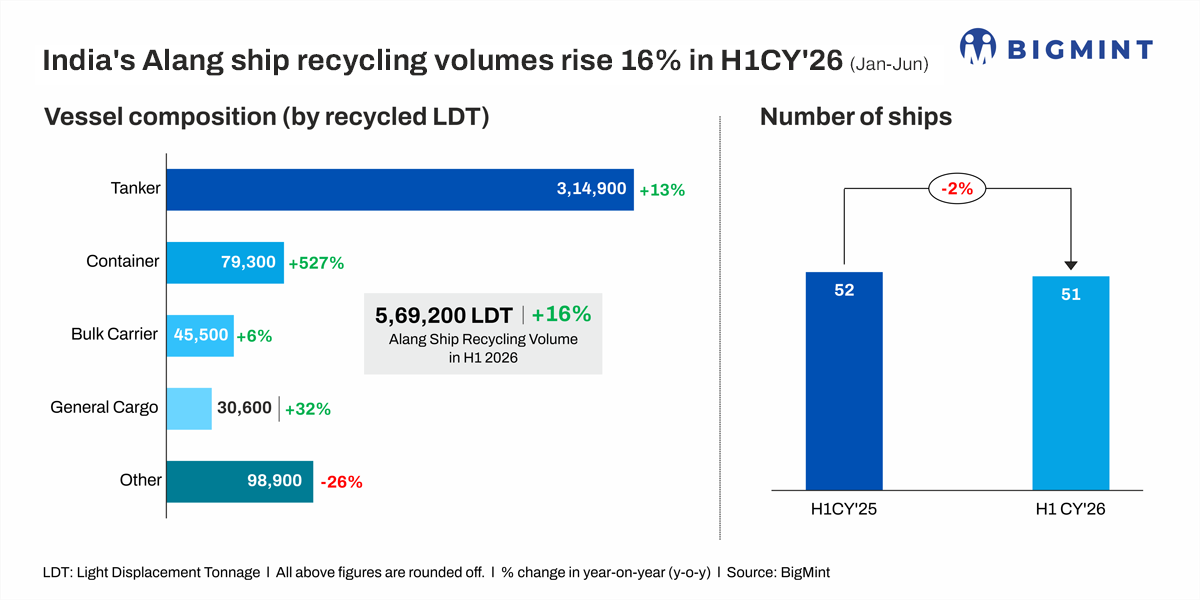
- Recycled volumes increase to 569,000 LDT despite stable vessel arrivals
- Weak domestic steel demand impacts yard processing, recycler margins
- Policy support, environmental compliance strengthen India’s long-term competitiveness
Morning Brief: India’s ship recycling industry increased recycled volumes at Alang by 16% y-o-y to 569,000 light displacement tonnes (LDT) in H1CY’26 from 491,500 LDT a year earlier, as per BigMint data, despite vessel arrivals remaining broadly unchanged at 51 ships compared with 52 ships in H1CY’25.
Larger tankers and container ships, rather than higher vessel arrivals, drove the increase in dismantling volumes.

Larger vessels drive recycling activity
The increase in recycled tonnage reflected a shift in vessel size and category mix rather than a structural increase in recycling activity. Larger tankers and container ships accounted for a greater share of vessels dismantled during the first half, lifting recycled volumes despite stable arrivals.
Market participants said geopolitical developments, including the Iran conflict and the Russia-Ukraine war, had little immediate impact on vessel arrivals because ship recycling transactions are typically concluded months in advance through international auctions and online sale platforms. However, financing sanctioned or Iran-linked vessels has become more challenging, with banks remaining cautious about issuing Letters of Credit, prompting buyers to increasingly rely on alternative settlement mechanisms. Despite these payment constraints, vessel inflows remained broadly consistent.
Weak steel demand weighs on recycling yards
Despite handling larger vessels, operating conditions at Alang remained challenging as weaker finished steel demand reduced recycled scrap offtake by secondary steelmakers. Mills largely restricted procurement to immediate requirements, slowing inventory movement and processing activity across recycling yards.
Alang has 153 ship recycling plots, of which 131 have been allotted by the Gujarat Maritime Board. Around 7-8 allotted plots remain non-operational, while approximately 115 yards comply with the Hong Kong International Convention (HKC). Several recyclers are also seeking certification from classification societies including IRClass, Bureau Veritas and Lloyd’s Register after RINA discontinued its certification services. Yard consolidation has continued as operators merge smaller plots to improve efficiency and meet evolving environmental standards.
Higher costs pressure recycler margins
Ship recyclers faced higher dismantling costs during March-May as commercial LPG prices surged amid peak seasonal demand. Black-market commercial LPG cylinder prices nearly doubled to INR 4,000-4,500 from INR 2,000-2,500 per cylinder, increasing gas-cutting costs by around INR 400/t. Cost pressures intensified further after the government raised the base price of commercial LPG cylinders by around INR 900-950 during May-June.
Although LPG prices have since normalised, weaker steel demand has continued to weigh on recycler margins. Elevated transportation costs have also regionalised domestic scrap movement, with recycled steel increasingly consumed in nearby markets rather than transported to traditional benchmark centres, reducing arbitrage opportunities. 
India outperforms regional peers
India was the only major South Asian ship recycling market to record growth during H1CY’26, with recycled volumes rising 16% y-o-y. In contrast, Bangladesh’s recycling activity declined over 21%, reflecting weaker vessel availability and slower yard operations, while Pakistan recorded a 15% decline amid cautious buying interest, lower yard utilisation and subdued recycling activity.
India’s relatively stable operating environment, improving environmental compliance and consistent vessel inflows continued to strengthen its competitive position among regional recycling destinations.
Outlook
Steel market conditions improved through April before weakening towards the end of H1CY’26. Rebar prices rose around 6% between January and April before declining nearly 10% during April-June as monsoon-related slowdown, weaker order inflows and cautious buyer sentiment weighed on demand. Ship scrap and HMS prices followed a similar trend, rising around 14% through April before easing 6-8% during May and June as mills shifted to need-based procurement.
Looking ahead, India’s ship recycling activity is expected to be driven by domestic steel demand, scrap prices, vessel availability and yard utilisation. The introduction of the Shipbreaking Credit Note (SbCN) under the Shipbuilding Financial Assistance Scheme (SBFAS) 2.0 could strengthen the sector’s long-term competitiveness by linking ship recycling with domestic shipbuilding, although the scheme has yet to materially influence vessel arrivals or recycling activity. Its impact, together with improvements in steel demand and construction activity, will shape the sector’s performance in H2CY’26 and beyond.
To provide feedback on this index or if you would like to contribute by becoming a data partner, please contact – support@bigmint.co

Leave a Reply