- Exclusive 945,000 t authorised-use allocation boosts steel export access
- HRC duty-free quota nearly triples to 33,456 t from 12,405 t earlier
The India-UK Comprehensive Economic and Trade Agreement (CETA), which comes into force on 15 July, will provide Indian steel exporters with duty-free access for more than 1.1 million tonnes (mnt) of steel exports annually under the UK’s revised steel safeguard regime, as stated by a government official.
The new framework substantially increases India’s country-specific quotas across key steel products and provides an exclusive allocation under the UK’s Authorised Use Scheme (AUS), mitigating the impact of Britain’s safeguard measures that had sharply reduced overall import quotas earlier this year.
The UK’s revised safeguard regime, introduced in April, had initially created uncertainty for Indian exporters after Britain reduced overall tariff-rate quotas (TRQs) by around 63%, doubled the out-of-quota tariff to 50%, and lowered allocations across several steel product categories.
Under the original allocation for July 2026-June 2027, India’s total safeguard quota was reduced by around 6% to 146,978 tonnes (t) from 156,637 t in the previous quota year. Within this, the country-specific quota for HRC (Category 1) was cut to 12,405 t, raising concerns over India’s ability to expand exports despite the UK’s growing dependence on steel imports amid declining domestic production capacity.
Following prolonged discussions during CETA implementation, India secured improved market access through revised country-specific allocations and an exclusive quota under the UK’s AUS.
Revised quotas significantly improve India’s market access
The revised quota regime provides India with annual duty-free access of over 1.1 mnt, comprising 168,029 t under country-specific quotas and an exclusive 945,000-t allocation under the UK’s Authorised Use Scheme.
The biggest gain has come in hot-rolled coils (Category 1A), where India’s country-specific quota has increased to 33,456 t from 12,405 t, nearly tripling the earlier allocation. In addition, India has secured a 40% share of the quota available under the AUS, equivalent to around 945,000 t annually, providing exporters with expanded duty-free access for downstream processing.
The revised framework also eases restrictions across several other steel products. Nine commodity codes under Category 28 (non-alloy wire) have been removed from safeguard measures, leaving around 95% of India’s exports in that category outside safeguard restrictions. Meanwhile, the residual quota for Category 12B (non-alloy merchant bars and light sections) has increased nearly tenfold to 4,540 t from 468 t, while Category 26 (other welded tubes) has risen to 16,327 t from 10,809 t.
Increased quotas strengthen India’s export outlook
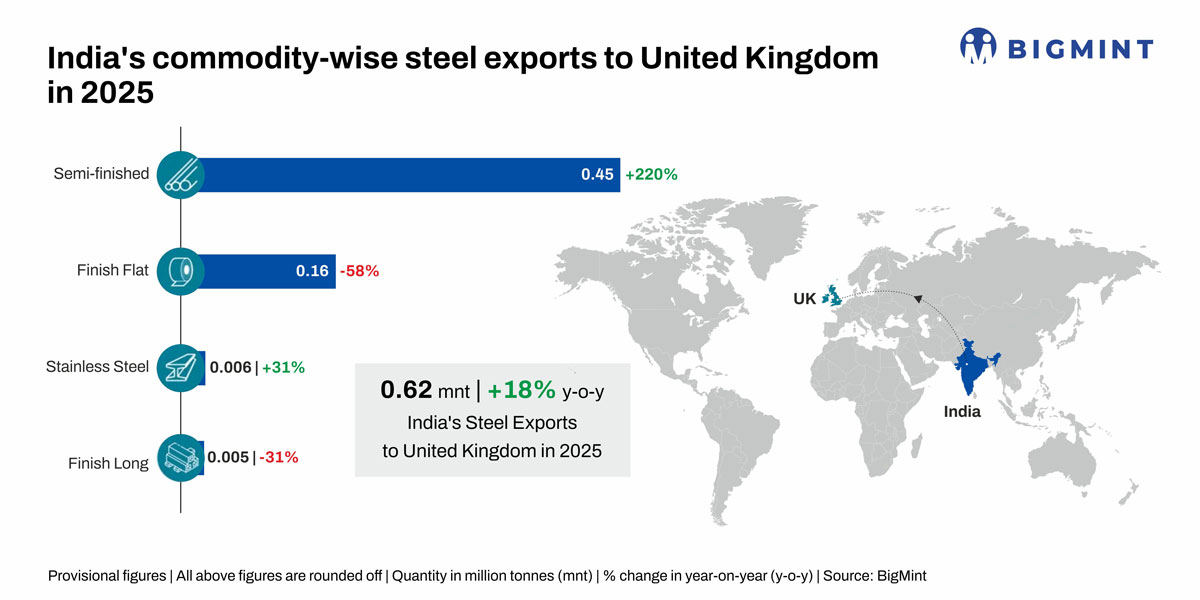
As per BigMint data, India increased its steel exports to the UK by 17% y-o-y in 2025 to over 620,000 t from 530,000 t in 2024, accounting for around 9% of the UK’s total steel imports.
The earlier safeguard revisions had raised concerns that lower country-specific quotas, particularly for HRC, could restrict India’s ability to fully benefit from CETA despite the removal of import duties. The revised allocations provide greater certainty for exporters by restoring higher quotas and adding exclusive access through the AUS.
The expanded quota access is expected to support higher shipments of flat steel, welded tubes and other value-added steel products. Export bookings and quota utilisation will remain key indicators to assess the actual impact of the revised framework in the coming months.
Leave a Reply