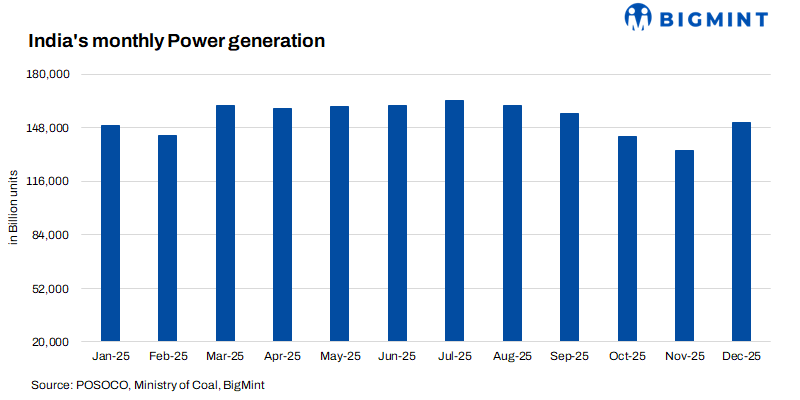
- Demand growth remains strong and structurally driven
- Power system operating with ample supply and low stress
India’s power sector entered 2026 with a combination of higher electricity demand, higher peak loads, falling exchange prices, and rising coal inventories. An analysis of power generation, Indian Electricity Exchange (IEX) day-ahead prices, peak demand patterns, and coal stock data monitored by the Central Electricity Authority (CEA) suggests that the electricity system is not only absorbing demand growth, but doing so with increasing structural comfort. Importantly, these trends point to genuine momentum in the underlying industrial and commercial economy, rather than weather-driven volatility.
Power generation: Growth continues, but the mix is shifting
A like-for-like comparison of 1-26 Jan’26 versus 1-26 Jan’25 shows a clear expansion in electricity generation.

While coal generation rose in absolute terms, its share declined by about 1.4 percentage points, as renewables accounted for the bulk of incremental supply. This indicates demand growth that is increasingly being met by lower marginal-cost sources, even as thermal capacity continues to anchor baseload requirements.
January 2026 also extended the momentum seen in December 2025. Average daily generation rose from 4,868 MU/day in December to 5,039 MU/day in January, confirming that the new year did not see a post-holiday demand fade.
Peak demand: Higher earlier and more consistent
The demand signal becomes even clearer when examining peak load.

Peak demand growth exceeded average energy growth, pointing to higher simultaneity of load, typically associated with industrial, commercial, and infrastructure activity rather than residential consumption alone. The highest peak in the period climbed from about 231 GW in January 2025 to about 245 GW in January 2026.
Equally important is when these peaks occurred. In both years, daily peaks clustered between 09:45–10:15 am, slightly earlier in January 2026 than in late December. This daytime peak profile aligns with working-hour economic activity and coincides with rising solar generation, which plays a critical role in moderating system stress.
IEX prices: Lower despite higher demand
Despite stronger generation and higher peaks, the IEX day-ahead market (DAM) told a very different story on prices.

Prices fell sharply even as volumes surged, indicating a market that was better supplied rather than demand-constrained. Higher renewable penetration, increased nuclear availability, and adequate coal generation ensured that incremental demand did not translate into scarcity pricing. In effect, the marginal unit of power became cheaper, not more expensive.
Coal stocks: Building buffers while burning more coal
Perhaps the most telling indicator of system comfort is coal inventory. The total coal stock increased by 1.98 mnt, rising from 53.24 mnt on 01 January 2026 to 55.22 mnt on 26 Jan’26, primarily due to improved coal receipts during the period.
Stocks increased despite higher coal-based generation, a strong sign that coal supply and logistics were able to outpace consumption.
Category-wise, the build-up was broad-based. Stocks at domestic coal-based plants rose about 1.7 mnt, while stocks at imported coal-based plants rose 0.3 mnt. Both pithead and non-pithead plants recorded increases in inventory.
This rising buffer removed fuel scarcity risk from the system, enabling generators to bid more confidently on the exchange and helping suppress price volatility.
What this says about the economy
Taken together, the data presents a coherent picture. Electricity generation has increased by around 5.5% year on year, while peak power demand is up by roughly 6% over the same period. In contrast, exchange power prices have declined by about 12% year on year. At the same time, coal inventories have risen by approximately 2 million tonnes.
This combination is rarely consistent with a slowing economy. Instead, it suggests broad-based daytime demand growth, typical of manufacturing, construction, transport, and services activity, being met by improving supply diversity and system flexibility. January 2026 reflects an Indian power system running ahead of stress – absorbing higher demand, managing higher peaks, and doing so with lower prices and stronger fuel buffers. As an economic signal, that is unambiguously positive.
Leave a Reply