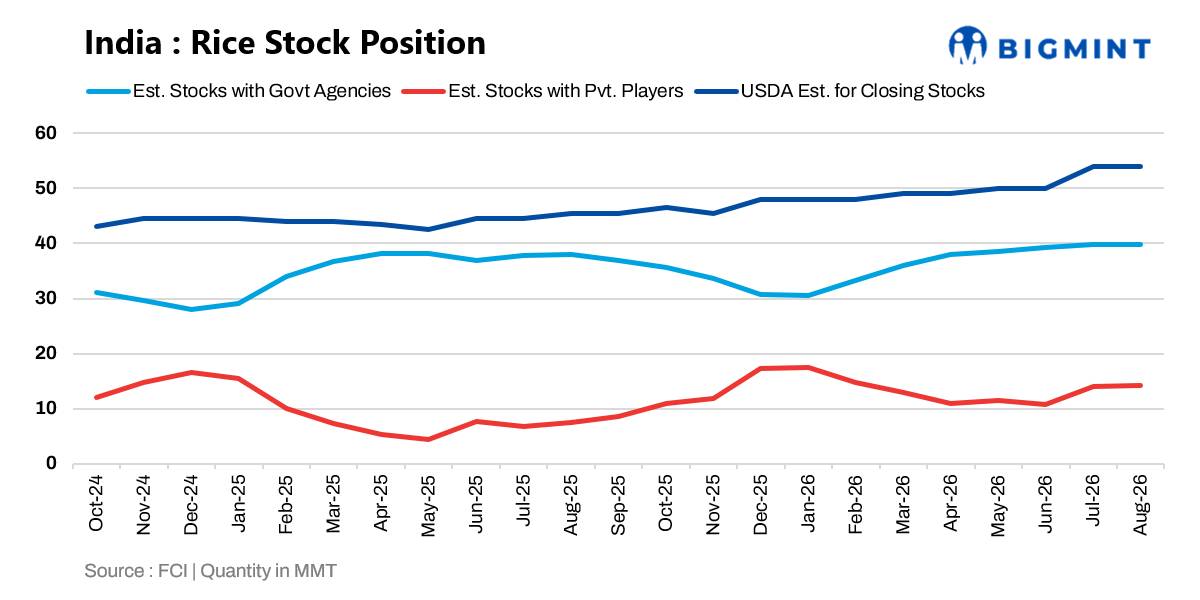
- Govt rice stocks remain stable m-o-m at nearly 40 mnt in Aug’26
- USDA estimates closing stocks at 54 mnt in Aug’26 against 50 mnt in Jun’26
India’s rice inventory position has strengthened further in August 2026, with both government and private-sector stocks remaining at comfortable levels. Government-held rice stocks stood at 39.8 million tonnes (mnt), broadly unchanged from 39.3 mnt in June, while private inventories increased sharply to 14.2 mnt from 10.7 mnt over the same period.
At the same time, the US Department of Agriculture (USDA) estimated that India’s closing rice stocks have climbed to 54 mnt, compared with 50 mnt in June and 46 mnt in August 2025. The stock position provides India with a sizeable buffer ahead of the next kharif procurement season and gives the government greater flexibility to balance domestic availability.
Government inventory remains well above buffer requirements
Government-held rice stocks stood at a record 39.8 mnt as of 1 August, around 5% higher than a year earlier and substantially above the buffer requirement of 13.5 mnt. With stocks remaining well above minimum requirements, the government has room to release additional quantities if domestic prices rise.
OMSS, ethanol provide additional avenues for stock liquidation
The government’s Open Market Sale Scheme is likely to remain an important mechanism for managing surplus inventories. FCI has already been using e-auctions and dedicated movement to increase rice availability in the domestic market. The 2026-27 OMSS policy also provides for rice sales to ethanol distilleries at Rs 2,320/qtl until 31 October, with the reserve price increasing to Rs 2,390/qtl from 1 November. In addition, the government has approved allocation of 230,000 tonnes of FCI rice for ethanol production. This could create a meaningful alternative outlet for surplus government rice and help prevent excessive accumulation ahead of fresh procurement.
Private inventories rebound after reaching a low
Private rice inventories have recovered sharply since June. Estimated holdings increased from 10.7 mnt in June to 14.1 mnt in July and 14.2 mnt in August, a rise of around 33% in just two months. The increase suggests that millers and traders have rebuilt stocks following the procurement season. It also indicates that market participants currently see sufficient availability to maintain higher working inventories. However, higher private stocks could also limit the upside in domestic rice prices unless export demand accelerates or the availability of particular varieties tightens.
High aggregate stocks do not mean all varieties are equally available
One important development outside the chart is the divergence between overall rice availability and availability of specific qualities. Rice prices in Tamil Nadu increased by around Rs 5-15/kg in July, with traders attributing the rise primarily to shortages of fine-quality varieties such as Bapatla Ponni and Karnataka Ponni from Andhra Pradesh, Telangana and Karnataka. Reduced cultivation, lower arrivals, and export demand were cited among the reasons. This highlights an important feature of India’s rice market: large national stocks can coexist with tightness in individual varieties or regions. Therefore, while the overall stock position is bearish-to-neutral for generic rice prices, premium and region-specific varieties can continue to command a premium when arrivals are insufficient.
Outlook
India’s overall rice balance remains comfortable, supported by 39.8 mnt of government rice stocks, 14.2 mnt of private inventories and a 54 mnt USDA closing-stock estimate. The immediate market implication is that a broad-based supply shortage appears unlikely. Instead, price movements are likely to increasingly depend on variety, region, export demand and logistics. Government stock liquidation through OMSS and ethanol could prevent excessive accumulation.
Leave a Reply