- Rates to Cotonou weaken amid import duty pressure
- Domestic market remains focus amid overseas disruptions
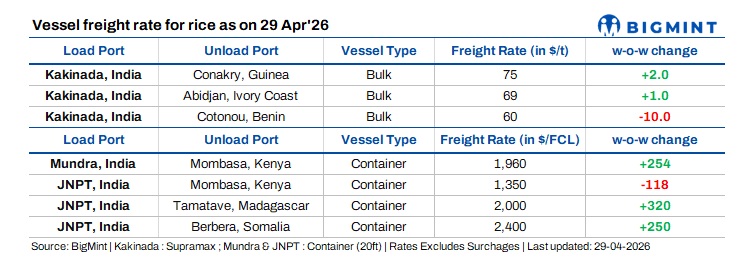
India’s rice export freights showed mixed trends w-o-w on 29 April 2026, with divergent bulk trends and firm container rates, as West African demand held steady while policy uncertainty and disruptions weighed on sentiment.
Market participants indicated that uncertainty linked to trade policies, alongside ongoing logistical disruptions in the Middle East, kept the market fragmented and cautious.
Bulk market mixed as freights Cotonou dip
West African bulk freights were mixed. Rates to Conakry, Guinea and Abidjan, Ivory Coast edged up on steady demand, while Cotonou, Benin fell sharply on import uncertainty, keeping activity cautious.
In Benin, new rules requiring prior government approval and a financial guarantee for rice imports slowed cargo flows, with charterers wary, and the approaching monsoon in Conakry may disrupt operations further.
A shipbroker said, “Rates are going up, but Cotonou is coming down because of the import notice. Now we are just waiting to see when it actually gets implemented or if there is any relaxation. However, May-June is expected to be significantly affected by the monsoon in Conakry.”
“We were mainly doing West African countries so far, but now we are not really sure if we can continue with Benin after the new rules,” another source stated.
Container market: Disruptions, surcharges keep rates elevated
Container freights stayed elevated, though rates showed mixed trends w-o-w, with minor corrections in some lanes were offset by ongoing disruptions, rerouting, and cost pressures.
Rerouting via Aqaba, Jeddah, Khorfakkan, Dekheila, and Fujairah was underway, likely increasing transit time and costs.
A shipbroker stated, “We have paused taking bookings for the Gulf and Far East routes for now, and the Gulf is a bit quiet at the moment.”
Another source told BigMint, “The Middle East market is still tight, which is putting pressure on freight forwarders’ margins. Shipping lines are imposing surcharges frequently and sometimes suddenly, which is pushing overall freight levels higher. Overall, the situation remains quite challenging; rising fuel prices and high fuel-related surcharges are making the market more volatile and commercially tight.”
Rice export activity slows amid volatility
While underlying demand for Indian rice remains present, execution continues to face challenges due to high freight costs, payment uncertainties, and operational disruptions.
The combination of elevated freights, policy uncertainty in key destinations, and ongoing geopolitical tensions is impacting exporters’ confidence and slowing shipment momentum.
A rice trader said, “Right now, we are focusing more on the domestic market due to disruptions in the international market and issues around buyers’ payment policies.”
Outlook
BigMint expects freight markets to remain volatile in the near term. Bulk markets may continue to see route-specific movements, particularly with policy developments in West Africa and weather-related disruptions in play. On the container side, continued Middle East uncertainty, frequent surcharges, and rerouting are likely to keep rates elevated and unpredictable.
With multiple external factors — including geopolitical risks, policy changes, and seasonal disruptions — still unfolding, market participants are expected to remain cautious, with limited visibility on near-term stabilisation.
Leave a Reply