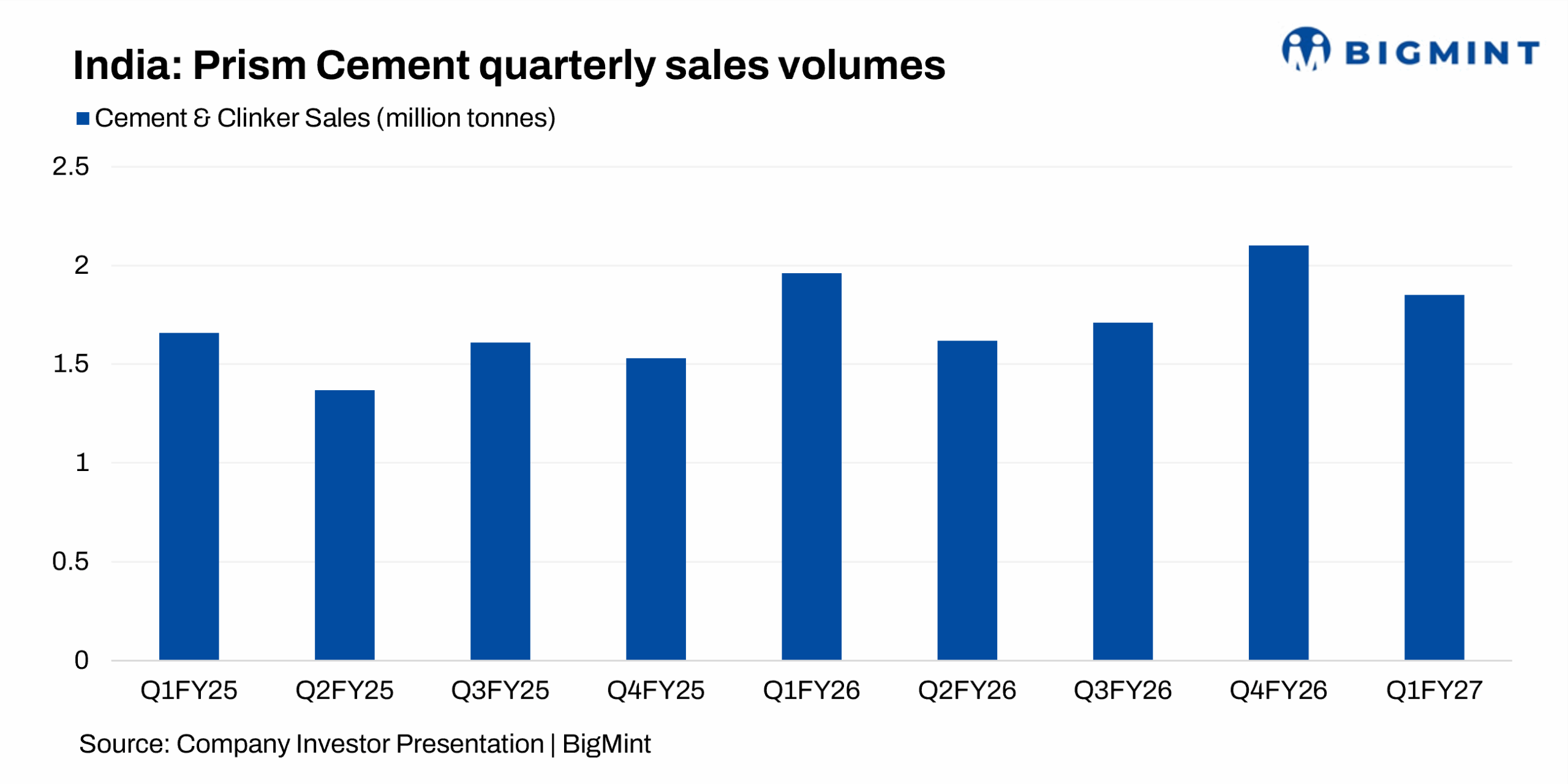
- Cement volumes fall 6% amid softer central India demand
- Premium products account for 67% of quarterly sales
Prism Cement reported divergent operating trends in Q1FY’27 for its cement and ready-mix concrete (RMC) business. Cement sales volumes declined amid softer demand and pricing pressure in central India, while the RMC business delivered strong growth in volumes, revenue, and profitability. Premiumisation and fuel-cost optimisation helped the cement business maintain EBITDA per tonne despite lower sales.
RMC volumes, profitability strengthen
Prism Cement’s Ready Mix Concrete (RMC) business reported revenue of INR 419 crore in Q1FY’27, up 24.9% y-o-y from INR 336 crore in Q1FY’26. Total volumes, including Commercial Concrete and Mega Projects, increased 14.1% to 9 lakh cubic metres from 7.9 lakh cubic metres.
Commercial Concrete volumes rose 11.5% y-o-y, while Mega Projects volumes increased 24.4%, supporting revenue growth. The RMC business reported EBITDA of INR 42.9 crore, compared with INR 17.1 crore in Q1FY’26, while EBITDA margin improved to 10.2% from 5.1%.
Commercial Concrete accounted for 86% of RMC revenue, followed by other segments at 9% and Mega Projects at 5%. The Mega Projects order book stood at around 13.9 lakh cubic metres as of 30 June, providing volume visibility for future execution.
Cement sales decline, but EBITDA/tonne remains stable
The company’s cement and clinker sales declined 6% y-o-y to 1.85 mnt in Q1FY’27 from 1.96 mnt a year earlier, reflecting weaker market conditions in central India.
Despite lower volumes and pressure from higher packaging and other input costs, EBITDA per tonne remained broadly stable at INR 706/t, compared with INR 708/t in Q1FY’26. Marginally better realisations and lower fuel costs helped offset the impact of weaker volumes.
Fuel costs declined to INR 1.61/Mcal from INR 1.68/Mcal. The company reduced its dependence on petcoke while increasing the use of domestic coal and alternative fuels and raw materials. Further upgrades to its alternative fuel and raw material facilities and debottlenecking may provide additional flexibility in managing energy costs.
Premiumisation, logistics efficiency support earnings
Premium products accounted for 67% of cement sales volumes in Q1FY’27, compared with 46% in Q1FY’26. The sharp increase highlights the company’s focus on improving its product mix and supporting realisations in a competitive market.
Average lead distance declined to 344 km from 356 km a year earlier, supporting logistics efficiency. The company operates an installed cement capacity of 5.6 mnt, along with supply agreements for an additional 1.37 mnt of aggregate grinding capacity across four units in Uttar Pradesh and Madhya Pradesh.
Its distribution network comprises around 2,300 effective dealers across Central and Eastern Uttar Pradesh, Madhya Pradesh and Bihar.
Outlook
Cement demand in central India should remain supported by housing and infrastructure, though new capacity may intensify competition and limit pricing. The company’s performance in coming quarters will depend on volume recovery, premiumisation and cost efficiencies. Lower fuel costs and shorter lead distances may support margins, while RMC profitability should benefit from strong order-book visibility, higher utilisation and operating leverage.
Leave a Reply