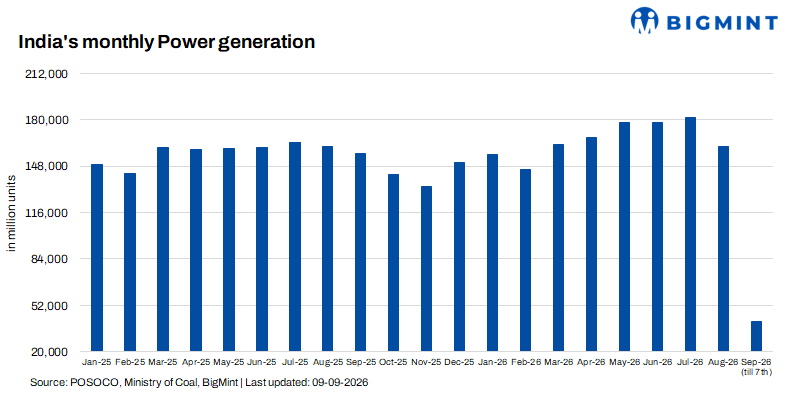
- Peak demand jumps 23% y-o-y; coal supplies about 77% of incremental generation
- TPP coal stocks fall below 27 mnt as govt, CIL, railways accelerate fuel movement
India’s power system entered September under considerably greater strain than a year earlier, with exceptionally strong electricity demand coinciding with weaker hydro generation and rapidly declining coal inventories at thermal power plants.
During 1-7 September 2026, all-India maximum demand met averaged about 251.7 GW, around 23% higher than 204.4 GW during the corresponding period of 2025. Demand repeatedly approached 250-257 GW compared with roughly 199-210 GW during the first week of September last year.
Power demand and generation surge
The generation system responded almost proportionately, with gross generation rising about 21% y-o-y to 41.1 TWh from 34 TWh.

But the changing generation mix is more significant than the headline increase.
Coal carries most of incremental load
Coal-fired generation increased approximately 27% y-o-y to 25.6 TWh, supplying around 5.5 TWh of the 7.1 TWh increase in total generation.
Renewable generation also performed strongly, rising about 24% to 7.5 TWh, but rapid demand growth meant renewables essentially maintained their share of the generation mix.
Hydro moved in the opposite direction.

Hydro generation fell around 8% y-o-y, reducing its share of generation from 17.1% to 12.9%.
The resulting equation is important: renewables generated substantially more electricity, but higher demand absorbed those gains while weaker hydro left coal covering most of the residual requirement.
Coal consequently supplied around 77% of incremental generation.
Higher burn translates directly into stock depletion
The increased thermal dispatch is now visible in CEA power-plant coal inventories.
Stocks declined from 28.64 mnt on 1 September to 26.7 mnt by 6 September, while inventories fell from 49% to 46% of normative requirements. The number of critical plants — those holding less than 25% of normative stock — climbed from 45 to 58.

Across 1-6 September, plants received roughly 12.98 mnt of coal but consumed around 15.43 mnt, leaving receipts approximately 2.45 mnt below burn.
The consequence is straightforward: even rising daily coal deliveries have not yet been sufficient to stop inventory depletion.
Rajasthan illustrates downstream stress
The problem is particularly acute at some non-pithead stations.
Rajasthan’s state generating fleet held only 16% of normative coal inventory by 6 September, with all seven monitored plants classified critical. Several plants were carrying stocks equivalent to only 12-22% of normative requirements, and CEA repeatedly instructed NCL, SECL and captive suppliers to augment deliveries.
Similar CEA remarks elsewhere identify railway supply, unloading constraints and liquidation of coal lying at ports, indicating that the stress is increasingly one of coal location and evacuation rather than national coal availability.
Govt response accelerates
The response from the government, Coal India, and Railways has become increasingly aggressive.
CIL production, which averaged only about 1.36 mnt/day during 1-3 September amid rain-affected operations, recovered as rainfall eased. By 6 September, production reached about 1.83 mnt/day, while power-sector dispatch increased to around 1.70 mnt/day.
Railways simultaneously increased power-sector coal loading from 370 rakes/day on 3 September to 444 rakes/day on 6 September, a 20% increase. MCL alone reached 111 rakes/day, while CIL siding loading rose to 305 rakes/day.
CIL has also allowed FSA-linked generators to lift additional coal by road, including quantities above contracted levels, supplementing rail movement where practical.
This is occurring despite CIL still holding around 76 mnt at pitheads and having supplied 322.9 mnt during April-August, up 6.7% y-o-y.
IEX confirms a tighter power market
The power exchange is providing an independent signal of tightness.
During 1-7 September, IEX Day-Ahead Market purchase bids reached 5.89 million MWh, while sell bids were only 1.97 million MWh. Despite the surge in buying interest, cleared volume fell about 17% y-o-y, while average DAM prices more than doubled to roughly INR 5.17/kWh. Several hourly blocks reached the INR 10/kWh ceiling.
Outlook
The immediate test is now whether recovering mine output, accelerated rail loading, and road and port evacuation can push coal receipts consistently above consumption.
If demand remains elevated and hydro stays weak, coal burn will remain high. Until receipts exceed burn, increased dispatches may merely slow the depletion of plant inventories rather than rebuild them.
September is therefore becoming a test not simply of India’s coal availability, but of the resilience of its entire mine-to-rail-to-power-plant supply chain.
Leave a Reply