- Coal inventories at power plants shrink but domestic supply remains robust
- IEX prices fall during daytime amid abundant solar output, evening sees spike
India’s electricity market entered August 2026 under markedly different conditions from a typical monsoon season. Rather than easing after the summer peak, electricity demand has remained resilient, forcing coal-fired generation to stay elevated despite record renewable output. At the same time, weaker hydroelectric generation has limited the seasonal relief normally provided by the monsoon, increasing dependence on dispatchable thermal power.
The power system has so far absorbed this demand successfully. Renewable generation continues to expand rapidly, domestic coal production and dispatch remain robust, and electricity markets are functioning efficiently. Yet beneath these positive indicators, coal inventories at thermal power plants continue to decline as consumption outpaces replenishment.
The emerging challenge is therefore not one of coal availability, but of maintaining adequate inventories at individual generating stations while sustaining elevated thermal generation through the remainder of the monsoon.
Electricity demand remains resilient through the monsoon
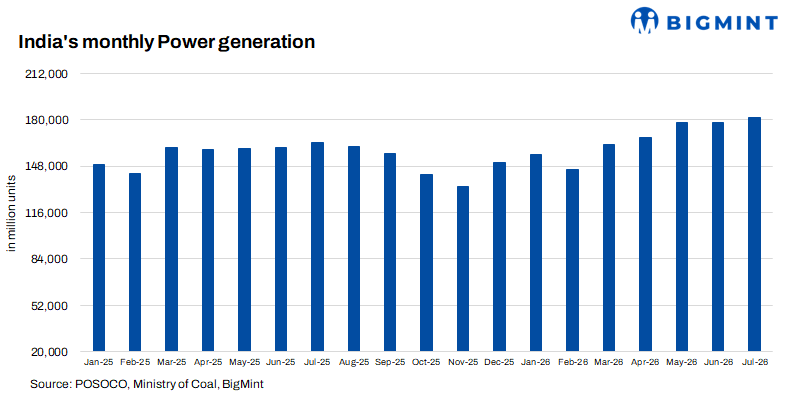
July marked a step-change in India’s electricity market. Maximum demand met reached 270.2 GW, while total electricity generation increased 10.6% year on year to 181.8 BU, reflecting continued economic activity and sustained cooling demand. Unlike a normal monsoon, electricity consumption did not moderate materially despite widespread rainfall across much of the country.
The trend has continued into August.
During the first nine days of August, India generated 51 BU of electricity, compared with 48.4 BU during the corresponding period of 2025, an increase of 5.4%. Growth remained broad-based, although the contribution from individual generation sources differed significantly.

The figures illustrate an increasingly diversified power system. Renewable generation continues to record the fastest growth, yet coal generation has also increased because overall electricity demand has remained strong while hydro output has weakened.
Weak hydro increases dependence on thermal generation
The defining feature of the 2026 monsoon has been the performance of hydro generation.
During July, hydroelectric output fell 22% y-o-y, while coal-fired generation increased 12.9% and renewable generation rose 30.2%. The same pattern persisted into early August, with hydro generation declining by almost one-fifth from the corresponding period last year.
This is an important structural development.
Under normal monsoon conditions, stronger reservoir inflows allow hydro stations to displace part of the thermal generation fleet. This year, however, hydro has provided considerably less support, leaving coal-fired generation to meet both underlying demand growth and part of the generation shortfall.
Rather than replacing coal, renewable energy has therefore complemented it. Solar and wind have supplied a growing share of daytime electricity, while thermal power stations have continued to provide the dispatchable generation needed to maintain system reliability.
IEX trading highlights changing electricity market
Activity on the Indian Energy Exchange (IEX) reflects these evolving market dynamics.
During the first nine days of August, demand for exchange-traded electricity remained substantially higher than a year earlier. Purchase bids increased 37.3% y-o-y to 2.79 million MWh, while sell bids rose 21.9% to 3.35 million MWh. Final scheduled volumes consequently increased 20.9%, indicating significantly higher participation in the short-term power market.

At first glance, the decline in average market clearing prices appears inconsistent with stronger electricity demand. The hourly trading data, however, reveal a more nuanced picture.
During daylight hours, abundant solar generation frequently pushed market clearing prices to exceptionally low levels, in several instances below INR 100/MWh and occasionally close to zero. Once solar generation declined after sunset, prices strengthened sharply as demand shifted towards dispatchable generation. Several evening trading sessions during the opening week of August cleared above INR 5,000/MWh, while some time blocks reached the exchange price cap of INR 10,000/MWh.
The hourly market behaviour suggests that India’s electricity market is becoming increasingly characterised by periods of abundant daytime renewable generation followed by tight evening supply conditions. The challenge is therefore shifting from securing sufficient energy to ensuring adequate system flexibility, with coal-fired generation playing an increasingly important balancing role alongside rapidly expanding renewable capacity.
Coal inventories continue to decline despite robust domestic supply
Perhaps the clearest indication of the pressure on India’s power system is the continued drawdown in coal inventories at thermal power plants.
Although Coal India has maintained healthy production and dispatch levels, coal consumption has continued to exceed receipts at many generating stations. Consequently, inventories have steadily declined throughout the monsoon despite the broader coal supply chain remaining well supplied.
According to the Central Electricity Authority (CEA), thermal power plant coal stocks declined steadily from 44.11 mnt on 30 June 2026 to 38.01 mnt by 31 July, marking a 6.1 mnt monthly reduction. The drawdown continued into August, with stocks falling by a further 1.18 mnt to 36.83 mnt as of 9 August. The sustained decline indicates higher coal consumption amid robust power demand and/or constrained domestic coal availability, highlighting the need for replenishment ahead of the post-monsoon demand and restocking period.
Power plant inventories declined by 6.1 mnt during July, followed by a further 1.2 mnt during the first nine days of August. While the pace of drawdown has moderated, inventories continue to trend lower.
Importantly, this should not be interpreted as a shortage of coal within the national supply system.
Coal India entered FY’27 with historically high pithead inventories and has deliberately prioritised dispatch over production to monetise these stocks. The broader supply chain therefore continues to hold comfortable inventories. The challenge lies in maintaining adequate stocks at the power plant, where coal is being consumed faster than it is being replenished.
Inventory pressure remains highly uneven
National inventory figures also conceal significant regional differences.
Several pithead generating stations continue to hold comfortable inventories because of their proximity to mines. By contrast, many inland plants that depend on long-distance railway movement are operating with considerably thinner stock buffers.
As of 9 August, coal inventories at several state-owned power utilities remained significantly below their respective normative stock levels, indicating continued supply and replenishment pressure. APGENCO held stocks equivalent to only 19% of normative levels, followed by MPPGCL at 34%, Rajasthan State Gencos at 36%, and UPRVUNL at 44%.
By comparison, a number of pithead stations and plants located in the eastern coal-producing states continued to maintain relatively comfortable inventories.
This divergence demonstrates that India’s challenge is increasingly one of coal logistics rather than coal availability. The CEA continues to identify rake availability, unloading constraints, railway programming and coal allocation as the principal reasons for low inventories at individual stations rather than insufficient domestic production.
Domestic coal continues to underpin the power sector
Despite declining inventories, the domestic coal supply chain continues to perform well.
Coal India has maintained strong dispatches throughout FY’27, while imported thermal coal remains relatively uncompetitive against domestic supplies. Consequently, thermal generators have relied overwhelmingly on domestic linkage coal to meet the higher coal burn associated with the weak monsoon.
This highlights an important structural feature of India’s power sector.
As renewable capacity continues expanding, coal is increasingly providing reliability rather than simply energy. During periods of weaker hydro generation or declining solar output, thermal stations remain the principal source of dispatchable generation capable of balancing the grid.
The combination of robust domestic production, efficient railway logistics and adequate pithead inventories has so far enabled the system to absorb higher demand without significant disruption.
Where could coal stocks finish the monsoon?
The key question for the market is whether inventories continue declining through August and September. The answer will depend on four factors:
– Electricity demand during the remainder of the monsoon.
– Recovery in hydro generation if rainfall improves.
– Coal receipts supported by mining and railway logistics.
– The pace at which thermal stations continue consuming coal.
The July drawdown represented an unusually rapid depletion of inventories. Early August suggests that the pace has moderated but has not stopped.
BigMint therefore considers the following scenarios to be the most realistic. By end-September 2026, thermal power plant coal stocks are projected to remain under pressure, with estimated inventories ranging from 24-32 mnt depending on demand and hydropower availability. If hydropower generation improves and electricity demand moderates, stocks could recover to around 30-32 mnt. Under a continuation of current trends, inventories may decline to 26-30 mnt, while a scenario of strong power demand combined with weak hydropower generation could push stocks down further to 24-26 mnt, increasing the need for sustained coal replenishment.
These should be viewed as analytical scenarios rather than fixed forecasts. Even the lower end of the range would not necessarily imply a national coal shortage, but it would leave considerably less operational flexibility within the power system.

Leave a Reply