- Need-based buying persists despite improvement in sponge iron prices
- Inventories at ports remain largely stable
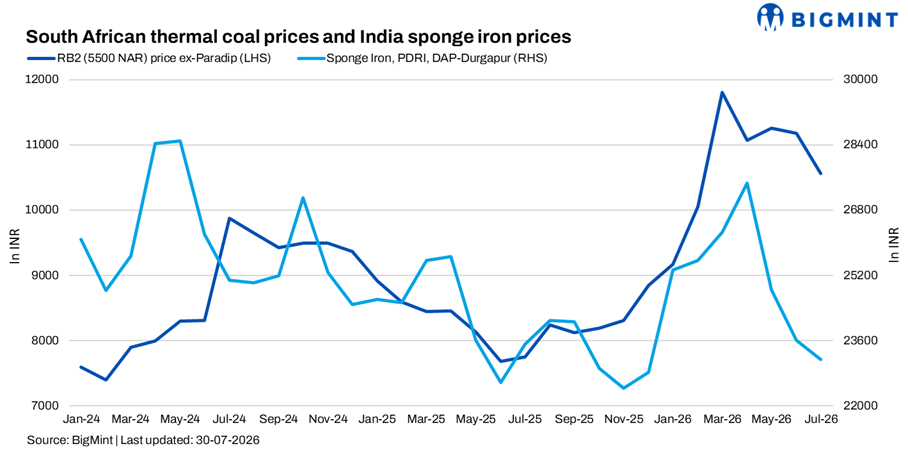
South African thermal coal prices at Indian ports increased further as on 30 July after firmer international indices and higher freight rates pushed replacement costs higher. However, buying interest remained subdued, with most consumers restricting purchases to immediate requirements despite an improvement in sponge iron prices. Market participants said higher offers failed to gain wider acceptance as buyers continued relying on competitively priced domestic coal and existing inventories.
As per BigMint’s assessment, RB2 (5,500 NAR) ex-Paradip increased by INR 450/t w-o-w to INR 11,000/t, while RB3 (4,800 NAR) rose INR 200/t to INR 9,100/t. At Vizag, RB2 climbed INR 200/t to INR 10,600/t, while RB3 increased INR 250/t to INR 9,050/t.
India’s thermal coal inventories at major ports remained largely stable, easing marginally to 14.21 mnt from 14.25 mnt a week earlier. Inventory drawdowns at Kandla, Dhamra, Hazira and Vizag were largely offset by replenishment at Mundra, Navlakhi, Tuticorin and Mangalore, indicating import arrivals remained broadly balanced with cargo evacuations.
Higher replacement costs lift offers, but buying remains muted
Market participants said higher FOB prices and rising freight costs continued to increase replacement costs for imported cargoes. FOB offers for 5,500 NAR coal were heard around $88-89/t, while CFR India offers increased to around $109-110/t. Buyers, however, remained well below these levels, with many delaying fresh purchases in anticipation of softer international prices. BigMint’s assessment for Panamax vessel freight rate from RBCT to Paradip has increased $1.4 w-o-w to $20.5/dmt as on 28 Jul’26.
Market activity in the export market remained selective. Two cargoes of South African 5,500 NAR thermal coal for second-half August loading were heard concluded at $88/t FOB and $89/t FOB RBCT, while another Supramax cargo of South African mid-CV coal for mid-August shipment was reportedly sold at around $81/t FOB Maputo (equivalent to a 5,500 NAR basis). Market participants said suppliers have largely moved on to offering September-loading cargoes at around $89/t FOB, although fresh buying interest has remained limited, with no significant bids reported.
Participants noted that higher portside offers were largely index-driven rather than demand-led. Although offers at several ports moved into the INR 11,000-11,500/t range for RB2, market acceptance remained limited, with only isolated requirement-based transactions reported. Several traders indicated that recent corrections in international benchmarks could gradually pull Indian portside offers back towards last week’s levels.
At the portside market, RB2 offers were heard around INR 10,800-11,000/t at Mangalore, INR 11,400-11,500/t at Gangavaram and Dhamra, while eastern ports largely quoted INR 10,500-10,600/t. RB3 offers were reported around INR 9,000-9,200/t at Mangalore and Vizag and INR 9,450-9,500/t at eastern ports. Market participants said enquiries remained scarce, with most consumers adequately covered for the next few months.
Domestic coal remains the preferred choice
Domestic coal continued to provide a significant cost advantage over imports. BigMint assessed 5,000 GCV coal at INR 5,700/t ex-works Bilaspur, up INR 150/t w-o-w, while 4,500 GCV coal increased INR 50/t to INR 4,300/t. Meanwhile, 38% FC (5,000 GCV) washed coal FOR Raipur rose another INR 200/t to INR 6,750/t, supported by tight availability of preferred ROM coal, weak SECL dispatches and higher production costs, including logistics, electricity and maintenance expenses. Strong competition for quality ROM coal in SECL spot e-auctions further constrained washery feedstock availability, keeping washed coal prices firm.
The sponge iron market showed mixed trends. PDRI DAP Durgapur increased INR 500/t w-o-w to INR 23,300/t, while southern markets strengthened on tighter merchant availability and reduced kiln operations. Nevertheless, procurement across most regions remained limited to immediate requirements as weak finished steel demand continued to pressure producer margins. Market participants said higher raw material costs were not being fully passed on, keeping imported thermal coal consumption subdued despite the modest recovery in sponge iron prices.
Outlook
Market participants expect buying interest in imported South African coal to remain largely requirement-based unless international prices soften meaningfully. While higher freight rates and firm FOB indices continue to support replacement costs, domestic coal remains substantially more competitive, limiting the willingness of Indian consumers to accept higher import offers. Any further correction in international benchmarks could narrow the bid-offer gap and bring Indian portside prices closer to prevailing transaction levels.
Leave a Reply