- Global offers rise on higher benchmark prices, geopolitical tensions
- Buyers continue to prefer domestic coal amid subdued steel demand
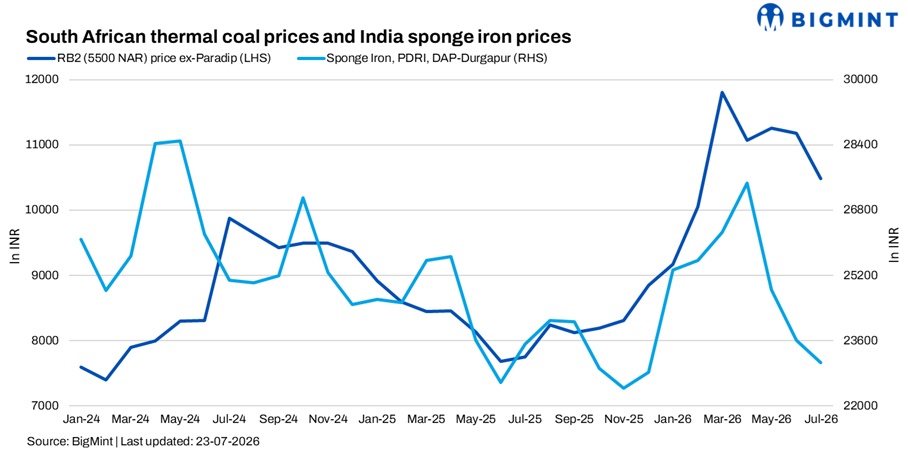
South African thermal coal prices at Indian ports edged up during the week ended 23 July as firmer international prices and higher replacement costs prompted traders to raise offers. However, market activity remained largely subdued, with negligible enquiries and no significant fresh bookings as consumers continued favouring domestic coal amid weak sponge iron and steel demand.
As per BigMint’s assessment, RB2 (5,500 NAR) ex-Paradip increased by INR 100/t w-o-w to INR 10,550/t, while RB3 (4,800 NAR) remained unchanged at INR 8,900/t. At Vizag, RB2 rose by INR 50/t to INR 10,400/t, whereas RB3 declined by INR 50/t to INR 8,800/t.
India’s thermal coal inventories at major ports increased marginally by 1% w-o-w to 14.25 mnt from 14.15 mnt, mainly due to higher stocks at Mundra and modest inventory additions at Hazira, Vizag, Mangalore, Karaikal, and Dahej. The inventory build-up indicates that import arrivals remained broadly balanced with cargo evacuations, while consumers continued restricting imports to immediate operational requirements.
Higher global offers widen bid-offer gap
Market participants reported that enquiries remained virtually absent during the week as buyers relied on domestic coal inventories and delayed fresh import commitments. Global offers strengthened following geopolitical tensions, lifting replacement costs for imported cargoes. However, Indian buyers remained unwilling to match higher offer levels due to weak downstream steel demand.
FOB offers for 5,500 NAR coal were heard around $88-90/t, while the lowest CFR India offers were around $105-106/t. Buyers, however, were bidding closer to $99-101/t CFR, resulting in a wide bid-offer spread and limited deal activity. Market participants indicated that imported coal demand is unlikely to recover unless international prices correct significantly.
Reflecting stronger demand from alternative markets, an exporter concluded two 5,500 NAR cargoes to Pakistan during the week at prevailing index-linked prices, underscoring the shift in South African coal flows away from India, where buying interest remains subdued.
At the portside market, RB2 offers were heard around INR 11,400/t at Krishnapatnam, INR 10,800/t at Ennore, and INR 10,800-11,000/t at Mangalore. RB3 offers were reported at INR 9,600/t, INR 9,000/t and INR 9,000-9,350/t, respectively. At Paradip, RB2 offers were heard around INR 10,750/t, while freshly discharged 5,500 NAR cargoes at Vizag were available near INR 10,350/t ex-port. One trade for RB3F fines (48% FC) was concluded at INR 7,550/t ex-Vizag, while participants also reported active bid-offer negotiations at Mangalore without any major transactions.
Market participants further noted that South African coal exports are increasingly being directed towards Pakistan, Europe, Sri Lanka, and Southeast Asia, while India’s share has declined sharply because of poor demand. Several traders also highlighted that no fresh South African cargoes have arrived at Vizag over the past two months, with trading activity largely confined to requirement-based purchases at southern ports.
Domestic coal, washed coal remain preferred
Domestic coal continued to offer a significant pricing advantage over imports. BigMint assessed 5,000 GCV coal at INR 5,550/t exw Bilaspur, up INR 50/t w-o-w, while 4,500 GCV coal increased by INR 200/t to INR 4,250/t.
Meanwhile, 38% FC washed coal (5,000 GCV) FOR Raipur rose by INR 200/t w-o-w to INR 6,550/t, supported by tight ROM coal availability and lower mine dispatches during the monsoon, which continued to constrain washery production.
The sponge iron market remained cautious despite a modest improvement in central India, where higher pellet costs supported offers. Buyers across regions largely restricted purchases to immediate requirements amid weak finished steel demand, while several producers continued operating cautiously due to margin pressure. The subdued sponge iron market continued to weigh on imported thermal coal consumption.
Outlook
Market participants expect imported South African coal demand to remain subdued over the next few months unless steel demand and sponge iron margins improve. Although geopolitical developments and higher replacement costs are supporting international offers, Indian consumers are expected to continue preferring domestic coal because of its price competitiveness and reliable availability. Until the gap between international offers and buyer expectations narrows, import activity is likely to remain limited and largely requirement-based.
Leave a Reply