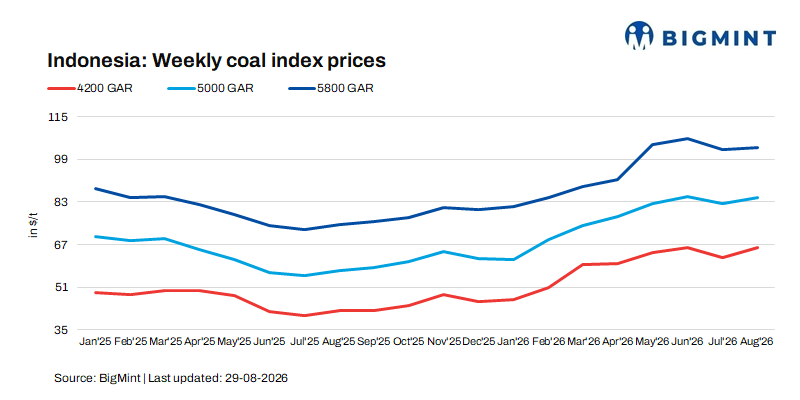
- FOB prices firm on supply constraints, stronger Chinese buying
- Around 47 power plants report critically low inventory levels
Indian portside prices of Indonesian thermal coal recorded a broad-based increase during the week ended 28 August 2026, driven by tightening availability from Indonesia, increased diversion of cargoes towards China, and a revival in market activity. Buying interest also improved, while elevated domestic coal supply constraints and stronger sponge iron prices supported enquiries from industrial consumers.
Sharp gains across key Indonesian grades
Premium 5,000 GAR coal prices rose sharply by INR 300/t w-o-w to around INR 10,800/t at Kandla and INR 10,700/t at Vizag. Meanwhile, 4,200 GAR coal increased by INR 150/t w-o-w to approximately INR 8,900/t at Kandla and INR 8,800/t at Vizag. At Navlakhi, 3,400 GAR coal advanced by INR 200/t w-o-w to around INR 7,150/t. The gains indicate a firmer pricing environment, particularly for mid-CV material, amid reduced spot availability and renewed buying interest.
Chinese buying diverts cargoes, tightening regional availability
Market activity has strengthened as Chinese buyers have absorbed a larger share of Indonesian cargoes. A market participant noted that most cargoes have reportedly been diverted towards China over the past 10-15 days, while supply constraints in Indonesia have further tightened availability. Rising requirements for mid-GAR material, combined with resumed market activity and stronger demand, have consequently provided significant upward momentum to Indian portside prices.
Indonesia’s new export framework to keep direct trade unaffected
Indonesia’s newly established state export-oversight body, PT Danantara Sumberdaya Indonesia (DSI), is not expected to disrupt existing coal trade relationships in the near term. Danantara CEO Rosan Roeslani indicated that exporters would continue to be permitted to sell directly to overseas buyers, with DSI respecting existing contractual and long-term commercial arrangements. This provides some near-term clarity to the market, although the evolving export framework remains a factor to monitor for its potential impact on future cargo availability and trading arrangements.
Port inventories rise marginally despite selective buying
Indian thermal coal inventories at major ports increased 1.4% w-o-w to 13.67 mnt in Week 34, from 13.48 mnt in Week 33. Higher inventories at Mundra, Navlakhi, Tuna and Karaikal more than offset declines at Magdalla, Mangalore and Vizag. However, the modest inventory build does not indicate a broad-based recovery in import demand, with buyers continuing to adopt a largely requirement-driven approach amid high delivered import costs. Monsoon-related disruptions to domestic coal dispatches, tighter availability of preferred grades and stronger sponge iron prices have nevertheless sustained enquiries for imported coal.
Power plant stocks signal persistent supply pressure
Coal stocks at Indian thermal power plants declined by around 9% w-o-w to 30.3 mnt as of 27 August, equivalent to only around 10 days of consumption. Approximately 47 power plants reported critical inventory levels, highlighting continued pressure on domestic coal availability and distribution. Uneven coal supplies and localised logistics constraints could encourage utilities facing shortages to selectively replenish imported thermal coal, particularly where domestic supplies of suitable grades remain constrained.
Global Indonesian benchmarks edge higher
Indonesian thermal coal FOB benchmarks also strengthened during the week, reflecting the tighter supply-demand balance. International prices increased by approximately $1-2/t for 5,800 GAR, $2-3/t for 4,200 GAR, and $0.5-1/t for 3,400 GAR coal. The relatively stronger movement in the 4,200 GAR segment is consistent with improving demand for mid-CV material and reduced spot availability.
Outlook
The near-term outlook for Indonesian thermal coal prices remains firm, with a moderate upside bias. Continued Chinese buying, potential diversion of Indonesian cargoes away from India, supply-side constraints in Indonesia, and critically low power-sector inventories are expected to provide support to prices. Demand for mid-GAR coal is likely to remain particularly strong as buyers seek alternatives amid domestic supply and logistics constraints.
However, high import costs, adequate port inventories and requirement-based purchasing could limit the pace of further price increases. Overall, prices are expected to remain elevated in the near term, with the direction largely dependent on the sustainability of Chinese procurement, Indonesian supply availability and the pace of replenishment by Indian power and industrial consumers.
Leave a Reply