- Weak demand, ample domestic supply keep portside prices largely stable
- Indonesia’s export reforms, potential Chinese demand may lift seaborne prices
Indian portside prices of Indonesian-origin thermal coal exhibited mixed trends during the week ended 24 July 2026, as weak domestic buying interest and comfortable domestic coal availability continued to weigh on import demand.
Most industrial consumers remained adequately covered through domestic supplies, limiting fresh import enquiries despite stable seaborne prices. Market activity was largely procurement-driven rather than speculative, with buyers continuing to purchase only against immediate consumption requirements.
Demand shift towards mid-, low-GAR coal shapes price movement
Price trends diverged across coal grades, reflecting changing consumption patterns across end-user industries.
Premium 5,000 GAR Indonesian coal prices remained unchanged w-o-w at around INR 10,500/t at Kandla and INR 10,400/t at Vizag, as subdued demand from industrial users offset stable supply conditions. Similarly, 4,200 GAR coal prices held steady at nearly INR 8,700/t at Kandla and INR 8,600/t at Vizag, supported by balanced market fundamentals.
In contrast, 3,400 GAR Indonesian coal gained around INR 100/t w-o-w to nearly INR 7,100/t at Navlakhi. The increase was primarily driven by limited domestic lignite availability under existing allocation quotas and steady procurement from ceramic manufacturers, who continued to favour lower-calorific-value imported coal as a cost-effective fuel alternative.
A market participant noted, “Demand for premium grades remained limited as consumers increasingly shifted towards mid-GAR coal to optimise fuel costs.” While sellers holding dry cargoes continued to realise firm prices, broader market demand remained weak. The participant also indicated that any meaningful upside in international prices would largely depend on a revival in Chinese import demand after September; otherwise, the market is expected to remain broadly stable.
Indonesia maintains strong production pace
Indonesia produced 367.06 million tonnes (mnt) of coal during H1CY’26, achieving 61.2% of its annual 600 mnt production target, according to the Ministry of Energy and Mineral Resources (ESDM). Of the total output, 81.58 mnt was allocated to meet Domestic Market Obligation (DMO) requirements, while around 231 mnt was exported. The robust production performance continues to support ample export availability despite ongoing policy reforms.
Earlier rollout of single-gate export mechanism could reshape trade flows
President Prabowo Subianto has confirmed that the country’s single-gate coal export mechanism will be fully implemented from 1 September 2026, significantly earlier than previously anticipated. Under the revised framework, state-owned PT Danantara Sumberdaya Indonesia (DSI) will serve as the exclusive export intermediary for coal, crude palm oil, and ferro-alloys.
The accelerated implementation is expected to improve pricing transparency and strengthen government oversight over export proceeds. However, market participants remain cautious, as the transition could temporarily influence cargo allocation, contractual negotiations, and export logistics during the initial implementation period.
Freight costs rise on geopolitical concerns
Ocean freights strengthened during the assessment week, with Supramax freights on the East Kalimantan-Navlakhi route increasing by approximately $2.4/t w-o-w to around $22.3/t. The increase reflected renewed geopolitical uncertainties and firmer vessel demand, raising delivered import costs despite largely stable FOB coal prices.
Port inventories continue to build gradually
India’s thermal coal inventories at major ports edged up 1% w-o-w to 14.25 mnt during the week ended 19 July, compared with 14.15 mnt a week earlier. The increase was primarily supported by higher stock accumulation at Mundra, alongside modest inventory additions at Hazira, Vizag, Mangalore, Karaikal, and Dahej, which outweighed inventory declines at several other ports.
The gradual inventory build-up indicates that import arrivals remained broadly aligned with cargo evacuations, while buyers continued to lift material selectively amid comfortable domestic coal supplies and cautious purchasing behaviour.
Power plants remain comfortably stocked despite w-o-w drawdown
Coal inventories at Indian thermal power plants declined by around 5.4% w-o-w to 39.72 mnt as of 23 July 2026, equivalent to approximately 13 days of consumption. Although inventories moderated during the week, stock levels remained sufficient to meet power sector requirements, reducing the urgency for additional imported coal purchases.
Nevertheless, around 28 thermal power plants continued to report critical inventory levels, highlighting regional logistics and distribution bottlenecks rather than any systemic shortage of domestic coal.
Global thermal coal prices ease further
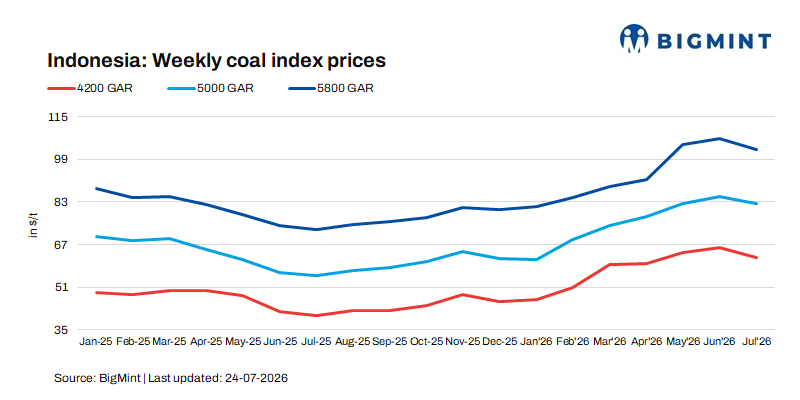
International thermal coal prices softened during the assessment week amid subdued buying interest across major importing markets. Indonesian benchmark prices of 5,800 GAR and 4,200 GAR declined marginally by around $0.1-0.5/t, while 3,400 GAR prices fell by approximately $0.5-1/t w-o-w. The continued weakness reflects ample export availability, comfortable inventories across key consuming regions, and the absence of any significant demand recovery.
Outlook
India’s imported thermal coal market is expected to remain stable, supported by ample domestic coal availability and comfortable inventories. While Indonesia’s strong supply should keep exports adequate, higher freight costs and potential Chinese buying may support FOB prices, with limited movement expected in Indian portside prices.

Leave a Reply