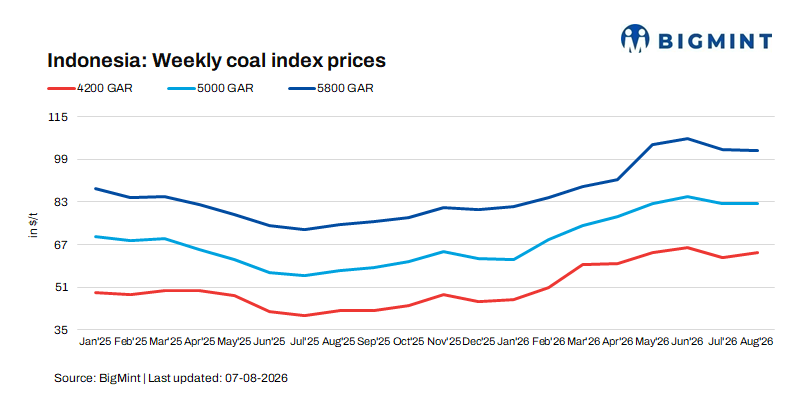
- Indonesia’s tighter supply policy supports global coal prices
- Weak import demand keeps Indian portside prices stable
Indian portside prices of Indonesian thermal coal remained largely stable during the week ended 7 August 2026, as subdued industrial consumption, comfortable domestic coal availability, and cautious procurement strategies continued to suppress fresh import demand.
Buyers largely restricted purchases to immediate operational requirements, while ample Coal India supplies and healthy domestic inventories reduced reliance on imported cargoes despite firmer international benchmark prices.
Premium grades hold firm despite limited buying interest
Portside prices across major Indonesian grades remained broadly unchanged during the week, reflecting a balanced market with limited trading activity. Premium 5,000 GAR coal was assessed at around INR 10,500/t at Kandla and INR 10,400/t at Vizag, while 4,200 GAR coal remained steady at approximately INR 8,700/t and INR 8,600/t, respectively.
Similarly, 3,400 GAR coal held stable near INR 7,000/t at Navlakhi. Market participants noted that “demand for mid and lower calorific-value coal remained relatively resilient in India and China, while higher-CV coal continued to face pressure due to shift in power generation towards natural gas by some countries. At the same time, several traders sought to liquidate inventories ahead of the peak monsoon period, limiting any upward price movement.”
Indonesia’s policy measures provide medium-term supply support
Indonesia’s Ministry of Energy and Mineral Resources (ESDM) continued reviewing 2026 RKAB revisions with a measured approach, prioritizing production quota approvals for miners paying higher royalty rates to maximise government revenue while maintaining market stability.
The government retained its coal production target at around 600 mnt, significantly below last year’s output, while increasing the Domestic Market Obligation (DMO) from 25% to 30% to strengthen domestic energy security. The planned redistribution of production quotas to new entrants may gradually tighten export availability over time, although the policy is primarily aimed at improving industry competitiveness rather than restricting exports.
Lower freight costs improve import economics
Ocean freight rates softened during the week, with Supramax freight on the East Kalimantan-Navlakhi route declining by $2.9/t w-o-w to around $19.5/t. The reduction in freight costs marginally improved import parity; however, lower logistics costs failed to stimulate significant buying interest as domestic coal remained readily available at competitive prices.
Port inventories decline as cargo evacuations outpace fresh arrivals
Thermal coal inventories at major Indian ports declined by 2.46% w-o-w to 13.86 million tonnes from 14.21 mnt. Inventory drawdowns at Karaikal, Vizag, Magdalla, Tuticorin, Hazira and several smaller ports outweighed fresh replenishments at Kandla, Mundra, Dhamra, Navlakhi, Dahej and Paradip. The decline suggests that cargo evacuations marginally exceeded fresh imports, reflecting restrained procurement activity rather than any supply tightness. Strong domestic coal production and uninterrupted Coal India dispatches continued to limit dependence on imported material.
Power plant stocks remain comfortable despite weekly decline
Coal inventories at Indian thermal power plants declined by around 3% w-o-w to 37.24 million tonnes as of 6 August 2026, equivalent to nearly 12 days of consumption. Although stock levels eased, they remained sufficient to meet current power demand comfortably. The 31 power plants reporting critical inventories continued to face localized logistics and coal distribution constraints rather than any structural shortage in domestic coal availability.
Global benchmark prices edge higher
International thermal coal prices strengthened modestly during the week. Indonesian benchmark prices increased by $0.1-0.5/t for 5,800 GAR coal, $1-2/t for 4,200 GAR coal, and $0.1-0.5/t for 3,400 GAR coal, supported by steady Asian demand and Indonesia’s cautious production management. However, these gains have yet to translate into higher Indian portside prices due to muted domestic buying activity.
Outlook
The Indian portside thermal coal market is expected to remain broadly stable in the near term. Comfortable domestic coal supplies, healthy power plant inventories, and subdued industrial demand are likely to keep import requirements limited despite firmer international prices and Indonesia’s tighter production management. While lower freight costs may improve import economics and Indonesian policy measures could provide medium-term support to global prices, any meaningful increase in Indian portside prices will depend on a sustained recovery in industrial coal consumption or a tightening of domestic coal availability.

Leave a Reply