- Pre-festive buying, low power plant stocks may lend support in near term
- Weak spot demand, adequate port inventories may limit upside
Indian portside prices of Indonesian thermal coal softened marginally w-o-w in the week ended 3 October 2026, as industrial consumers remained cautious amid limited immediate needs and adequate availability in the spot market.
Prices of 5,000 GAR coal were stable at around INR 11,800/t at Kandla and INR 11,700/t at Vizag, while 4,200 GAR declined INR 50/t to INR 9,900/t and INR 9,850/t, respectively. Meanwhile, 3,400 GAR coal at Navlakhi fell INR 50/t to around INR 7,900/t. Market participants reported limited trading activity, with offers largely unchanged as buyers continued to adopt a wait-and-watch approach.
Power-sector inventory tightening limits downside
Despite weak spot demand, tightening thermal coal inventories at power plants are providing underlying support to imported coal prices. Domestic thermal power-plant stocks declined around 9% w-o-w to 21.06 mnt as of 1 October, equivalent to only around seven days of consumption, with nearly 85 plants reportedly at critical inventory levels.
The decline is particularly important for imported coal demand, as utilities may need to replenish inventories if domestic availability remains insufficient. However, fresh domestic coal arrivals and efforts to maintain higher plant stocks could limit the immediate urgency for imported coal procurement.
Port inventories remain adequate but composition is changing
Coal stocks at major Indian ports covered by BigMint declined to 18.35 mnt as of 26 September from 18.72 mnt a week earlier. However, the overall decline masks divergent movements across grades. Coking coal inventories fell 12.4% to 5.30 mnt, while non-coking coal stocks increased 3.0% to 13.05 mnt.
The relatively comfortable availability of non-coking coal at ports is limiting immediate replenishment pressure for Indonesian thermal coal, although continued drawdown in power-sector inventories could gradually improve buying interest.
Global benchmarks show selective price movement
Indonesia’s HBA benchmarks remained broadly softer in H1 October, with the 6,322 kcal/kg GAR benchmark declining 0.8% to $122.52/t and 5,300 GAR falling 3.6% to $90.60/t. The 4,100 GAR benchmark, however, increased marginally by 0.4% to $63.45/t, while 3,400 GAR declined 1.5% to $43.84/t. The mixed movement indicates differentiated demand across grades rather than a broad-based collapse in Indonesian coal fundamentals.
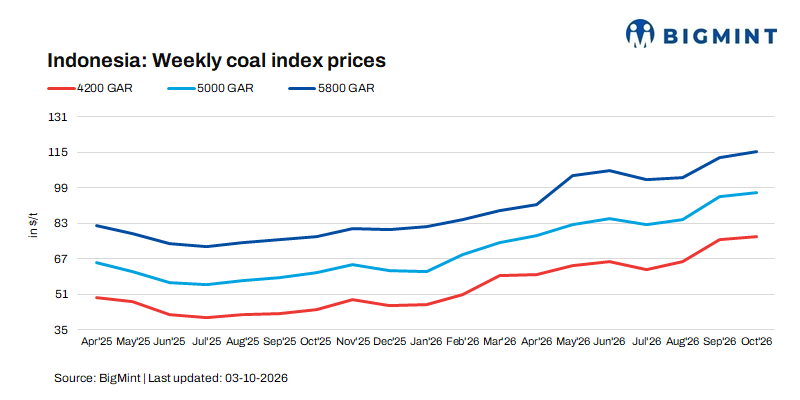
Weekly export indices also showed a mixed trend, with 4,200 GAR FOB prices rising around $0.5-1/t, 3,400 GAR declining $0.5-1/t and 5,800 GAR increasing by around $2-3/t.
Replacement costs and supply expectations remain important
Relatively firm replacement costs are providing a floor to Indian portside prices, reducing sellers’ willingness to make significant downward adjustments despite subdued spot demand. At the same time, expectations of improved regional supply and softer international thermal coal prices are limiting buyers’ willingness to chase higher offers. This balance between replacement economics and weak spot demand is likely to keep price movements measured in the near term.
Pre-festive demand could provide seasonal support
Market participants suggested that market activity is expected to improve gradually as buyers enter the pre-festive procurement cycle. Industrial consumers may increase purchases ahead of the festive period to secure near-term fuel requirements, potentially supporting Indonesian coal demand after the recent period of cautious buying. However, the extent of the recovery will depend on industrial operating rates, inventory positions, and the competitiveness of imported coal against domestic alternatives.
China’s post-holiday activity remains a key market trigger
China’s return to the market following the 1-7 October Golden Week holiday is another important factor for Indonesian coal sentiment. Any increase in Chinese import buying could strengthen regional demand and provide support to Indonesian export prices. Conversely, continued preference for domestic coal, supported by domestic production and availability, could restrict seaborne demand and limit upside in Indonesian benchmarks.
Outlook
Indonesian thermal coal prices are expected to remain largely stable in the near term, with a mild upward bias if demand improves. Weak industrial procurement, adequate non-coking coal availability at ports and softer global benchmarks will continue to restrict significant price gains. However, declining power-plant inventories, critical stock levels at several utilities, firm replacement costs and potential pre-festive restocking could provide downside protection. The key near-term triggers will be the pace of Indian power-sector replenishment, pre-festive industrial buying, Chinese import activity after Golden Week, Indonesian export availability and movements in competing international coal prices.
Leave a Reply