- Falling power plant stocks, firm replacement costs limit downside
- Indian industrial users cautious, suppliers pause sales amid uncertainty
Indian portside prices of Indonesian thermal coal declined w-o-w in the week ended 25 September 2026, as subdued industrial demand and cautious buying weighed on spot-market activity. However, the downside remained limited by declining domestic power-plant inventories and relatively firm replacement costs, keeping the underlying market fundamentals supported.
Indonesian coal prices edge lower amid weak spot demand
Indonesian 5,000 GAR coal prices declined by INR 100/t w-o-w to around INR 11,800/t at Kandla and INR 11,700/t at Vizag. Prices of 4,200 GAR coal also softened by INR 50/t to around INR 9,950/t at Kandla and INR 9,850/t at Vizag. Meanwhile, 3,400 GAR coal at Navlakhi decreased by INR 50/t w-o-w to around INR 7,950/t.
The marginal decline was primarily driven by weak spot demand and cautious purchasing from core industries. Market participants reported limited buying interest, with subdued performance across key industrial consumers restricting fresh procurement. Several suppliers have reportedly kept sales on hold amid uncertainty over near-term demand, resulting in limited spot-market transactions.
Buyers are largely adopting a need-based procurement approach, avoiding aggressive inventory building while monitoring both domestic coal availability and international prices. This has limited the ability of sellers to pass on higher replacement costs to the spot market and contributed to the w-o-w decline in portside prices.
Port stock drawdown provides fundamental support
Despite weak spot-market activity, India’s thermal coal fundamentals remain relatively firm due to continued drawdown in power-sector inventories. Coal stocks at major Indian ports declined 2.05% w-o-w to 18.72 mnt during 13-19 September, from 19.11 mnt in the previous week.
The decline was led by non-coking coal inventories, which fell 3.05% to 12.68 mnt, while coking coal stocks remained broadly stable at around 6.04 mnt. The inventory decline occurred despite substantial fresh cargo arrivals during the week, indicating continued evacuation of imported coal towards power plants and industrial consumers, including cement and steel producers.
Therefore, the fall in port inventories appears to reflect ongoing consumption and evacuation rather than a lack of fresh arrivals, suggesting that imported coal continues to move through the supply chain despite subdued spot-market activity.
Power-plant stocks tighten despite fresh coal arrivals
The more significant fundamental signal is emerging from thermal power-plant inventories. Domestic thermal power-plant coal stocks declined by around 5% w-o-w to 23.4 mnt as of 24 September, equivalent to only around seven days of consumption. Nearly 80 plants were reportedly at critical inventory levels.
The continued drawdown in power-plant inventories is providing support to imported coal replacement costs. While spot buyers remain cautious, tighter domestic coal availability could encourage power consumers to rely more on imported coal, particularly where domestic supplies or logistics remain constrained.
This creates a divergence between weak immediate spot demand and relatively firm underlying replacement economics, limiting the downside potential for Indonesian coal prices.
Global Indonesian benchmarks show mixed trend
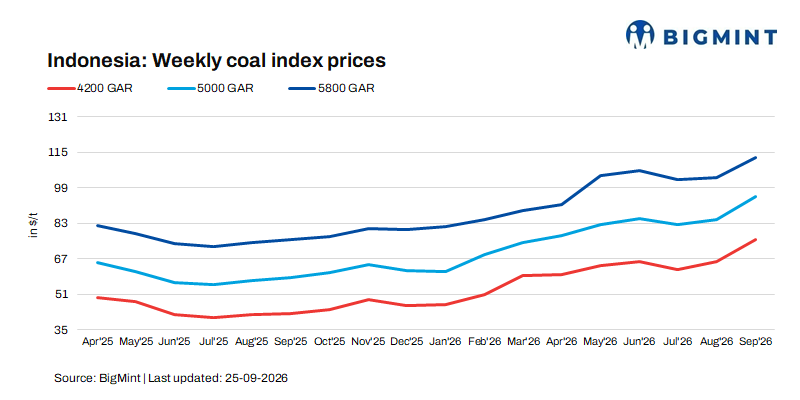
The broader Indonesian market remained mixed during the week. 4,200 GAR FOB prices increased by around $0.1-0.2/t, while 3,400 GAR prices gained around $2-3/t. Meanwhile, 5,800 GAR prices remained broadly stable.
The firmness in lower-CV grades, despite weak Indian spot demand, suggests that supply-side and replacement-cost factors continue to provide underlying support in the Indonesian market. However, the divergence between international benchmarks and Indian portside prices also indicates that Indian buyers remain reluctant to chase higher prices amid subdued industrial consumption.
Outlook
Indian portside prices of Indonesian thermal coal are expected to remain range-bound with a mild downward bias in the near term. Weak industrial demand, cautious spot procurement and sellers’ reluctance to actively transact are likely to keep prices under pressure. However, the downside is expected to remain limited by declining power-plant inventories, critical stock levels at several plants and relatively firm replacement costs.
The market is likely to remain two-sided, with weak spot demand acting as the primary bearish factor, while tighter domestic coal availability and continued power-sector consumption provide a floor. A sustained recovery in industrial demand or further deterioration in domestic power-plant stocks could strengthen buying interest and support prices, whereas continued weak core-sector activity and improved domestic coal availability could result in further price erosion.
Leave a Reply