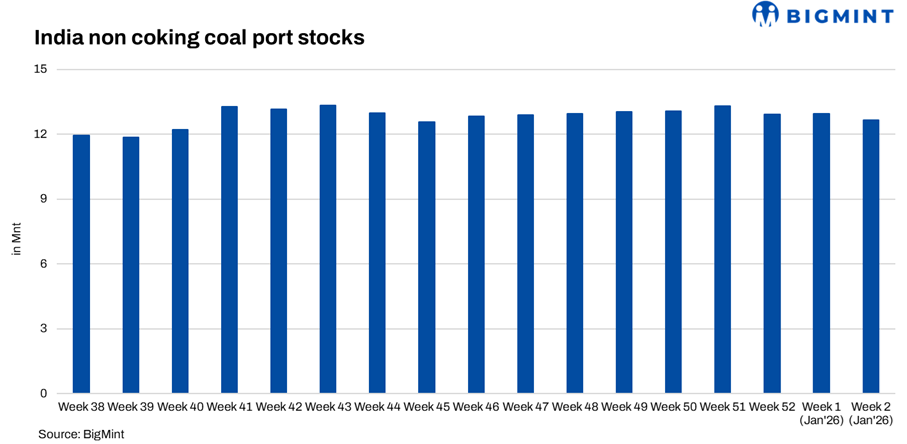
- Post-holiday evacuation drove broad stock drawdown
- Paradip and Kandla led weekly inventory declines
India’s portside thermal coal inventories declined 2.3% w-o-w to 12.65 mnt in week 2 of 2026 from 12.95 mnt in week 1, as evacuation activity picked up after the holiday period. While arrivals remained uneven across ports, faster dispatches at several large locations led to a net drawdown in stocks, reversing the stability seen during the year-end slowdown.
East coast: sharp drawdown led by Paradip
On the east coast, stock movements turned decisively weaker. Paradip recorded a sharp decline of 17.8% w-o-w, with inventories falling to 1.46 mnt from 1.77 mnt, reflecting higher evacuation as industrial and power-sector lifting resumed. Dhamra also saw stocks ease by 2.3% to 1.21 mnt, indicating steady outflows with limited fresh arrivals during the week.

West coast: mundra builds, kandla corrects
West coast trends remained mixed. Mundra posted an 8.1% w-o-w build to 0.99 mnt, supported by selective arrivals and slower evacuation. In contrast, Kandla saw a notable drawdown of 14.1%, with stocks declining to 0.46 mnt, as dispatches outpaced inflows following earlier accumulation.
Company-wise: mixed inventory movement
At the company level, Adani Enterprises’ portside coal inventories were largely unchanged at 3.37 mnt, indicating balanced arrivals and evacuation during the week. Agarwal Coal recorded a 2.3% w-o-w increase in stocks to 1.12 mnt, suggesting relatively slower dispatches compared with arrivals.
Broader port trends
Beyond the major ports, inventories showed divergent movements. Navlakhi, Dahej, Vizag, and Magdalla recorded moderate stock builds, while ports such as Gangavaram, Jamnagar, Tuna, and Goa saw sharper drawdowns. The dispersion highlighted port-specific evacuation dynamics rather than a uniform national trend.
Outlook
Portside inventories are likely to remain volatile in the near term. As post-holiday evacuation normalises and arrivals remain uneven, stock movements are expected to be driven more by dispatch patterns than aggressive restocking. A clearer directional trend may emerge once sustained buying from power and industrial consumers resumes.
Leave a Reply