- Initial polymer requirement estimated at around 29 t
- Wider rollout could unlock recurring demand
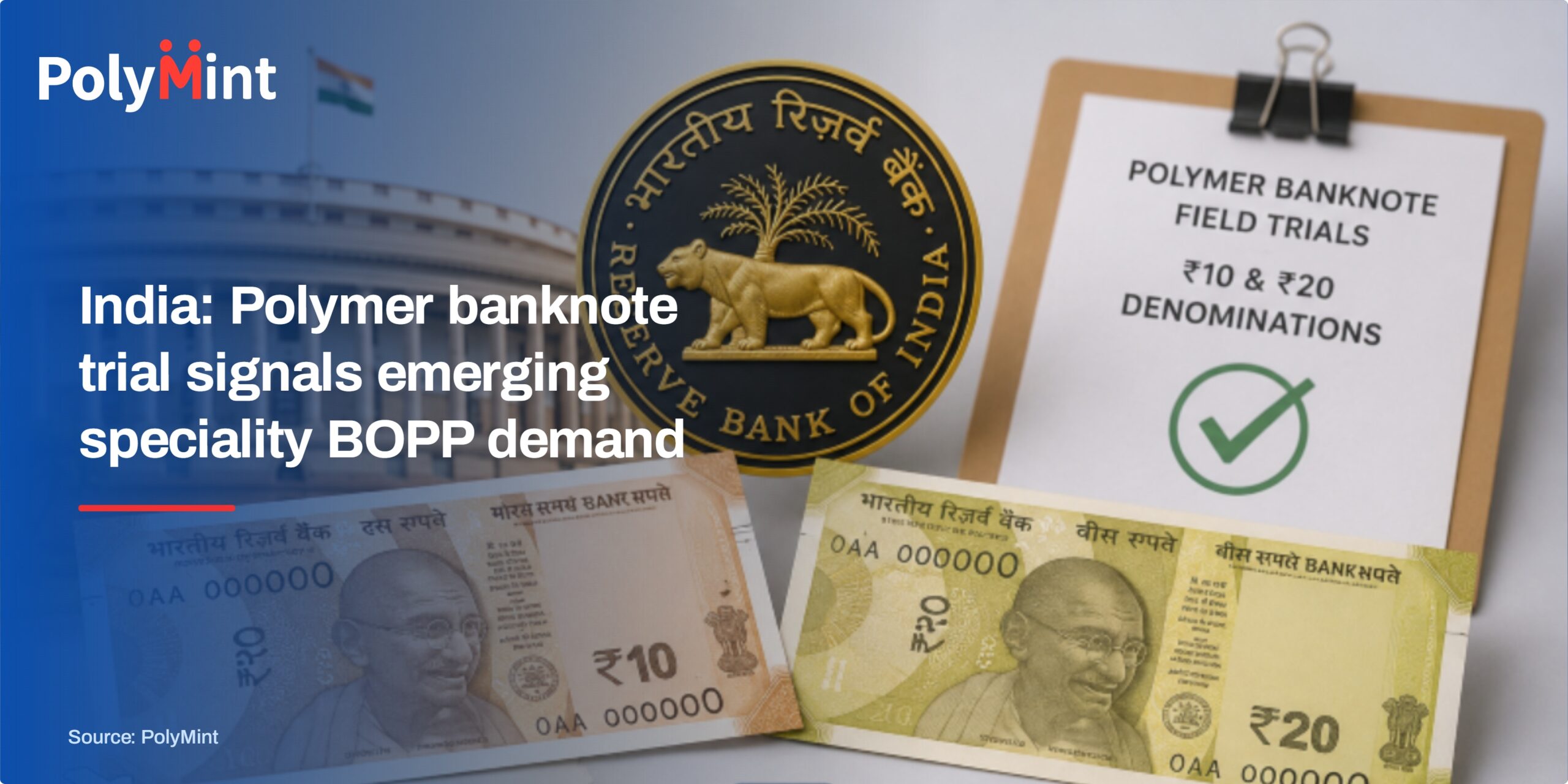
India’s planned polymer banknote trial could create a new speciality application for biaxially oriented polypropylene (BOPP), although the immediate volume opportunity remains small. The government has approved trials involving 2 billion notes, comprising 1 billion 10-rupee notes and 1 billion 20-rupee notes, while Bharatiya Reserve Bank Note Mudran Pvt. Ltd. (BRBNMPL) has opened a global expression of interest (EOI) for 68,000 reams of opacified polymer substrate with security features. The EOI closes on 18 August 2026.
Small volume, specialised application
The immediate procurement equals around 34 million sheets. Based on the indicative 70 × 150 mm dimensions and 90-micron thickness, the underlying polymer requirement is estimated at around 29 t, excluding conversion losses, coatings and security components.
This volume is too small to materially affect India’s polypropylene (PP) or mainstream BOPP balance. The significance instead lies in the specialised nature of the application. Unlike conventional BOPP film, banknote substrate requires opacification, coatings, security features, and stringent technical controls.
Domestic BOPP prices of INR 154-157/kg can provide a reference for the underlying film value. However, the eventual banknote-substrate price cannot be derived from this benchmark because additional processing and security features add value, and no awarded price is available yet.
Qualification matters more than capacity
The opportunity is therefore likely to favour suppliers with proven capabilities in security substrate, speciality film production, and security feature integration rather than BOPP capacity alone.
The current EOI is consequently more important as a supplier qualification and commercial benchmark-setting exercise than for its immediate polymer volume.
Scale-up holds the real opportunity
The commercial significance would increase if the 10 rupee and 20 rupee trials progress into wider circulation. Subsequent procurement and expansion into additional denominations could create recurring demand for security-grade polymer substrate.
The key indicators through 2026 will be supplier selection, awarded substrate price, and trial outcomes. If commercial issuance follows, the application could develop from a small trial requirement into a recurring speciality BOPP demand segment.
Leave a Reply