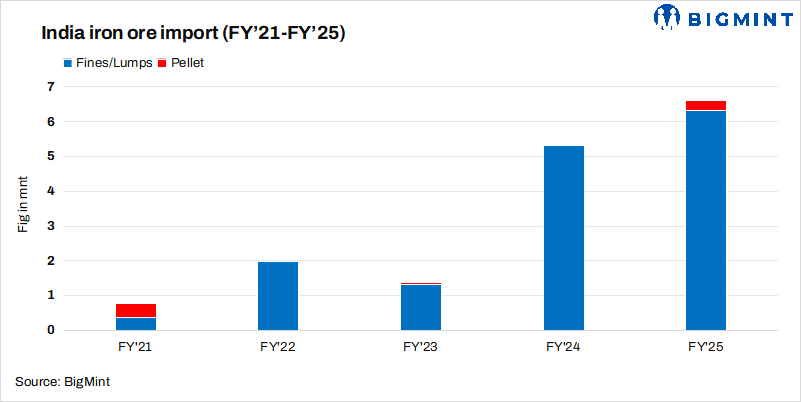
- Over 300,000 t imported from Oman over Dec’24-Apr’25
- Nearly 30% of production capacity remains underutilised
The Pellet Manufacturers’ Association of India (PMAI) has voiced serious concerns over increasing imports of iron ore pellets into the country, particularly from Oman, warning that such imports are undermining the domestic industry’s viability and threatening the broader objectives of self-reliant industrial growth.
In a letter dated 15 May 2025, addressed to Sandeep Poundrik, Secretary of the Ministry of Steel, PMAI highlighted the critical state of the domestic pellet industry. The association, representing 31 pellet producers across seven Indian states, emphasised that besides a marginal export volume by a few players, nearly 30% of domestic production capacity remains underutilised. The industry currently has an installed capacity of approximately 156 million tonnes (mnt) of iron ore pellets per annum, with nearly 60% of this capacity held by captive producers.
As reported earlier by BigMint, Indian steel mills have increasingly sourced pellets from suppliers in the Middle East and North Africa (MENA) region recently, driven by a decline in global prices and constrained domestic availability.
Surge in imports from Oman
A primary point of concern is the sharp increase in pellet imports reportedly originating from Oman. Over 300,000 tonnes (t) of iron ore pellets were imported between December 2024 and April 2025, according to data shared by PMAI. However, the association also cast doubts on the actual origin of these imports, noting that Oman may not have the domestic production capacity to justify such volumes, raising questions of transshipment or rerouting from other countries.
Why is PMAI concerned about rising pellet imports?
- Underutilisation of domestic capacity: Despite an installed capacity of 156 mnt, the industry currently produces only around 100 mnt of pellets, resulting in a capacity utilisation of approximately 69%. Promoting domestic production instead of relying on imports would help optimise this capacity and reinforce the strength of the local industry.
- Impact on investments in the sector: Encouraged by the Union Government’s commitments and assurances, the pellet industry witnessed rapid growth, with significant capital investments and the adoption of advanced technologies. This expansion was driven by expectations of a robust domestic market.
- Undermines Atmanirbhar Bharat initiative: The Government of India has been actively promoting domestic manufacturing through the Atmanirbhar Bharat initiative. Supporting indigenous pellet production aligns with this vision, while increased imports run counter to the goal of achieving self-reliance in critical industrial sectors.
Industry’s appeal
The association has called upon the Ministry of Steel to take urgent policy measures to curb pellet imports and support domestic producers. “Allowing imports in such a scenario further aggravates the challenges faced by local manufacturers,” said Deepak Bhatnagar, Secretary General of PMAI. He urged the government to protect domestic capacity and align trade policy with national priorities such as environmental sustainability and industrial self-reliance.
The PMAI emphasised that iron ore pellets, being a “green raw material,” support sustainable mining practices and contribute to environmental conservation – factors that should strengthen the case for prioritising domestic production.
As India aspires to become a global manufacturing hub, industry leaders stress the importance of safeguarding critical sectors such as pellet manufacturing, which form the backbone of the steel supply chain.
Leave a Reply