- Processing machinery investment grows at 11.1% CAGR over six years
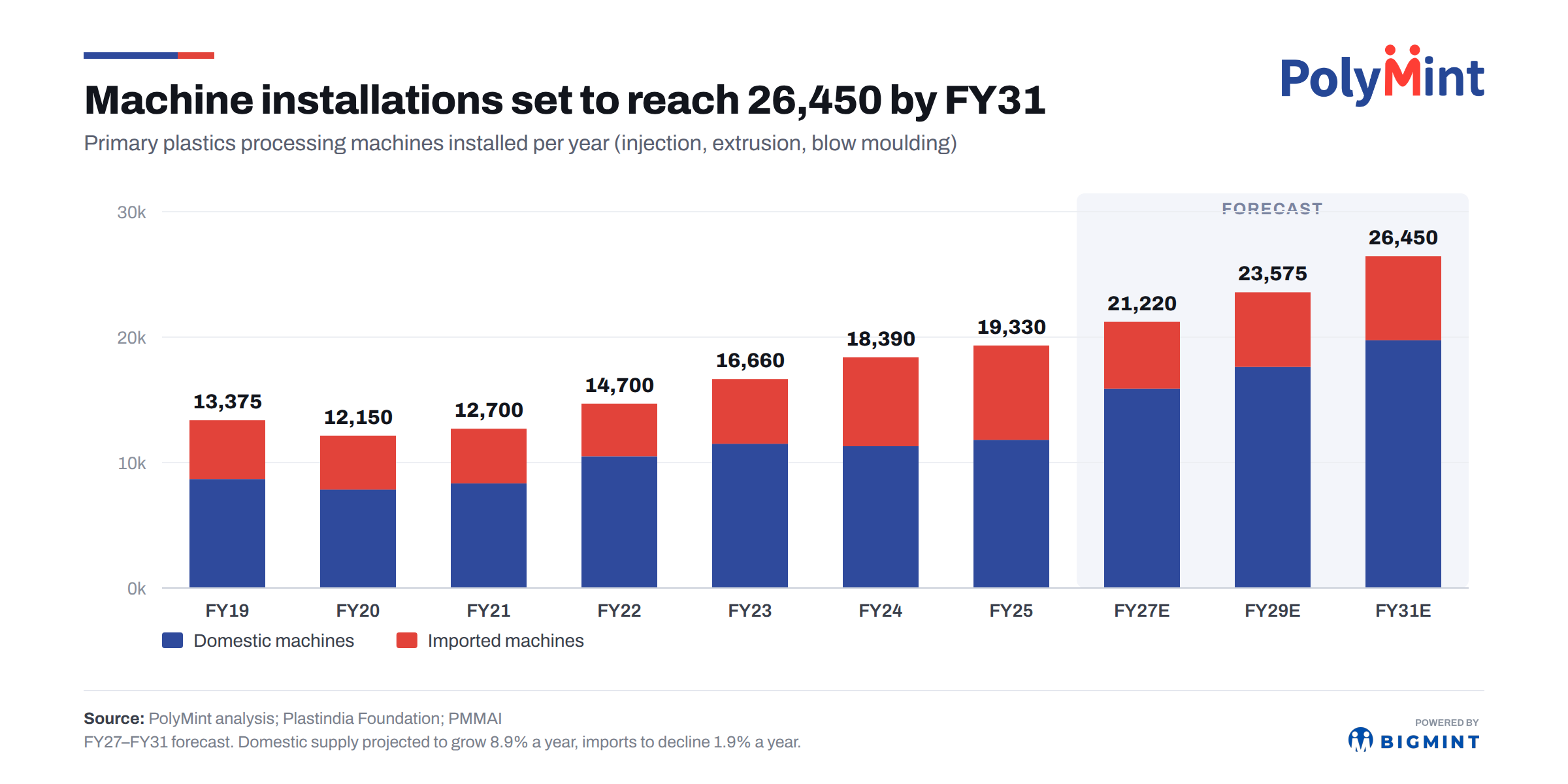
- Annual machine installations forecast to reach 26,450 by FY31
India installed a record 19,330 primary plastics processing machines in FY25, up from 13,375 in FY19, according to Plastindia Foundation and Plastics Machinery Manufacturers Association of India (PMMAI) data. Investment in processing machinery reached ₹12,770 crore in FY25, growing at an annual rate of 11.1% over six years.
Imports accounted for 39% of installations in FY25, up from 35% in FY19, as imported machinery gained share faster than domestic supply. The outlook points to a reversal, with domestic supply projected to grow 8.9% annually and imports to decline 1.9% annually through FY31.
Domestic manufacturing enters a turning point
India has more than 2.56 lakh primary processing machines and approximately 81 million tonnes of processing capacity, including compounding and recycling. The industry is expected to invest ₹1.9 lakh crore in machinery, moulds and converting lines between FY26 and FY31.
Domestic installations increased from 8,690 machines in FY19 to 11,813 in FY25, while imports rose from 4,685 to 7,517. If the forecast materialises, domestic manufacturers could increase their share of annual installations from around 61% in FY25 to approximately 75% by FY31, as total installations expand.

Segment-wise outlook
By FY31, annual installations are projected to reach 16,900 injection moulding machines, 7,550 extrusion machines and 2,000 blow moulding machines, compared with 12,600, 5,330 and 1,400, respectively, in FY25.

Blow moulding is projected to grow fastest, narrowly ahead of extrusion, while injection moulding will remain the largest segment. Demand across packaging, automotive, consumer goods, films, pipes and containers will shape investment requirements across these technologies.
Import competition and technology trends
India’s 2024 machinery imports highlight the competitive position of international suppliers. According to World Bank WITS trade data, China supplied approximately US$164 million of India’s injection moulding machine imports, while Germany supplied around US$59 million of extrusion machinery and US$49 million of blow moulding machines.
For Indian manufacturers, the opportunity lies in strengthening domestic capabilities while competing on equipment quality, lifecycle costs, reliability and after-sales support.
Meanwhile, automation, energy-efficient drives and digital monitoring are becoming increasingly important to converter productivity. Recycling-compatible machinery is also gaining relevance as processors seek to handle recycled polymers while maintaining output quality.
Why this matters in Ahmedabad
Which technologies will give converters an edge in the next investment cycle?
At PLAST.CONNECT 2026 – West India, PolyMint will bring together industry leaders to discuss automation, Industry 4.0, energy-efficient machinery and recycling technology.
Technical Sessions 4 and 5 on Machinery & Technology, supported by PMMAI, feature Jayanta Chatterjee, Business Head – Recycling Machines, Lohia Corp, discussing processing and recycling machinery, automation and smart factories.
Join us on 22 October 2026 at Le Méridien, Ahmedabad, and be part of the conversation shaping India’s plastics value chain.

Leave a Reply