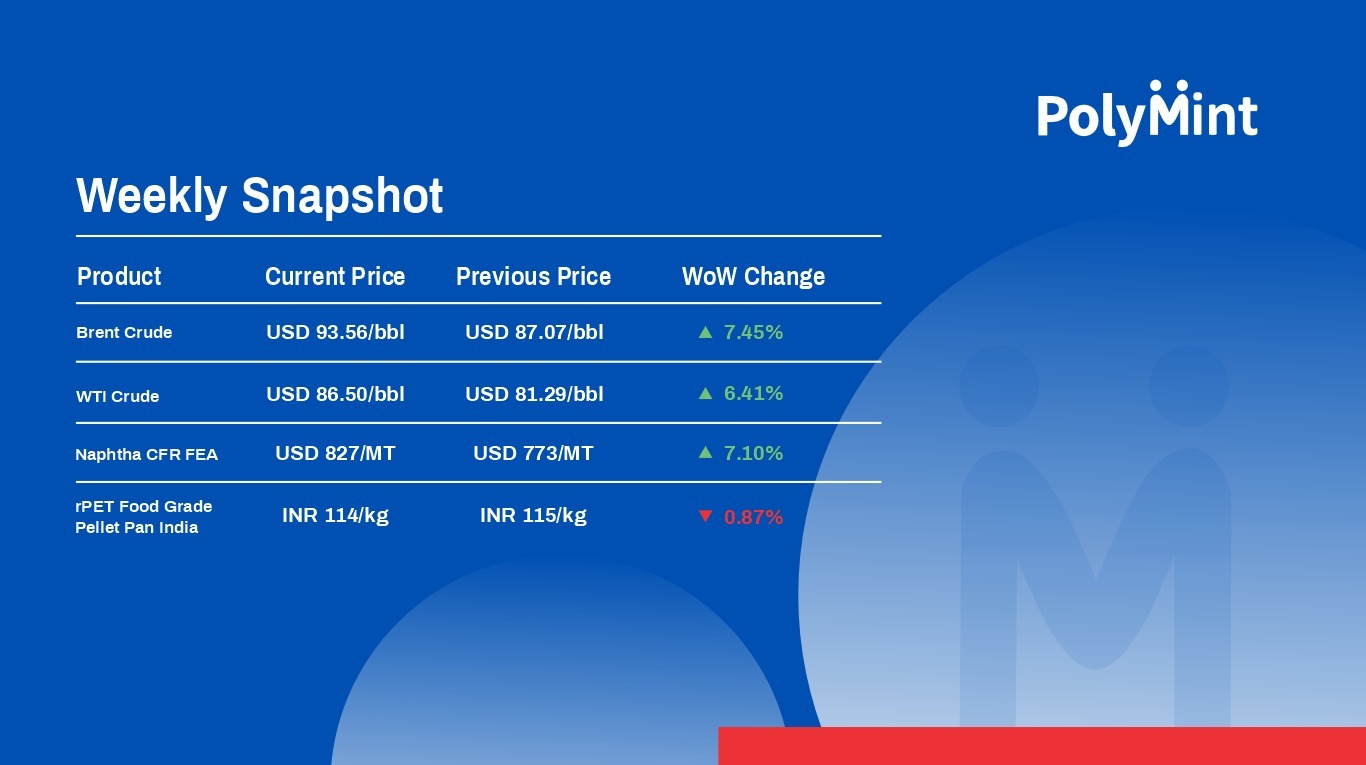
- Naphtha rises to USD 825-830/MT as crude strengthens above USD 93/bbl.
- rPET sentiment varies regionally amid mixed demand and collection trends.
India’s PET market showed signs of improvement during the assessment week ended 21 August 2026, supported by better buying interest ahead of Diwali and firmer crude and feedstock costs. Brent crude rose above USD 93/bbl as continued US-Iran tensions and uncertainty around the Strait of Hormuz kept supply concerns elevated. Naphtha CFR FEA also increased by around USD 40/MT during the week to USD 825-830/MT.
Virgin PET demand improved marginally, with converters beginning seasonal stocking while maintaining lean inventories. Assessed import and domestic spot prices remained unchanged week on week, although some deals were heard at INR 0.5-1/kg below prevailing market levels. Meanwhile, rPET prices were broadly stable, with limited availability of quality bottle feedstock supporting values despite muted export demand and mixed regional buying interest.
Crude oil
Crude oil strengthened throughout most of the week as stalled US-Iran negotiations and continued uncertainty around the reopening of the Strait of Hormuz kept supply risks elevated. Brent moved from USD 88.54/bbl on 17 August to USD 93.56/bbl on 21 August, gaining 7.45% week on week. WTI similarly increased to USD 86.50/bbl.
Brent crossed USD 91/bbl on 18 August after the expiration of the US-Iran peace deal reduced hopes for a near-term agreement. Prices continued higher over the following sessions as stalled negotiations and Hormuz shipping risks kept the market focused on potential supply disruptions. By 21 August, Brent had moved above USD 93/bbl, gaining more than 5% during the week.
The sustained crude rally provided renewed cost support to the polyester chain, although continued physical crude flows limited a sharper increase in prices.
Feedstock market
The PET feedstock chain strengthened during the week, with Naphtha CFR FEA rising to USD 825-830/MT, up around 7% week on week from USD 770-775/MT. Naphtha gained around USD 40/MT during the week, supported by firmer crude and persistent Middle East supply risks.
Domestic polyester feedstock prices also strengthened. RIL increased PTA by INR 1.10/kg to INR 93/kg and DEG by INR 2.80/kg to INR 114.10/kg, effective 15 August, while MEG was reduced by INR 0.60/kg to INR 69.70/kg effective 16 August. RIL’s Mixed Xylene prices increased to INR 128/kg ex-Hazira and INR 127/kg ex-Patalganga.
IOCL also increased PTA by INR 1.10/kg to INR 101.40/kg, DEG by INR 2.80/kg to INR 116.40/kg and MEG by INR 3/kg to INR 78.10/kg, effective 15 August.
The broad-based increase in PTA, DEG and Mixed Xylene indicates renewed upstream cost pressure, although the divergent movement in MEG has limited the overall increase in polyester feedstock costs.
Virgin PET market
India’s virgin PET market remained largely stable during the assessment week, with assessed import and domestic spot prices unchanged week on week. Import offers were assessed at INR 122.50/kg ex-Mundra and INR 123.50/kg ex-Nhava Sheva, while domestic spot prices stood at INR 124/kg ex-Mumbai and INR 126/kg ex-Delhi.
However, market participants reported deals being concluded around INR 0.5-1/kg below assessed levels, indicating continued buyer resistance despite improving demand ahead of Diwali. Buying remained largely need-based, with converters maintaining lean inventories.
RIL and IVL Dhunseri extended their INR 2/kg early-bird offer until 18 August, supporting some procurement. After the offer period, market participants increasingly focused on whether seasonal demand would be sufficient to support a price revision.
A trader from north india said PET demand had improved marginally on Diwali stocking, while supply remained comfortable. The source expected most producers to roll over prices, although some market participants were considering a INR 1-2/kg increase if demand strengthened further.
A western India converter said buying interest had improved but remained largely need-based, with converters maintaining lean inventories. The converter expects PET prices to remain stable in the near term unless stronger seasonal demand results in tighter availability.
Recycled PET market
The recycled PET market remained broadly stable during the week, with Delhi NCR PET bottle bales holding at INR 52/kg, <30 ppm flakes at INR 83/kg, <100 ppm flakes at INR 76/kg and food-grade pellets at INR 114/kg.
Regional sentiment remained mixed. Mumbai continued to face weak downstream demand and comfortable recycler inventories, while Delhi-NCR showed stronger interest in higher-quality feedstock. Gujarat remained broadly balanced, supported by steady collection and availability.
A Delhi-NCR recycler reported purchasing 150 tonnes of soft PET bottles at INR 58/kg, indicating firm demand for suitable feedstock. In Gujarat, a Surat recycler reported a 250-tonne regular bottle-bale deal at around INR 50.50/kg, while a certified Rajkot recycler expected a possible INR 2/kg increase as market activity improves towards Diwali.
Export demand remained a constraint, particularly for pellets, with high freight costs weighing on export economics. However, demand for high-quality flakes remained relatively better, particularly from US and European buyers. Overall, tighter availability of quality feedstock is helping support rPET prices despite muted export buying.

Outlook
Virgin PET is likely to maintain a stable-to-firm bias over the next 1-2 weeks as Diwali stocking gains momentum and Brent remains above USD 90/bbl. If crude sustains current levels and naphtha remains around USD 800-850/MT, producers may seek a INR 1-2/kg increase, although comfortable supply and lean buying could limit the upside.
rPET is expected to remain range-bound with a firm bias, particularly for higher-quality flakes. Bottle-bale prices could hold around INR 51-53/kg, while stronger Diwali demand and slower collection could support select regional markets. However, muted export demand and high freight costs are likely to cap significant gains in pellets.
Leave a Reply