- Tight availability of lumps and fines pushes up raw material costs
- Stronger sponge iron and billet demand supports pellet buying
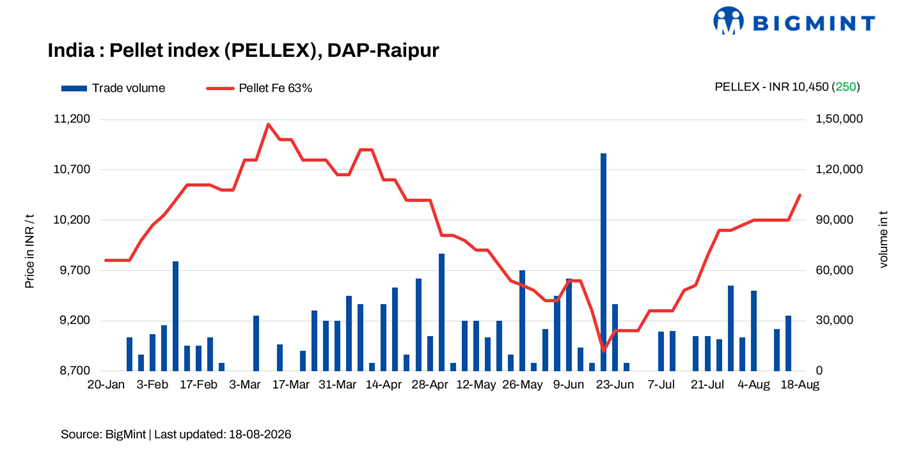
PELLEX, BigMint’s bi-weekly domestic pellet (Fe 63%) index for Raipur, increased by INR 250/t to INR 10,450/t ($109/t) DAP on 18 August 2026 from INR 10,200/t on 14 August. The rise was primarily driven by a shortage of iron ore lumps and fines, which pushed up sponge iron and billet prices and improved procurement sentiment across the market.
Pellet offers also moved higher, with sellers quoting above INR 10,300/t ($107/t) ex-works. Improved demand from sponge iron and billet producers, coupled with limited availability of alternative iron ore feedstock, allowed pellet producers to hold firm on higher offers.
Rationale
- PELLEX has been derived using data points, i.e., trades, offers, and bids. To download the detailed methodology, click here.
- Zero (0) deals were recorded in this publishing window. Thus, the T1 trade category was accorded a weightage of 0%.
- Twenty (20) firm offers, bids, and indicative prices were heard, of which fourteen (14) were taken for price calculation and given the balance 100% weightage.
Price movements and offers
Pellet manufacturers in Raipur, Chhattisgarh, hiked offers for Fe 62.5/63% (+/-0.5%) grade pellets to INR 10,200-10,400/t ($105-107/t) exw this afternoon (on 18 August).
No deals for Fe 62.5/63% grade pellets were reported to BigMint from Raipur-based sellers during the assessment period. The increase came amid tightening availability of iron ore lumps and fines in the region. The shortage pushed up sponge iron and billet prices, prompting producers to step up pellet procurement to maintain production levels.
Market scenario
OMC will auction 1.831 mnt of iron ore on 19 August 2026, comprising 1.21 mnt of fines and 0.62 mnt of lumps. The miner has significantly reduced the offered quantity this month amid heavy monsoon conditions, which have hampered mining operations. This has led to a surge of INR 100-250/t in lump prices across grades. Meanwhile, for fines, base prices for mid- and low-grade material (Fe <62%) have been raised by INR 100/t, while high-grade fines prices remain unchanged.
A Raipur-based seller commented, “Raw material costs have increased, while sponge iron and billet markets have also strengthened over the last few days. Although buyers remain cautious, producers have had to revise pellet offers higher amid increased fines prices and tighter availability.”
Higher raw material costs, combined with tight availability of suitable fines, has encouraged pellet producers to raise offers.
A Raipur-based buyer said, “Pellets are expensive at current levels, so bookings remain selective. Material from adjoining regions is available at around INR 100-200/t discount, limiting buying interest in Raipur.”
Meanwhile, demand across Raipur, Raigarh and the broader eastern and central India belt has improved over the last two to three days, particularly for sponge iron and billet. Decent bookings were reported towards Gujarat, Vashi and Maharashtra.
A trader noted that the improvement in sponge iron and billet demand has provided indirect support to pellets. Lower offered quantities in the OMC auction have also tightened supply and raised expectations of further price increases, strengthening market sentiment.
Participants also highlighted tightness in the local scrap market, which is supporting downstream steel prices and, consequently, sponge iron and billet realisations. This downstream strength is lending further support to pellet prices.
A Raipur-based buyer said, “The downstream market is looking better, with sponge iron and billet receiving good support and scrap availability remaining tight. However, pellet prices have moved beyond comfortable buying levels.”
Market participants expect sponge iron and billet demand to remain slightly better if downstream prices continue to hold. Another seller informed BigMint, “The increase in sponge iron and billet prices has been comparatively stronger than in pellets. Pellet producers are mainly passing on higher fines costs, while improved sponge iron demand is also allowing them to maintain higher offers.”
A buyer reasoned, “At INR 10,300-10,500/t, pellets are too expensive to buy aggressively. Our workable levels are closer to INR 9,700-10,000/t ex-works. Unless downstream prices strengthen further or raw material availability tightens, we will continue buying only against immediate requirements.”

Key market drivers
- Sponge iron prices rise w-o-w: Sponge PDRI prices gained by INR 1,500/t w-o-w to INR 27,000/t ($282/t) exw Raipur on 18 August. Prices rose by INR 700/t on a d-o-d basis. Strong enquiries and better trade movement have boosted seller confidence, prompting producers to raise offers. Overall market sentiment has turned positive, although bulk purchases remain limited as several buyers have already covered their immediate requirements.
- Billet prices increase w-o-w: BigMint’s billet index in Raipur rose by INR 850/t w-o-w to INR 39,400/t ($412/t) exw on 18 August 2026. Billet index increased by INR 200/t d-o-d to INR 39,400/t exw-Raipur, extending its recent upward trend. Prices supported by a modest improvement in buying activity across the semi-finished steel segment. Although market sentiment remained volatile amid mixed cues from neighbouring markets, selective bookings at varied price levels provided support to spot prices. The increase in billet bookings indicates some improvement in market participation, although sustained demand recovery remains dependent on downstream steel offtake.
Outlook
Near-term pellet prices are expected to remain firm, supported by higher OMC raw material costs, tight fines availability, and improving sponge iron and billet demand. However, high prevailing offers and a wide gap with buyers’ workable levels are likely to keep bookings selective. Further upside will largely depend on the degree of premiums received over upcoming OMC auction outcome and sustained strength in downstream steel prices.
Leave a Reply