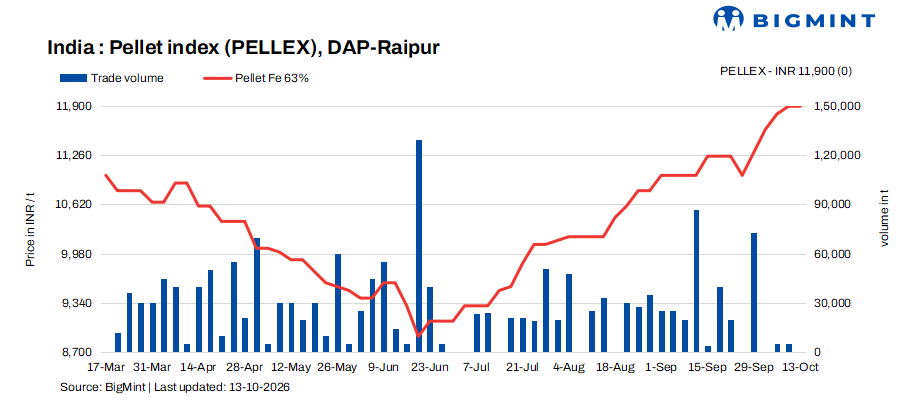
- Plant shutdowns support pellet prices amid limited availability
- Weak downstream demand and poor price viability weigh on buying
PELLEX, BigMint’s bi-weekly domestic pellet (Fe 63% ± 0.5%) index for Raipur, remained unchanged at INR 11,900/t ($125/t) DAP Raipur on 13 October 2026 compared with the previous assessment on 9 October.
Pellet prices remained firm amid limited availability, as several pellet plants in Chhattisgarh have either undertaken maintenance shutdowns or are planning to suspend operations. The resulting supply constraints have supported prices despite weakening demand from downstream steel segments.
However, declining finished steel and sponge iron prices have further affected pellet price viability, keeping market participants cautious. No deals were reported at the prevailing price level during the assessment window, as prices remained unviable amid weak downstream market conditions.
Rationale
- PELLEX has been derived using data points, i.e., trades, offers, and bids. To download the detailed methodology, click here.
- Zero (0) deals were recorded in this publishing window and was taken for calculation. Thus, the T1 trade category was accorded a weightage of 0%.
- Fourteen (14) firm offers, bids, and indicative prices were heard, of which thirteen (13) were taken for price calculation and given the balance 50% weightage.
Price movements and offers
Major pellet manufacturers in Chhattisgarh largely maintained their offers for Fe 62.5/63% (± 0.5%) grade pellets in line with the previous assessment. Sellers remained reluctant to reduce prices, supported by tight availability amid ongoing and planned plant shutdowns.
On the demand side, buying interest remained subdued as elevated pellet prices continued to weigh on procurement viability. The decline in finished steel and sponge iron prices has further weakened purchasing sentiment, prompting market participants to defer purchases and adopt a wait-and-watch approach.
Market scenario
The Raipur pellet market remained firm, primarily supported by supply-side constraints rather than an improvement in demand. Market participants reported relatively tight availability of iron ore lumps, while elevated lump prices have added to input cost pressures for sponge iron producers.
Additionally, limited coal availability has encouraged some sponge iron manufacturers to consider using pellets in the production of pellet-based direct reduced iron (P-DRI), as this route requires less coal. However, this shift has not translated into stronger pellet demand, with high prices and weak downstream steel market conditions continuing to restrict fresh purchases.
Market participants expect prices to come under pressure once pellet plants resume operations and additional material becomes available. Several manufacturers remain out of the market due to shutdowns, and their return could increase supply.
In the near term, pellet prices are likely to remain supported by restricted availability, although sustained weakness in downstream demand and poor price viability could limit further gains. Market participants are expected to remain cautious and await improved price alignment before resuming purchases.
Key market drivers
- Sponge iron prices fall by INR 1,250/t ($13/t) w-o-w: Sponge PDRI prices stood at INR 28,100/t ($295/t) exw Raipur, softening by INR 1,250/t ($13/t) w-o-w on 13 October against 9 October, amid subdued demand and limited buying activity. Sluggish finished steel demand continued to weigh on market sentiment, with finished steel prices declining by INR 200-500/t across regions. The weakness in finished steel cascaded down the value chain, exerting further pressure on sponge iron prices.
- Billet prices drop by INR 1,600/t ($17/t) w-o-w: BigMint’s billet index in Raipur declined by INR 1,600/t ($17/t) to INR 44,150/t ($464/t) exw on on 13 October against 9 October, amid weak demand and subdued market participation. Despite lower offers, buying interest remained limited as sluggish finished steel demand prompted buyers to defer fresh bookings until downstream offtake improves. Weak cues from neighbouring markets and continued pressure from the finished steel segment further dampened sentiment, keeping billet prices on a downward trajectory.
Outlook
Leave a Reply