- Inquiries shrink, with most buyers having already met urgent needs
- Several plants refrain from offers due to limited demand visibility
The pellet market in the Raipur region remained under pressure over the last few days, primarily due to weakening market sentiments and a continued decline in downstream steel prices. The sharp correction witnessed in sponge iron and billet prices significantly dampened buying interest, keeping overall trade activity muted in the region.
Price movements, trades
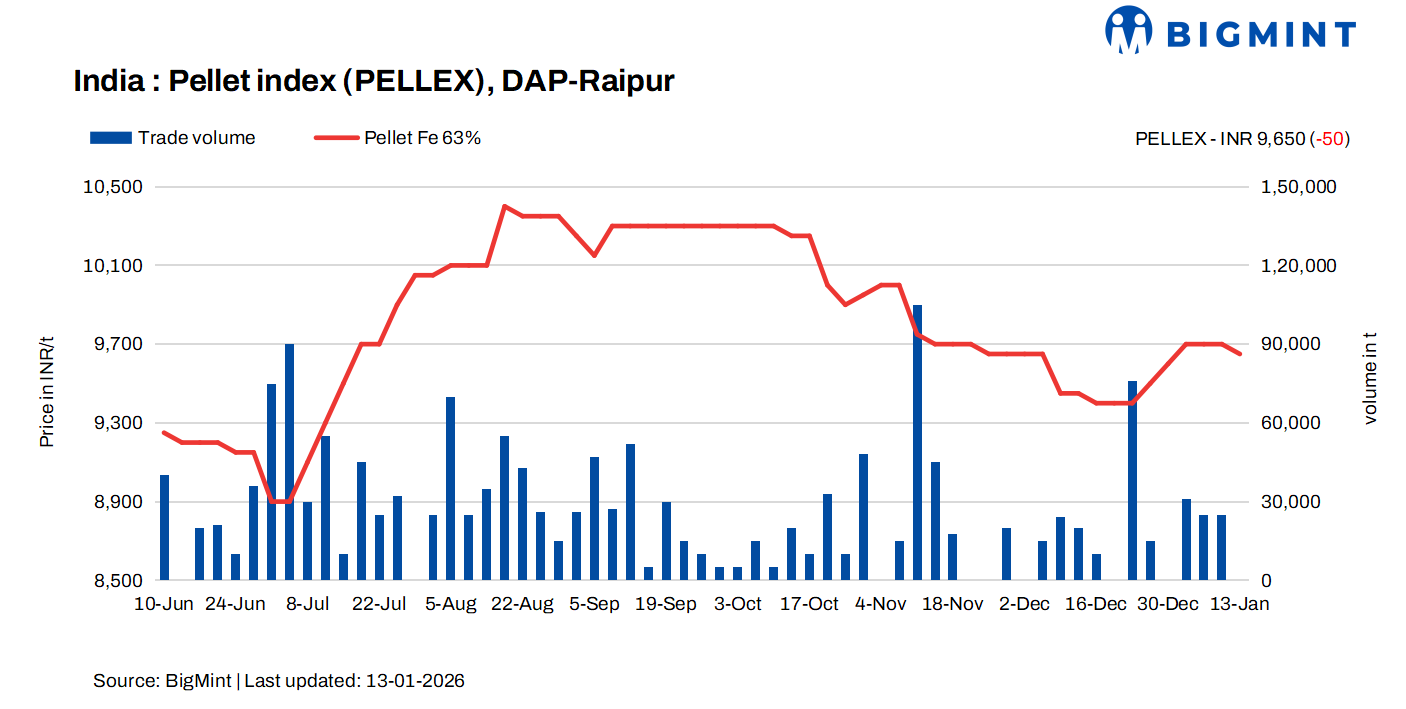
PELLEX, BigMint’s bi-weekly domestic pellet (Fe63%) index for Raipur, fell by INR 50/t to INR 9,650/t ($107/t) DAP on Tuesday compared to the previous assessment on 9 January. No pellet deals were reported in the Raipur region in this publishing window.
Raipur-based pellet producers kept offers for Fe 62.5-63% (+/-0.5) pellets stable at INR 9,500-9,600/t ($105-106/t) exw. Meanwhile, some Odisha-based sellers offered material at higher levels of INR 9,700-10,100/t ($107-112/t) DAP in Raipur.
Market scenario
Market participants noted that sellers largely maintained their existing offers; however, aggressive inquiries from buyers were absent. Trading activity remained largely silent, as steelmakers adopted a cautious approach amid ongoing price volatility in the downstream market.
A pellet producer based in Raipur said, “We are keeping our offers unchanged for now, but inquiries are very limited. Buyers are hesitant to commit at current levels due to continuous weakness in sponge iron and billet prices.” Another market participant added that several pellet plants are currently refraining from offering material, citing a lack of demand visibility.
According to market sources, a few buyers had already secured need-based quantities in the previous week and are now staying on the sidelines, waiting for clearer market direction. A steelmaker stated, “Most buyers have covered immediate requirements and are now in wait-and-watch mode. There is no urgency to book material at the present offers.”
Some market participants expect a price correction in the near term due to muted buying interest. Another buyer noted, “Pellet prices in Raipur are likely to see some correction as buyers are unwilling to accept current offers. Fresh trades may only conclude after sellers revise prices in line with the sharp fall in sponge iron and billet rates.”
Rationale
- PELLEX has been derived using data points, i.e., trades, offers, and bids. To download the detailed methodology, click here.
- No deals were recorded in this publishing window, so this category was not taken for calculation. Thus, the T1 trade category was accorded 0% weightage.
- Thirteen (13) firm offers, bids, and indicative prices were heard. Twelve (12) were taken for price calculation and given 100% weightage.

Key market drivers
- Sponge iron prices fall w-o-w: Sponge iron prices declined by INR 1,000/t ($11/t) w-o-w on 13 January to INR 23,400/t ($259/t) exw-Raipur. Furthermore, prices dropped by INR 250/t ($3/t) d-o-d. Sellers reduced offers in an attempt to revive buying activity; however, expectations of further price cuts prompted some buyers to remain cautious. Even so, buying interest was witnessed in the market today, with participants engaging in need-based purchases as sentiment showed a mild improvement towards the latter part of the session.
- Billet prices drop w-o-w: BigMint’s billet index decreased by INR 800/t ($9/t) w-o-w to INR 39,300/t ($435/t) exw-Raipur on 1 January. Meanwhile, prices fell by INR 200/t ($2/t) d-o-d. Weak cues from neighbouring markets further weighed on sentiment. Ongoing corrections in finished steel prices spilled over into the semi-finished segment, prompting billet producers to maintain a conservative pricing approach. Overall trading activity stayed thin, with transactions largely limited to immediate requirements and concluded at lower price levels.
Outlook
Pellet prices are expected to revise in the next week, as pellet producers look for fresh trades. Some sources have stated that bulk buyers are waiting for the OMC auction to gain clarity on prices before making further purchases.
Leave a Reply