- Crude steel output rises 8% y-o-y, iron ore production up 17%
- AM/NS, Jindal Steel Limited register sharp output growth
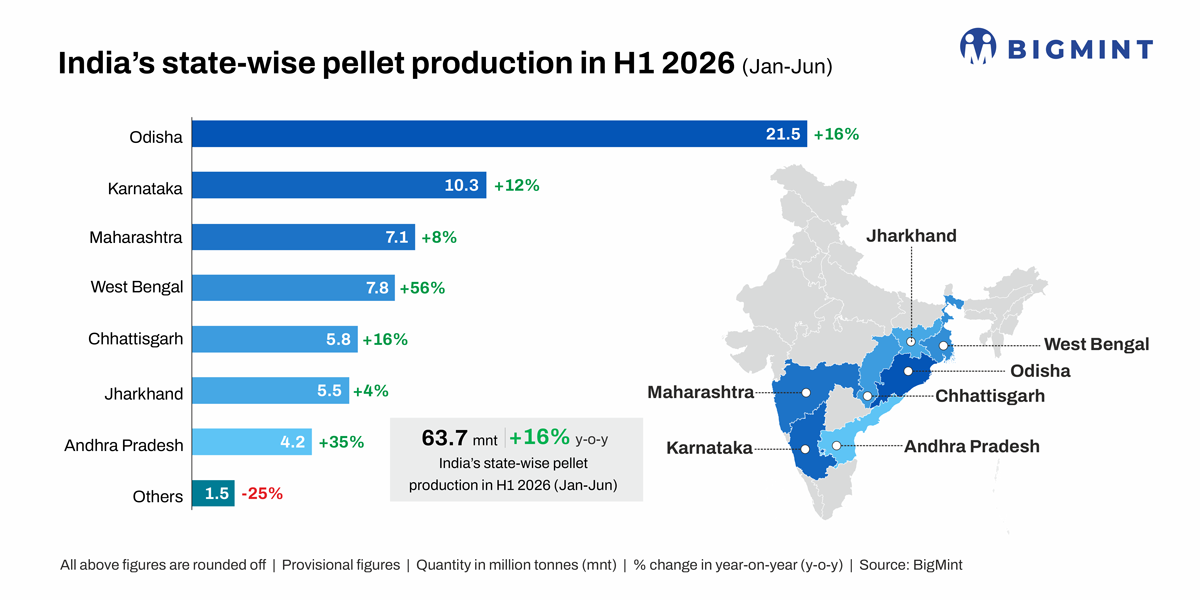
India’s iron ore pellet production increased to 63.7 million tonnes (mnt) in January-June 2026 (H1CY’26), up 16% y-o-y from 54.7 mnt in the corresponding period last year, according to provisional data maintained by BigMint. The increase, led by Odisha and Maharashtra, was supported by stronger fundamentals across the domestic ferrous value chain. India’s iron ore production climbed 17% y-o-y to 184 mnt in H1CY’26, while crude steel output reached 8% to 87 mnt in H1CY’26, ensuring adequate raw material availability and supporting higher pellet consumption across both blast furnace (BF) and direct reduced iron (DRI) routes.
Despite the healthy production growth, the industry’s expansion remained concentrated in a few states and producers. At the same time, subdued export demand continued to limit capacity utilisation, keeping pressure on standalone pellet manufacturers.
State-wise production
Odisha retained its position as India’s largest pellet-producing state, with output rising 16% to 21.5 mnt in H1CY’26 from 18.5 mnt in the corresponding period last year. The increase was supported by higher production at AM/NS and Jindal Steel, as well as higher operating rates across smaller merchant pellet plants.
Karnataka remained the second-largest producer, with output increasing 12% to 10.3 mnt from 9.2 mnt. Maharashtra registered the sharpest growth among major producing states, with production rising 56% to 7.8 mnt from 5 mnt, driven by capacity ramp-ups, especially at Lloyds Metal.
According to market participants, Lloyds Metal’s rapid production expansion has disrupted supply dynamics at major markets due to aggressive price competition. For example, Lloyds Metal has been shipping material to other regions such as Kandla, Raipur, and Hyderabad, which has eroded the market share of merchant producers there.
West Bengal increased production by 8% to 7.1 mnt from 6.6 mnt, while Chhattisgarh and Jharkhand recorded moderate gains to 5.8 mnt and 5.5 mnt, respectively. Andhra Pradesh also witnessed a sharp improvement, with output up 35% to 4.2 mnt compared with 3.1 mnt in H1CY’25.
Overall, pellet production growth remained concentrated in eastern and central India, where iron ore availability and integrated steel capacities continue to support higher output.
Top producers
Integrated steelmakers increased pellet production in H1CY’26, with steelmaking expansions accelerating. JSW Group remained India’s largest pellet producer during H1CY’26, with production increasing 14% to 14.8 mnt from 13 mnt in the year-ago period.
AM/NS India emerged as one of the fastest-growing major producers, with output rising 41% to 8 mnt from 5.7 mnt, supported by higher operating rates and pellet exports. Tata Steel’s pellet production increased marginally to 6.4 mnt from 6 mnt, while Jindal Steel Ltd expanded output by 37% to 5.7 mnt from 4.1 mnt.

Domestic demand remains strong; exports soften
Higher hot metal production continued to support domestic pellet consumption during the review period. Blast furnace-based steelmakers consumed around 31 mnt of pellets in H1CY’26, compared with 24 mnt a year earlier, reflecting a 29% increase in pellet usage in integrated steelmaking. This reflects increasing preference for pellets to sinter in blast furnace-based steelmaking.
Pellet consumption by the DRI sector also increased 11% to 31 mnt from 28 mnt, supported by sustained sponge iron production and the operational advantages of pellet-based DRI over iron ore lumps.
India imported around 1.1 mnt of pellets during H1CY’26, broadly unchanged from 1 mnt a year ago. However, pellet exports declined by 24% to 2.2 mnt from 2.9 mnt, as weaker international demand, better domestic realisations, and increased competition from overseas suppliers reduced export opportunities.
Capacity utilisation remains challenge
India’s pellet capacity has continued to expand over the past few years, supported by investments from both integrated steelmakers and merchant producers. As of FY’26, India’s pellet capacity stood at 179 mnt against 165 mnt in the previous fiscal year, gaining around 8.5% y-o-y.
The fact that production growth has outpaced the increase in installed capacity indicates that capacity utilisation improved in H1CY’26, at around roughly 71% compared to 66% in the year-ago period. However, utilisation levels remain below optimal due to declining exports and increasing competition within the domestic market.
The widening gap between installed capacity and actual production continues to weigh on operating margins, particularly for standalone pellet manufacturers that rely more heavily on export markets.
Outlook
India’s pellet production is expected to remain on a growth trajectory through the remainder of CY’26, supported by healthy crude steel output, strong iron ore availability and sustained demand from both BF and DRI segments.
However, export demand is likely to remain subdued amid steady global pellet supply and cautious overseas buying. Going forward, improving capacity utilisation and strengthening domestic consumption will be more critical for the industry’s profitability than further capacity additions, as producers increasingly focus on operational efficiency and higher-value pellet grades.
Leave a Reply