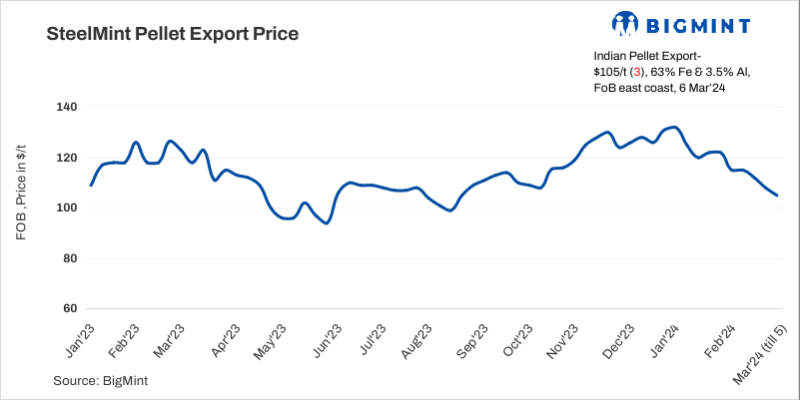
- Recent Indian pellet export tenders remain inconclusive
- Eastern India-based pellet plants curtail production
BigMint’s India pellet (Fe 63%, 3% Al) export index (FOB east coast) decreased by $3/tonne (t) to $105/t on 6 March 2024. No deals were recorded from the east coast of India in this publishing window. For another time in about six months, the pellet export index has hit a six-month low. The last time such levels were reached was in August 2023.
The pellet export market has been performing rather poorly over the last few days, on the back of lower bids from buyers along with weak demand in the seaborne market. A wide gap between bids and offers was seen.
A southern India-based pellet producer floated a tender for exports of 50,000 t of pellets (Fe63%, 8% Al2O3 + SiO2) yesterday. As per sources, owing to bid-offer disparity, it was not feasible for the pellet maker to conclude at that level. Another pellet export tender was floated by an eastern region player, but the response was weak.
An eastern India pellet maker said: “The current market flow is not supporting Indian pellets in the overseas market. We heard that port stocks in China are also high and steel mills there were more looking for lower grade fines to reduce the production cost of finished steel. Some Odisha-based players are learnt to have curtailed output by 10-15%, while a couple of Indian players have opted for maintenance shutdown.”
Another producer said: “We are sending material to markets in southern and western India through coastal shipping. This will allow us to load more material and lower the freight cost compared to rake movement. We also heard an Odisha-based pellet producer has sold around 100,000 t of raw pellets to a Chennai buyer at $124-125/t CNF – a price that was feasible compared to export offers.”
On the other hand, Chinese sources said that portside offers in China for Indian pellets (Fe 63.5%) have declined by around RMB 20/t ($3/t) w-o-w on 6 March. Offers were recorded at around RMB 1,035/t at ($144/t) Qingdao, inclusive of all import taxes and port charges.
Why are pellet export prices under pressure?
- Low export realisation against domestic: Domestic pellet realisations were higher by INR 750/t ($9/t) compared to exports. Domestic pellet (Fe 63%) prices fell by INR 200/t w-o-w to INR 7,850/t exw ($95/t) in Barbil, eastern India. BigMint’s pellet export ex-plant price realisation for Barbil was down by INR 200/t ($2.5/t) to INR 7,100/t exw ($86/t) this week.
- Lower downstream steel demand in China: Billet prices in Tangshan fell by RMB 70/t ($10/t) w-o-w to RMB 3,480/t ($483/t) on 6 March. Prices include 13% VAT. Finished steel demand in China had not improved after the Lunar holidays and this led to a drop in the raw material prices and lowering of production costs. Rebar demand is fairly low, and demand for construction steel is hardly increasing.
- Fall in future prices w-o-w: Iron ore futures on the Dalian Commodity Exchange (DCE) for May 2024 contract decreased by RMB 7.5/t ($1/t) to RMB 881.5/t ($122/t) on 6 March compared to last week. On a d-o-d basis, prices remained largely stable.
- Pellet inventories at Chinese ports rise: Pellet inventories at China’s major ports rose by 0.15 mnt to 7.65 mnt on 28 February compared to last week, according to SteelHome data. Pellet inventory at ports were recorded at a one-year high, as per SteelHome data.

Rationale:
- No pellet export deal was recorded and thus not taken into consideration. It was given 0% weightage in index calculation Click here for methodology.
- Nine (9) indicative prices were received, and eight (8) were considered for calculation of the index, and given a 100% weightage.
India’s pellet export shipments stood at 183,480 t in the last week of February compared to 174,600 t in the fourth week, as per vessel line-up data maintained with BiglMint.

Outlook:
As per BigMint’s analysis, pellet prices in the seaborne market are expected to remain under pressure following the poor downstream steel demand in China. Considering both the domestic and export markets, a few more plants from eastern India may cut pellet production in the coming days.