- Higher paddy costs, limited miller availability in central India lift export offers
- New-season crop prospects, export demand to determine price direction ahead
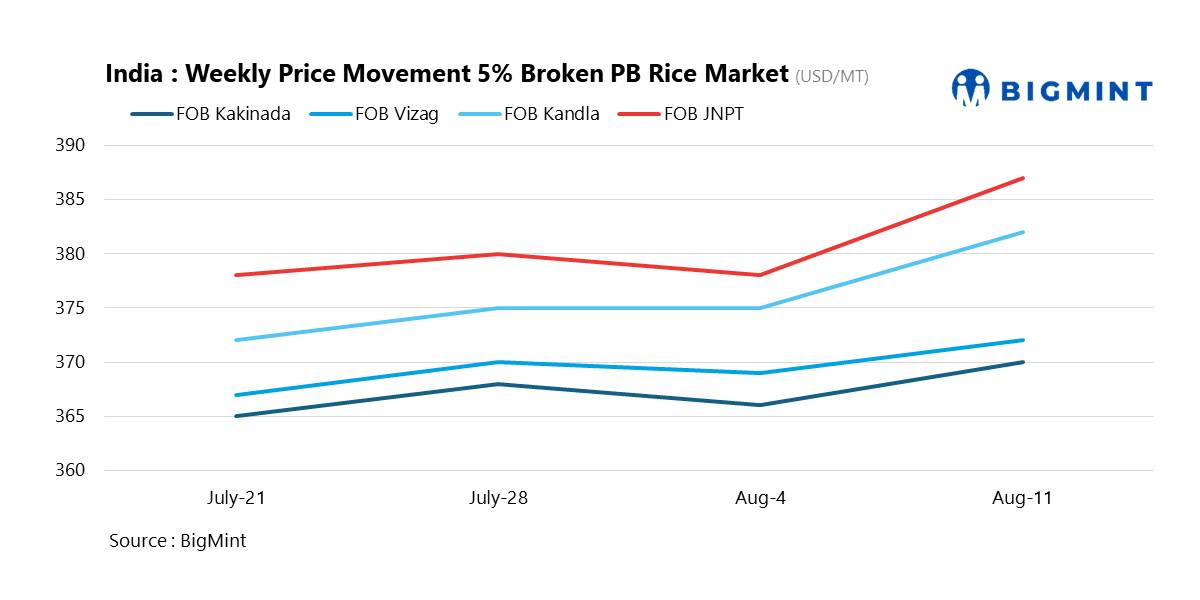
Indian parboiled (PB) 5% broken rice export prices have increased across all major ports over the past three weeks, reaching a 10-month high. According to BigMint’s price assessments, FOB Jawaharlal Nehru Port Trust (JNPT) prices rose to $387/tonne (t) on 11 August from $378/t on 21 July, while FOB Kandla increased to $382/t from $372/t. FOB Vizag climbed to $372/t from $367/t, and FOB Kakinada rose to $370/t from $365/t.
Paddy availability remains key market factor
The recent increase in Indian PB 5% broken rice export prices has been supported by higher domestic paddy prices and tighter availability in some markets, while concerns over the upcoming new-season crop have added to price uncertainty. However, Indian rice remains competitively priced in the global market.
Most major rice milling hubs in central India, such as Nagpur, Raipur, and Gondia, are experiencing a shortage of paddy for milling activities. Consequently, paddy prices have risen by INR 500-700/quintal in a month, which has, in turn, lifted rice prices. Tight availability of suitable paddy is also being reported in some mandis, affecting the ability of mills to replenish raw material. This has kept replacement costs firm for some varieties, while exporters continue to assess domestic procurement costs before finalising export offers.
Weather remains a major uncertainty for the new crop
Weather has emerged as another important factor for the rice market. India’s southwest monsoon was initially slow, with the government forecasting 2026 seasonal rainfall at 90% of the long-period average (LPA) and a 60% probability of deficient rainfall. El Nino conditions were also expected to develop during the monsoon season.
Rice is particularly sensitive to the availability and distribution of monsoon rainfall during the crop cycle. Concerns over a potentially strong El Nino have, therefore, increased uncertainty around crop development, particularly in rain-dependent areas. The United States Department of Agriculture (USDA) also highlighted the risk of lower rainfall and heat stress to kharif crops, including rice.
However, the situation is not uniformly negative. Recent rainfall has helped narrow the sowing gap, with kharif sowing reaching 87.7% of the normal seasonal area as of 7 August, only 1.8% below the previous year. All India rice sowing has reached 34.5 MHa. lagging by 1.5 MHa. compared to the same period last year, as per the Government of India.
Strong export demand supports prices
India’s export demand has remained supportive, particularly for non-basmati rice. India’s rice exports increased by 5% during January-June 2026, with higher non-basmati shipments to African markets offsetting weaker basmati exports. This demand has helped maintain buying interest for export-oriented varieties even as domestic availability becomes tighter in some markets.
Government stocks provide a cushion
Despite concerns over the upcoming crop, India’s government rice stocks remain comfortable. As of 1 July 2026, rice stocks in the Central Pool stood at 40,311,000 t, up from 39,632,000 t on 1 June and significantly above the 1 July buffer norm of 13,540,000 t, providing a substantial supply cushion amid weather-related uncertainty surrounding the new kharif crop. However, although government-held stocks remain elevated, their availability for commercial trade is limited.
Outlook
Indian 5% broken rice prices are expected to remain firm in the near term, supported by higher domestic paddy replacement costs and weather uncertainty around the kharif crop. However, strong competition from Vietnam, Thailand, and Pakistan and price-sensitive overseas buyers could limit further upside. The pace of new-season paddy arrivals and export demand will remain key factors for FOB prices.
Leave a Reply