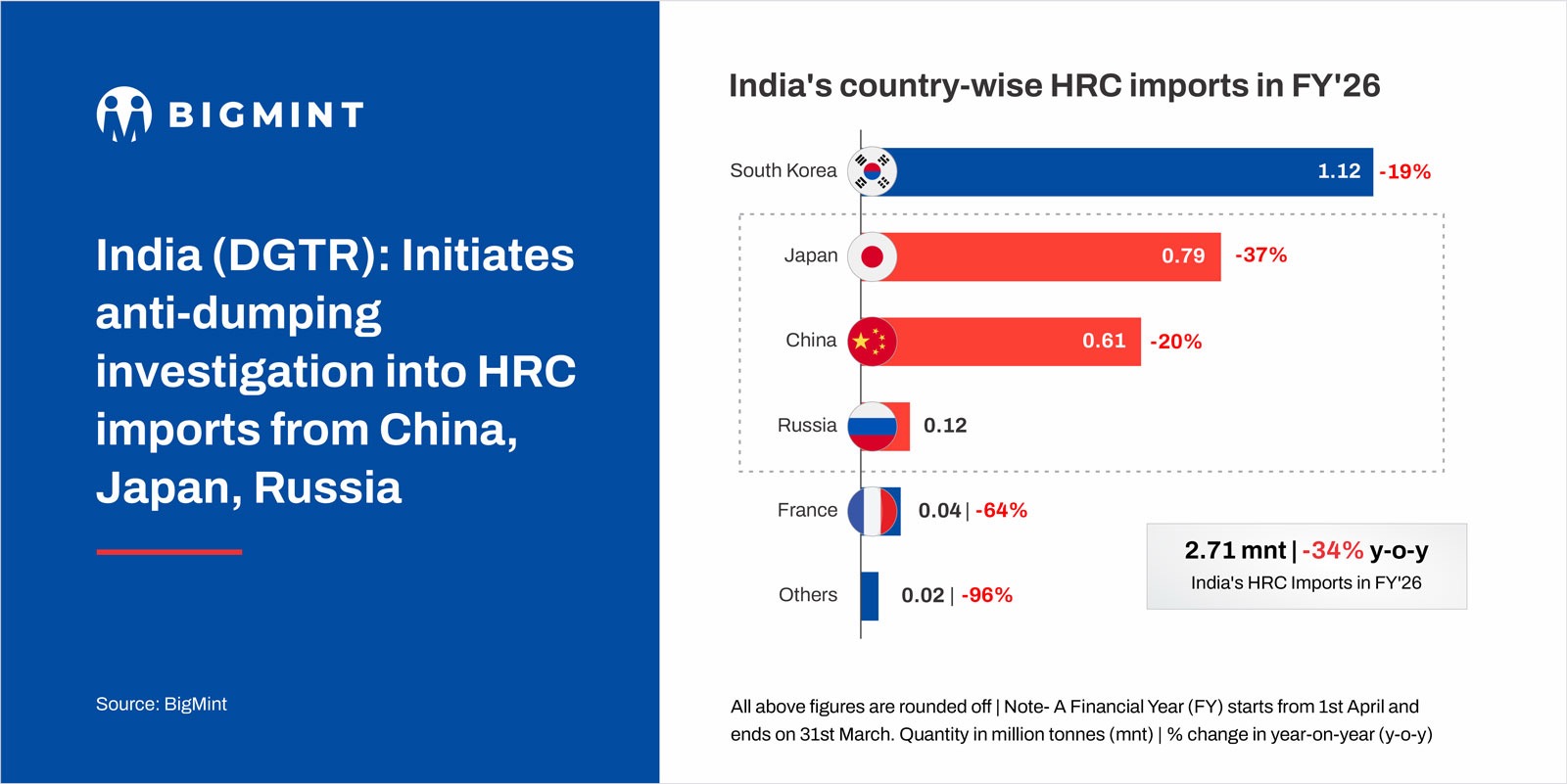
- Application submitted by JSW, JSW Vijayanagar Metallics and Jindal Odisha
- India’s low safeguard duty compared to EU, US results in redirection of shipments
The Directorate General of Trade Remedies (DGTR) under India’s Ministry of Commerce has opened an anti-dumping (AD) investigation into hot-rolled flat steel products originating in or exported from China, Japan and Russia.
The investigation involves hot-rolled flat products of alloy or non-alloy steel, not clad, plated or coated, of a thickness up to 25 mm and width up to 2100 mm. The products under the current investigation fall under the HS codes 7208, 7211, 7225 and 7226. These are used in automotive, oil and gas line pipes/exploration, cold rolled steel products, pipe manufacturing, general engineering & fabrication, construction and capital goods.
Dumping & material injury
The investigation was launched after an application was submitted by JSW Steel, JSW Vijayanagar Metallics and Jindal Steel Odisha. These companies claimed that import volumes from the three origins had increased sharply and were undercutting domestic prices, with the product under consideration being imported at dumped prices causing material injury to the domestic industry.
The application has been supported by Tata Steel Limited and Steel Authority of India Limited.
The ‘standing requirement’ under Rule 5(3) is that an application is considered to have sufficient standing if producers supporting it account at least 25% of the total Indian production of that article.
As per BigMint data, consolidated production of hot-rolled coil by JSW Steel and Jindal Odisha in FY’26 stood at over 24 mnt, which was roughly 35% of total domestic production of nearly 70 mnt. Therefore, the application satisfies Rule 5(3).
The producers submitted prima facie evidence of dumping, which the DGTR found satisfactory. The agency will now investigate “the existence, degree, and effect of the dumping,” the notification said.
The applicants have claimed that the volume of imports increased in both absolute terms and in relation to demand in India over the injury period. The imports are threatening to cause injury to the domestic industry in view of the rapid increase in their volumes, declining import prices, surplus capacities available with exporters, capacity expansion plans of the exporters and trade remedial measures and tariff measures imposed by other countries.
The applicants have asked for retrospective imposition of the duty. The domestic producers have proposed January-December 2025 as the investigation period, the DGTR said. The agency also plans to investigate injury to the domestic industry over the financial years ended March 2023, 2024 and 2025 as well as the investigation period.
India’s HR steel imports
Indian finished steel imports increased over 2023 and peaked at over 9.4 mnt in 2024 because of surplus supply and weak domestic demand in other major steel producing countries, particularly China. But imports fell in 2025 to 7.9 mnt after India imposed safeguard duties on a provisional basis from April, followed by a three-year extension in December.

Industry sources told BigMint that because of high tariffs in major importing geographies such as the EU and the US, and because of the low 11.5% safeguard duty in India, major suppliers are channelling material towards India at a time of strong consumption in the country compared with other major nations.
Outlook
The spike in prices in the domestic market following the Iran war led to a narrowing of the margin with landed costs of imports from FTA and non-FTA countries. There was also a surge in imports under the Advanced Authorisation Scheme for re-export of pipe and tubular products to the Middle East, which avoided both safeguard duty as well as BIS certification requirement.
With the AD investigation in place, and considering the roughly INR 5,000-7,000/t spread with landed imports from FTA countries and China, import appetite may remain subdued during the monsoons. A major Indian mill which routinely imports hot-rolled products from Japan may face supply issues going forward.
Leave a Reply