- Allocation ratio improves to 39% in Aug’26 from 33% in Jul
- Apr-Aug allocation remains low at 37%, reflecting selective buying
Coal India Limited (CIL)’s offered volume for its Single Window Mode Agnostic (SWMA) e-auction declined 16.4% m-o-m to 21.07 million tonnes (mnt) in August 2026, from 25.19 mnt in July, while allocated volumes eased marginally by 1.3% to 8.28 mnt, from 8.39 mnt. Consequently, the allocation ratio improved to 39% in August from 33% in July. The average premium over notified prices also increased significantly to 59% from 41%, indicating stronger competition for available coal and sustained buyer preference for select grades, even as overall auction volumes remained subdued.
The subdued allocation against offered quantities indicates that buyers remained selective, with bidding concentrated on coal qualities and origins offering stronger economic value amid monsoon-related supply constraints and tighter availability of preferred grades.
NCL, NEC record full allocation, while MCL sees largest offtake in absolute volumes
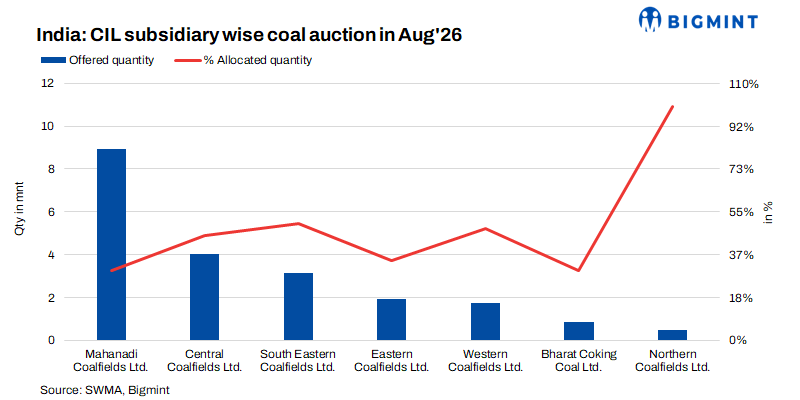
Among CIL subsidiaries, NCL and NEC recorded 100% allocation, reflecting strong demand for their offered coal. NCL also commanded the highest premium of 173% over notified prices, indicating particularly strong competition for its material.
SECL allocated 50% of its offered 3.13 mnt at an average premium of 81%, while WCL allocated 48% at a 55% premium. ECL’s allocation stood at 34%, but its 72% premium indicated strong bidding for the quantities sold. MCL, despite being the largest contributor with 8.93 mnt offered, allocated only 2.68 mnt (30%), suggesting relatively selective buying even as the average premium remained at 33%.

Allocation remains low in Apr-Aug’26, demand concentrated in select grades
During April-August 2026, CIL offered a cumulative 129.17 mnt through e-auctions, while only 47.74 mnt was allocated, resulting in an allocation rate of 37%. The average premium over notified prices stood at 46%.
The relatively low conversion of offered quantities into actual allocations suggests that buyers have remained price-sensitive, while demand has been concentrated around specific coal grades and locations where supply availability is comparatively constrained.
SECL leads Apr-Aug’26 allocations, MCL accounts for largest offered volume
During April-August 2026, SECL recorded the highest allocation ratio among the major subsidiaries at 67%, with 14.75 mnt allocated against 21.86 mnt offered. WCL followed at 49%, while CCL allocated 39% of its offered volume.
MCL, despite offering the largest quantity at 48.98 mnt, allocated only 12.06 mnt, or 25%, indicating a significant gap between supply offered and buyer uptake. NCL and NEC again recorded 100% allocation, reflecting sustained demand for their comparatively limited auction quantities.
Premiums highlight persistent competition for preferred coal
The auction data points to a clear divergence between volume absorption and price discovery. While only around two-fifths of the coal offered was allocated in both August and the April-August period, the material that cleared the auctions attracted substantial premiums.
This suggests that buyers are increasingly prioritising specific grades, origins, and quality parameters rather than aggressively securing volumes across the entire auction offering. The elevated premiums, particularly for NCL, SECL and ECL coal, also indicate that supply tightness in preferred segments continues to support competitive bidding.
Outlook
Going forward, CIL’s e-auction performance is likely to remain influenced by monsoon-related mining and logistics disruptions, availability of preferred grades, power-sector demand and prevailing domestic coal prices. Unless supply conditions improve, competition for higher-quality and strategically located coal is expected to remain firm. However, the relatively low allocation ratio suggests that high premiums may continue to coexist with selective procurement, as buyers balance the need to secure coal against elevated auction prices.
Leave a Reply